Alberta researchers combine X-rays, virtual reality for new medical treatments

Advertisement

Advertise with us

EDMONTON - No, they're not X-ray specs.

Read this article for free:


or

Already have an account? Log in here »

To continue reading, please subscribe:

Subscribe and receive a limited-edition Free Press branded hat or tote.

Digital Subscription

One year of digital access for only $205*

  • Enjoy unlimited reading on winnipegfreepress.com
  • Read the E-Edition, our digital replica newspaper
  • Access News Break, our award-winning app
  • Play interactive puzzles

*First annual payment billed as $205.00 + GST for one year. This annual subscription will automatically renew at $233.00 + GST every 52 weeks (10% off the regular annual price of $259.35). Offer available to new and qualified returning subscribers only. Cancel any time.

To continue reading, please subscribe:

Add Free Press access to your Brandon Sun subscription for only an additional

$1 for the first 4 weeks*

  • Enjoy unlimited reading on winnipegfreepress.com
  • Read the E-Edition, our digital replica newspaper
  • Access News Break, our award-winning app
  • Play interactive puzzles
Start now

*Your next Brandon Sun subscription payment will increase by $1.00 and you will be charged $17.95 plus GST for four weeks. After four weeks, your payment will increase to $24.95 plus GST every four weeks.

Hey there, time traveller!
This article was published 07/03/2019 (2737 days ago), so information in it may no longer be current.

EDMONTON – No, they’re not X-ray specs.

But a University of Alberta team has come up with a way to combine medical imaging with virtual reality to help clinicians locate and understand what’s happening inside their patients’ bodies as they treat them.

“One of the classic problems you always hear about when clinicians are training is that you treat the person, not the X-ray,” said Greg Kawchuk, a professor in the University of Alberta’s physical therapy department. “Here’s a way to unite those two domains.”
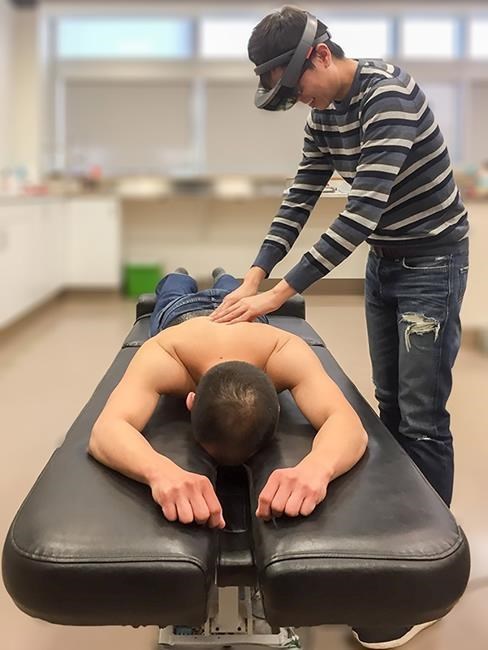
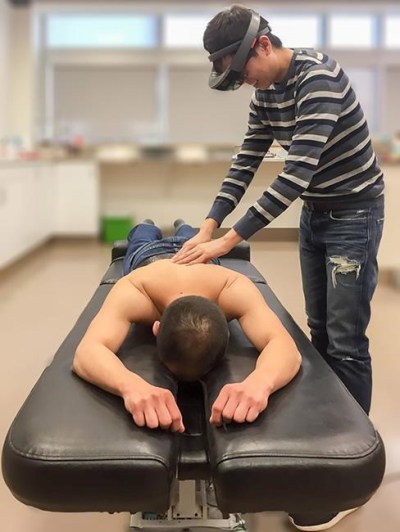
A University of Alberta team has come up with a way to combine medical imaging with virtual reality to help clinicians locate and understand what's happening inside their patients' bodies as they treat them. A demonstration of the virtual reality goggles is seen in an undated handout photo. THE CANADIAN PRESS/HO-Rehab Robotics Lab, Greg Kawchuk, *MANDATORY CREDIT*

Kawchuk and his colleagues have figured out how to use a commercially available set of virtual reality goggles to help doctors or other professionals view an X-ray superimposed on a patient’s body. They can align the image with the patient in front of them.

That not only allows clinicians to get a more precise idea of where the problem is and what it might be, it also allows them to bring the patient into the equation.

“The problem with X-rays has always been you take this thing (and) read it in a different room completely separated from the patient and their experiences,” Kawchuk said.

“(A patient) is more than just their image. There’s stories to be listened to. There’s context.”

Kawchuk imagines how a conversation might go with a doctor using the goggles:

“Where does it hurt? Here? OK, now I see it in the image that goes along with it when I poke you here.”

The goggles take advantage of recent innovations in virtual reality that allow a wearer to see the virtual world and the actual world at the same time.

“You see what you normally see and (the goggles) add stuff into there.”

It sounds like a simple matter to make the added “stuff” an X-ray. But it wasn’t.

Bodies aren’t flat. To accurately map an image onto the curves in a person’s back or chest, Kawchuk and his co-workers had to figure out how to distort the flat X-ray to account for them.

They’ve managed to get the image to within eight millimetres of the exact location. That’s not close enough for surgical applications, but it is for many medical purposes, including teaching.

New, higher-resolution goggles are hitting the market all the time, Kawchuk added. And artificial intelligence programs may help users more closely line up image with reality.

Eventually, he said, the technique might be available as an app using a generic X-ray that may not match a patient’s body exactly, but is still useful.

“It’s early days,” said Kawchuk. “It think it’s going to be pretty ubiquitous as the years go by.”

— Follow Bob Weber on Twitter at @row1960
Report Error Submit a Tip

More Stories

Red River Polytechnic looks to expand after MITT takeover

Maggie Macintosh and Morgan Modjeski 4 minute read Preview

Red River Polytechnic looks to expand after MITT takeover

Maggie Macintosh and Morgan Modjeski 4 minute read Tuesday, Sep. 1, 2026

Red River College Polytechnic is celebrating an enrolment bump and eyeing new high school partnerships as part of its merger with a longtime competitor.

For the first time, nearly 400 students attended their first day of RRC Polytech in Winnipeg’s south end on Tuesday.

The new campus is outfitted with two school logos — a new red one and a blue design belonging to the Manitoba Institute of Trades and Technology.

“It feels great to be a part of history,” said Dom McLaren, an 18-year-old who is enrolled in RRC Polytech’s network and systems administration program. “I’m definitely going to enjoy my time.”

Read
Tuesday, Sep. 1, 2026

Alberta researchers mix X-rays, virtual reality

Bob Weber, The Canadian Press 3 minute read Preview

Alberta researchers mix X-rays, virtual reality

Bob Weber, The Canadian Press 3 minute read Thursday, Mar. 7, 2019

EDMONTON - No, they're not X-ray specs.

But a University of Alberta team has come up with a way to combine medical imaging with virtual reality to help clinicians locate and understand what's happening inside their patients' bodies as they treat them.

"One of the classic problems you always hear about when clinicians are training is that you treat the person, not the X-ray," said Greg Kawchuk, a professor in the University of Alberta's physical therapy department. "Here's a way to unite those two domains."

Kawchuk and his colleagues have figured out how to use a commercially available set of virtual reality goggles to help doctors or other professionals view an X-ray superimposed on a patient's body. They can align the image with the patient in front of them.

Read
Thursday, Mar. 7, 2019

‘Where are they going to go?’: encampment policy blamed for homeless people sleeping outside thrift store

Scott Billeck 5 minute read Preview

‘Where are they going to go?’: encampment policy blamed for homeless people sleeping outside thrift store

Scott Billeck 5 minute read Yesterday at 4:55 PM CDT

The owner of a Portage Avenue thrift shop says the city’s encampment ban has pushed dozens of homeless people from tent communities to spaces near her store.

Susan Lockhart, who runs Just Like New to You at 635 Portage Ave., says anywhere from 25 to 50 people can be found at any given time behind the store and along the back lane stretching between Sherbrook and Furby streets.

“Where are they going to go?” she said Wednesday from her shop. “I was just here on the weekend and I couldn’t get to our back door. There were people everywhere. Mattresses.”

Earlier this week, the city reported 275 people were known to be living in 72 encampments across Winnipeg — down from 100 encampments housing about 700 people last September. The report also noted that 141 sites have been remediated since the city’s encampment policy came into effect in November.

Read
Yesterday at 4:55 PM CDT

NDP defends involvement of U.S. company in Hydro project

Chris Kitching 5 minute read Preview

NDP defends involvement of U.S. company in Hydro project

Chris Kitching 5 minute read Yesterday at 6:10 PM CDT

A U.S. company that donated to Donald Trump’s 2025 presidential inauguration could build Manitoba Hydro’s proposed $3-billion natural gas turbines, which has drawn criticism from an environmental group amid the NDP government’s pushback to tariffs.

Read
Yesterday at 6:10 PM CDT

Provencher Park eyed for new aquatic centre

Malak Abas 4 minute read Preview

Provencher Park eyed for new aquatic centre

Malak Abas 4 minute read Tuesday, Sep. 1, 2026

Provencher Park may be the next site for a new aquatic centre.

Read
Tuesday, Sep. 1, 2026

What's Up: Smiley Face, Shari Lapena book launch, Winnipeg Comedy Showcase, Ximbombo Dance Party, Mending with Tradition

5 minute read Preview

What's Up: Smiley Face, Shari Lapena book launch, Winnipeg Comedy Showcase, Ximbombo Dance Party, Mending with Tradition

5 minute read 6:00 AM CDT

Smiley FaceDave Barber Cinematheque, 100 Arthur St.Tonight, 7 p.m.; Saturday, 3 p.m.Admission $11.50When all is said and done, and her career on screen is assessed in full, Anna Faris might just be remembered as one of the definitive comic actors of the 2000s.

Aside from starring in the Scary Movie franchise, which has been spoofing prestige and shlock for a quarter of a century, Faris, who turns 50 in November, showed off her comic chops as ex-centrefold Shelley Darlingson in the underrated 2009 film The House Bunny, creating a character who has developed a cult following. On Mom, Faris and co-star Allison Janney balanced producer Chuck Lorre’s penchant for horny humour with genuinely touching performances dealing with thorny issues such as addiction.

All those versions of Faris meet in the centre in filmmaker Gregg Araki’s 2007 stoner comedy Smiley Face, which finds Jane (Faris) sidetracked from the most straightforward mission by cannabis consumption. The extended supporting cast — featuring John Krasinski, Jane Lynch, Marion Ross, Jim Rash and Emmy winner Roscoe Lee Browne in his final role — is loads of fun, with Faris using each scene partner as a funhouse mirror to reflect her ascent into chaotic highness.

Faris, who stars in the current buddy comedy Spa Weekend, will return to more prestigious territory this fall in Primetime, director Lance Oppenheim’s dramatization of the rise of To Catch a Predator host Chris Hansen; Faris plays Mary Joan Hansen, the wife of Hansen, played by Robert Pattinson.

Read
6:00 AM CDT