Promising gene therapy for British Columbia man with rare genetic disease
Advertisement
Read this article for free:
or
Already have an account? Log in here »
To continue reading, please subscribe:

Digital Subscription
One year of digital access for only $205*
- Enjoy unlimited reading on winnipegfreepress.com
- Read the E-Edition, our digital replica newspaper
- Access News Break, our award-winning app
- Play interactive puzzles
*First annual payment billed as $205.00 + GST for one year. This annual subscription will automatically renew at $233.00 + GST every 52 weeks (10% off the regular annual price of $259.35). Offer available to new and qualified returning subscribers only. Cancel any time.
To continue reading, please subscribe:
Add Free Press access to your Brandon Sun subscription for only an additional
$1 for the first 4 weeks*
- Enjoy unlimited reading on winnipegfreepress.com
- Read the E-Edition, our digital replica newspaper
- Access News Break, our award-winning app
- Play interactive puzzles
*Your next Brandon Sun subscription payment will increase by $1.00 and you will be charged $17.95 plus GST for four weeks. After four weeks, your payment will increase to $24.95 plus GST every four weeks.
Read unlimited articles for free today:
or
Already have an account? Log in here »
Hey there, time traveller!
This article was published 14/03/2019 (2731 days ago), so information in it may no longer be current.
CALGARY – A big sushi meal would have once made Josh McQuillin gravely ill, but the British Columbia man can now gorge on one of his favourite foods worry-free thanks to a clinical trial for his rare genetic disorder.
McQuillin was 12 when he was diagnosed with urea cycle disorder, a life-threatening condition that causes ammonia to build up in the body and can put a person in a coma.
He had to strictly limit how much protein he ate and took expensive medication several times a day. He could never be too far from a hospital, which made it hard to travel abroad or join friends backcountry camping.
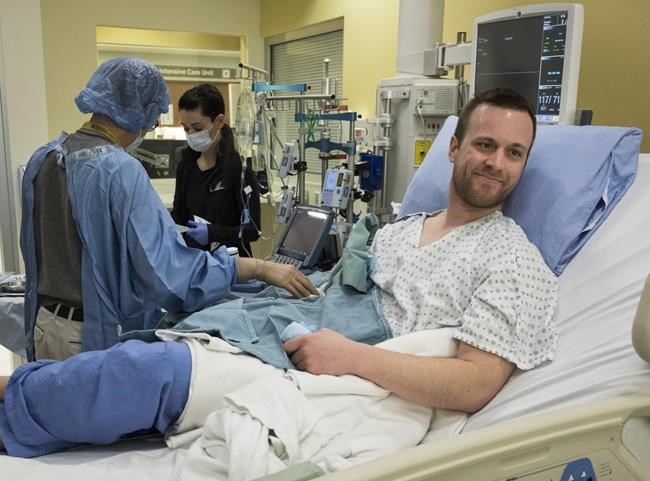
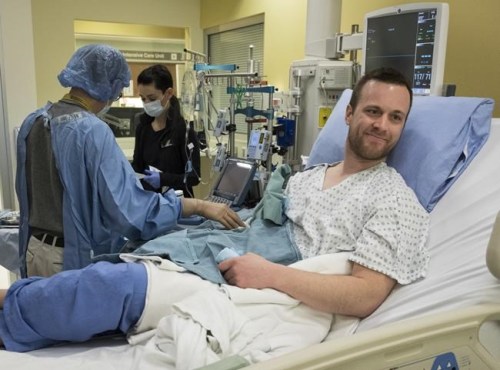
“Now I can eat as much protein as I want. I’m eating differently, sleeping differently, exercising differently,” McQuillin, 30, said during a monitoring appointment at Calgary’s Foothills Medical Centre on Thursday.
“I’ve gained a bit of weight. I’ve never had to fight weight gain before, which is kind of funny. I’ve always been underweight my whole entire life.”
The genes needed to process ammonia were delivered to McQuillin’s liver intravenously. A virus, modified to be harmless, was used as a transmitter.
Aneal Khan with the University of Calgary’s Cumming School of Medicine said McQuillin is believed to be the first Canadian to receive intravenous gene replacement therapy for urea cycle disorder.
McQuillin, who lives in Prince George, B.C., said he felt the results two weeks after the one-time injection.
Khan is leading the Canadian portion of an international clinical trial on gene therapy for urea cycle disorder. He also treated McQuillin in Ontario when he first got sick as a boy.
Khan recalled telling McQuillin’s parents years ago that he wasn’t sure their son would survive.
“Since he’s had this therapy, his ammonia has not gone high, despite him eating whatever amount of protein he wants. It’s a massive change,” said Khan. “We’re very excited — especially for rare genetic diseases, DNA diseases — that we don’t have to tell the parents that stuff anymore.”
Khan said similar strategies have shown promise for treating other genetic diseases involving the liver, such as hemophilia.
Alberta Health Services has set aside beds in Foothills hospital’s intensive care unit for clinical trial patients. That’s important, because it’s often not known whether an experimental treatment will have serious adverse effects, said Christopher Doig, a medical director in intensive care for the agency’s Calgary zone.
“They can get it in a very safe way where they can be very closely watched, very closely monitored. At the same time, we’re not using resources taking away from other patients.”
McQuillin said he’s looking forward to going on a road trip in the United Kingdom this spring without having to worry about his medication or whether the nearest hospital can treat his condition. He can also rest easier when on his forestry job, which once required painstaking meal planning for trips into the bush.
“Everything’s 100 per cent good to go for now,” he said.
“I guess my only concern or fear is they don’t know really how long it will last. But it’s definitely exciting.”
Note to readers: This is a corrected story. An earlier version, based on information provided by the University of Calgary and Alberta Health Services, said McQuillin was the first Canadian to receive gene replacement therapy intravenously and that Aneal Khan led the entire clinical trial.