Are eggs good or bad for you? New research rekindles debate

Advertisement

Advertise with us

The latest U.S. research on eggs won't go over easy for those who can't eat breakfast without them.

Read this article for free:


or

Already have an account? Log in here »

To continue reading, please subscribe:

Subscribe and receive a limited-edition Free Press branded hat or tote.

Digital Subscription

One year of digital access for only $205*

  • Enjoy unlimited reading on winnipegfreepress.com
  • Read the E-Edition, our digital replica newspaper
  • Access News Break, our award-winning app
  • Play interactive puzzles

*First annual payment billed as $205.00 + GST for one year. This annual subscription will automatically renew at $233.00 + GST every 52 weeks (10% off the regular annual price of $259.35). Offer available to new and qualified returning subscribers only. Cancel any time.

To continue reading, please subscribe:

Add Free Press access to your Brandon Sun subscription for only an additional

$1 for the first 4 weeks*

  • Enjoy unlimited reading on winnipegfreepress.com
  • Read the E-Edition, our digital replica newspaper
  • Access News Break, our award-winning app
  • Play interactive puzzles
Start now

*Your next Brandon Sun subscription payment will increase by $1.00 and you will be charged $17.95 plus GST for four weeks. After four weeks, your payment will increase to $24.95 plus GST every four weeks.

Hey there, time traveller!
This article was published 15/03/2019 (2704 days ago), so information in it may no longer be current.

The latest U.S. research on eggs won’t go over easy for those who can’t eat breakfast without them.

Adults who ate about 1 1/2 eggs daily had a slightly higher risk of heart disease than those who ate no eggs. The study showed the more eggs, the greater the risk. The chances of dying early were also elevated.

The researchers say the culprit is cholesterol, found in egg yolks and other foods, including shellfish, dairy products and red meat. The study focused on eggs because they’re among the most commonly eaten cholesterol-rich foods. They can still be part of a healthy diet, but in smaller quantities than many Americans have gotten used to, the researchers say.
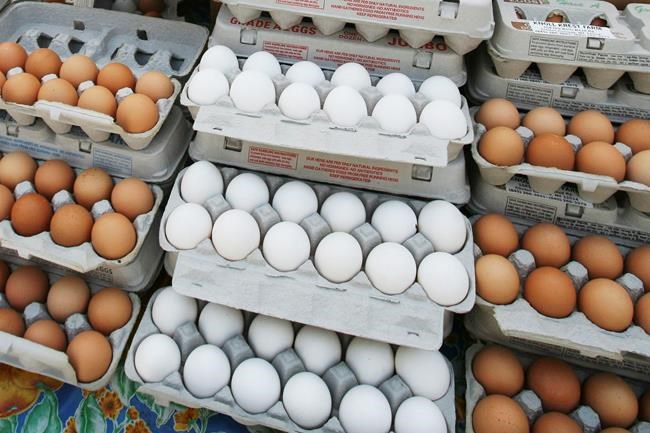
FILE - In this May 14, 2008 file photo, cartons of eggs are displayed for sale in the Union Square green market in New York. The latest U.S. research on eggs won‚Äôt go over easy for those can‚Äôt eat breakfast without them. Study participants who ate about 1 ¬? eggs daily had a slightly higher risk of heart disease than those who ate no eggs. The study showed the more eggs, the greater the risk. The chances of dying early were also elevated. (AP Photo/Mark Lennihan)

U.S. dietary guidelines that eased limits on cholesterol have helped eggs make a comeback.

The study has limitations and contradicts recent research, but is likely to rekindle the long-standing debate about eggs.

The new results were published online Friday in the Journal of the American Medical Association.

THE STUDY

Researchers at Northwestern University’s Feinberg School of Medicine and elsewhere pooled results from six previous studies, analyzing data on almost 30,000 U.S. adults who self-reported daily food intake. Participants were followed for roughly 17 years, on average.

The researchers calculated that those who ate 300 milligrams of cholesterol daily — about 1 1/2 eggs — were 17 per cent more likely to develop heart disease than whose who didn’t eat eggs.

The researchers based their conclusions on what participants said they ate at the start of each study. They took into account high blood pressure, smoking, obesity and other traits that could contribute to heart problems. Risks were found with eggs and cholesterol in general; a separate analysis was not done for every cholesterol-rich food.

Dr. Bruce Lee of Johns Hopkins University, said nutrition studies are often weak because they rely on people remembering what they ate.

“We know that dietary recall can be terrible,” said Lee. The new study offers only observational data but doesn’t show that eggs and cholesterol caused heart disease and deaths, said Lee, who wasn’t involved in the research.

Senior author Norrina Allen, a preventive medicine specialist, noted that the study lacks information on whether participants ate eggs hard-boiled, poached, fried, or scrambled in butter, which she said could affect health risks.

Some people think ‘”I can eat as many eggs as I want'” but the results suggest moderation is a better approach, she said.

THE DEBATE

Eggs are a leading source of dietary cholesterol, which once was thought to be strongly related to blood cholesterol levels and heart disease. Older studies suggesting that link led to nutrition guidelines almost a decade ago that recommended consuming no more than 300 milligrams of cholesterol daily; one egg contains about 186 milligrams.

Newer research questioned that relationship, finding that saturated fats contribute more to unhealthy levels of blood cholesterol that can lead to heart problems.

The latest U.S. government nutrition guidelines, from 2015, removed the strict daily cholesterol limit. While eating as little cholesterol as possible is still advised, the recommendations say eggs can still be part of a healthy diet, as a good source of protein, along with lean meat, poultry, beans and nuts. Nutrition experts say the new study is unlikely to change that advice.

BOTTOM LINE

Dr. Frank Hu of Harvard University noted that most previous studies have shown that eating a few eggs weekly is not linked with risks for heart disease in generally healthy people.

“I don’t think that this study would change general healthy eating guidelines” that emphasize fruits, vegetables, whole grains, nuts and beans and limiting processed meats and sugar, Hu said. Eggs, a breakfast staple for many, can be included but other options should also be considered, “like whole grain toast with nut butter, fresh fruits, and yogurt,” Hu said.

Dr. Rosalind Coleman, a professor of nutrition and pediatrics at the University of North Carolina, offered broader advice.

“The main message for the public is not to select a single type of food as ‘bad’ or ‘good’ but to evaluate your total diet in terms of variety and amount.

“I’m sorry if it seems like a boring recommendation,” she added, but for most people, the most important diet advice “should be to maintain a healthy weight, to exercise, and to get an adequate amount of sleep.”

___

Follow AP Medical Writer Lindsey Tanner at @LindseyTanner.

___

The Associated Press Health & Science Department receives support from the Howard Hughes Medical Institute’s Department of Science Education. The AP is solely responsible for all content.

Report Error Submit a Tip

More Stories

Puzzles Palace

1 minute read Monday, Jul. 27, 2026

To solve our puzzles, please subscribe with this special offer: |

Letters, Aug. 8

7 minute read 2:01 AM CDT

Where is the love?Re: The true costs of your pet — for everyone (Think Tank, Aug. 7)

Before I put Jerry Storie’s mean-spirited diatribe at the bottom of the cage of my precious lovebirds, Harry and Sally, they need to tell him that not only do pet birds add joy and song to a household, they also represent love for all in the pet kingdom.

Yes, pets cost money but they’re still cheaper than kids. Pets earn their keep just by being the lovable creatures they are. Even those with behaviour problems deserve our care.

The animal-human bond has been scientifically proven to reduce stress, blood pressure and, most importantly, loneliness. Pets can help children learn social skills and are crucial to society as therapy agents. They get folks out walking and talking to each other. Many unsheltered people have comfort pets, often feeding their pets before themselves. Manitoba Harvest gives out pet food when donations allow, and Bear Clan has held pet food drives.

The view from here: Phyllis Green. Boob Tree, 1975

2 minute read Preview

The view from here: Phyllis Green. Boob Tree, 1975

2 minute read 2:01 AM CDT

Staycation: The Art of Being Here feautres more than 100 Manitoba-related artworks from the Winnipeg Art Gallery-Qaumajuq collection, spanning the past 50 years. These pieces reveal how the places around us are layered with memory, story and lived experience. Over the coming weeks, the Free Press will spotlight works from this eclectic exhibition, each one offering a new way of seeing home. Experience it in person and enjoy some staycation time at the gallery, on view until December.

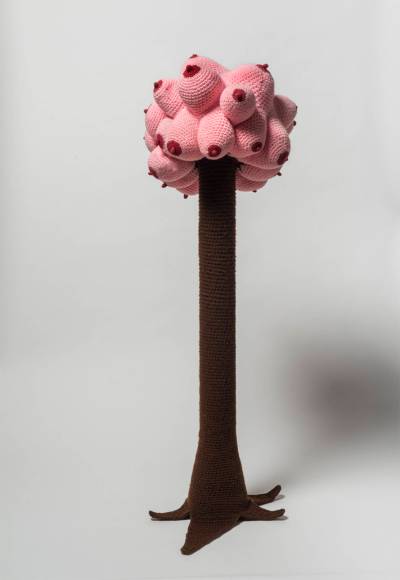
Phyllis Green. Boob Tree, 1975

(Yarn, wood. Collection of the Winnipeg Art Gallery; Acquired with funds from the Estate of Mr. and Mrs. Bernard Naylor, funds administered by The Winnipeg Foundation, 2014-128. Photo: Ernest Mayer.)

The year 1975 was designated International Women’s Year by the United Nations, and in celebration, the WAG staged the show Images of Women, which explored how women had historically been depicted, an impressive selection but by mostly male artists. Amid pushback from the community, Sharron Zenith Corne and Marian Yeo organized a second exhibition, Woman as Viewer, which challenged those portrayals by only featuring works by women. It was called the first Canadian exhibition of feminist art. American artist Phyllis Green’s Boob Tree, a four-foot-tall crochet sculpture of a cluster of breasts, adorned the exhibit posters, which were so popular they were snatched by passersby! The sculpture is playful and unsettling, re-appropriating the objectification of women’s bodies.

Read
2:01 AM CDT

Leon’s Getting Larger and their tours are getting longer

Tiago Resko 4 minute read Preview

Leon’s Getting Larger and their tours are getting longer

Tiago Resko 4 minute read Yesterday at 3:00 AM CDT

Emo music was never just a phase for Nikola Boticki.

“It was people just saying the things I was feeling,” says the 26-year-old vocalist and guitarist. “Growing up, it’s kind of like, ‘I feel that way but I’m not going to say that out loud,’ so it was nice to hear someone say it.”

Boticki got into the punk subgenre near the end of his angsty high school years and his appreciation only grew while in isolation during the COVID-19 pandemic.

The music inspired him to form his own emo band, Leon’s Getting Larger, with friends Luke Penner (vocals/drums) and Noah St Hilaire (bass).

Read
Yesterday at 3:00 AM CDT

$60M, six-storey Harbourview Terrace due to open in June 2028

Aaron Epp 3 minute read Preview

$60M, six-storey Harbourview Terrace due to open in June 2028

Aaron Epp 3 minute read Yesterday at 7:24 PM CDT

They donned high-vis vests and brandished shovels with gold-coloured blades Friday morning at the ceremonial groundbreaking for a multi-family residential development in northeast Winnipeg.

Concord Projects has started construction of Harbourview Terrace, the inaugural development by two-year-old real estate company Foxhill Properties. Located in North Kildonan at 1820 De Vries Ave., the $60-million, six-storey apartment building will contain 179 units.

Founder and president Frank Koch-Schulte, who runs the company with his wife Alisha, said Foxhill wants to develop and manage properties with integrity.

“This is kind of like my opportunity to try to do things our way, which I feel is a way that keeps tenants in mind,” Koch-Schulte said. “We live in this neighbourhood. We’re very much invested in seeing quality housing go here.”

Read
Yesterday at 7:24 PM CDT

Poilievre’s lips moving, but Canadians aren’t interested in what he’s saying

Tom Brodbeck 5 minute read Preview

Poilievre’s lips moving, but Canadians aren’t interested in what he’s saying

Tom Brodbeck 5 minute read Thursday, Aug. 6, 2026

Pierre Poilievre’s biggest political challenge right now isn’t Prime Minister Mark Carney’s popularity.

It’s the fact that he still seems to be campaigning against a political landscape that no longer exists.

More than a year after the 2025 federal election, the Conservative leader is still relying on the same message, the same themes and the same attacks that defined his party’s campaign before voters went to the polls.

And Canadians appear to be tuning it out.

Read
Thursday, Aug. 6, 2026