W.S. Merwin, prize-winning poet of nature, dies at 91

Advertisement

Advertise with us

NEW YORK - W.S. Merwin, a prolific and versatile poetry master who evolved through a wide range of styles as he celebrated nature, condemned war and industrialism and reached for the elusive past, died Friday. He was 91.

Read this article for free:


or

Already have an account? Log in here »

To continue reading, please subscribe:

Subscribe and receive a limited-edition Free Press branded hat or tote.

Digital Subscription

One year of digital access for only $205*

  • Enjoy unlimited reading on winnipegfreepress.com
  • Read the E-Edition, our digital replica newspaper
  • Access News Break, our award-winning app
  • Play interactive puzzles

*First annual payment billed as $205.00 + GST for one year. This annual subscription will automatically renew at $233.00 + GST every 52 weeks (10% off the regular annual price of $259.35). Offer available to new and qualified returning subscribers only. Cancel any time.

To continue reading, please subscribe:

Add Free Press access to your Brandon Sun subscription for only an additional

$1 for the first 4 weeks*

  • Enjoy unlimited reading on winnipegfreepress.com
  • Read the E-Edition, our digital replica newspaper
  • Access News Break, our award-winning app
  • Play interactive puzzles
Start now

*Your next Brandon Sun subscription payment will increase by $1.00 and you will be charged $17.95 plus GST for four weeks. After four weeks, your payment will increase to $24.95 plus GST every four weeks.

Hey there, time traveller!
This article was published 15/03/2019 (2719 days ago), so information in it may no longer be current.

NEW YORK – W.S. Merwin, a prolific and versatile poetry master who evolved through a wide range of styles as he celebrated nature, condemned war and industrialism and reached for the elusive past, died Friday. He was 91.

A Pulitzer Prize winner and former U.S. poet laureate, Merwin completed more than 20 books, from early works inspired by myths and legends to fiery protests against environmental destruction and the conflict in Vietnam to late meditations on age and time.

He wrote rhymes and blank verse, a brief report on the month of January and a book-length story in verse about colonialism and the birth of modern Hawaii. Like his hero, Henry David Thoreau, he was inspired equally by reverence for the planet and anger against injustice.
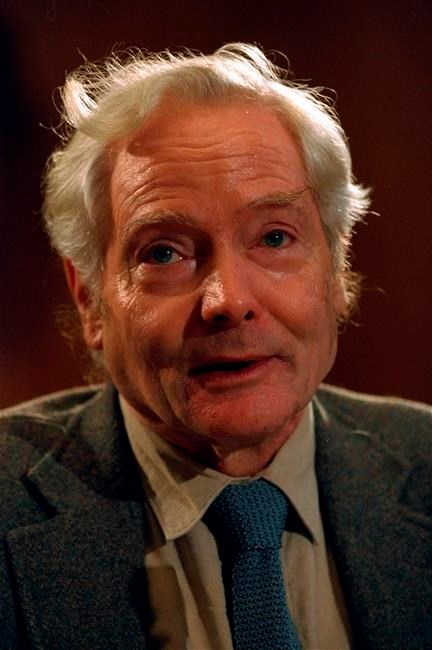
FILE - In this Sept. 29, 1994 file photo, poet W.S. Merwin is recognized by the Academy of American Poets after winning the Tanning Prize in Washington. Merwin, a prolific and versatile master of modern poetry who evolved through a wide range of styles as he celebrated nature, condemned war and industrialism and reached for the elusive past, died on Friday, March 15, 2019 at his home in Hawaii. A Pulitzer Prize winner and former U.S. poet laureate, Merwin completed more than 20 books and ranked high in the pantheon for decades, from early works inspired by myths and legends to late meditations on age and time. (AP Photo, File)

He died in his sleep at his home on the Hawaiian island of Maui, according to publisher Copper Canyon Press and the Merwin Conservancy, which the poet founded.

“He is an artist with a very clear spiritual profile, and intellectual and moral consistency, which encompasses both his work and his life,” fellow poet Edward Hirsch once said of him.

Merwin received virtually every honour a poet could ask for — more, it turned out, than he desired.

Citing the Vietnam War, he declined a Pulitzer in 1971 for “The Carrier of Ladders,” saying that he was “too conscious of being an American to accept public congratulation with good grace, or to welcome it except as an occasion for expressing openly a shame which many Americans feel.”

He also rejected membership in the National Institute of Arts and Letters, now the American Academy of Arts and Letters, but changed his mind five years later, in 1977.

Among other awards he accepted: a National Book Award for “Migration” in 2005, a Pulitzer in 2009 for “The Shadow of Sirius,” and such lifetime achievement honours as the Tanning Prize, the Bollingen Prize and a gold medal from the arts academy. He was chosen the country’s poet laureate in 2010 and served a single one-year term.

The changes in his work were no more dramatic than the changes in his life, which spanned continents and religious faiths. The son of a Presbyterian minister, he was raised in the urban East during the Great Depression, spent years as a young man in France, Mexico, Spain and England and lived his final decades as a Buddhist in a solar-powered house he designed on an old pineapple plantation, surrounded by a rain forest, on the northeast coast of Maui.

“There was something incomplete about the world of streets and sidewalks and cement,” he told the Paris Review in 1986. “I remember walking in the streets of New York and New Jersey and telling myself, as a kind of reassurance, that the ground was really under there.”

William Stanley Merwin was born in New York City in 1927. He soon moved to Union City, New Jersey, living for years on a street now called “W.S. Merwin Way,” then to Scranton, Pennsylvania.

In a long, autobiographical poem, “Testimony,” he remembered his father as a weary, disappointed man, subsisting on “pinched salaries” and “travelling sick with some nameless illuminating ill.” His mother was orphaned early in life and grieved again when her baby, a boy she meant to name after her father, died “when he had scarcely wakened.”

In a household as grim as an abandoned parking lot, the way out was pointed by words, which seemed to float around Merwin like magic bubbles. He would try to memorize scripture he heard his father recite and fairy tales his mother told him. By age 13, he was already composing hymns.

He received a scholarship from Princeton University, becoming the first family member to attend college, and began meeting some of the great poets of the present and future. Galway Kinnell was a classmate at Princeton, and John Berryman a teacher.
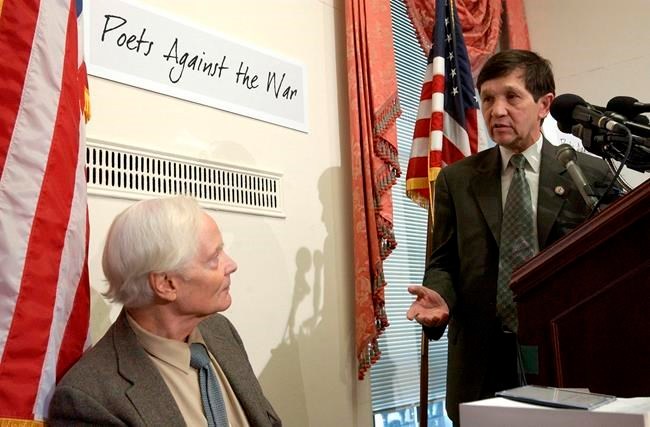
FILE -- In this March 5, 2003 file photo, U.S. Rep. Dennis Kucinich, D-Ohio, right, gestures toward Pulitzer Prize winning poet W.S. Merwin during a Capitol Hill news conference. Merwin, a prolific and versatile master of modern poetry who evolved through a wide range of styles as he celebrated nature, condemned war and industrialism and reached for the elusive past, died on Friday, March 15, 2019 at his home in Hawaii. A Pulitzer Prize winner and former U.S. poet laureate, Merwin completed more than 20 books and ranked high in the pantheon for decades, from early works inspired by myths and legends to late meditations on age and time. (AP Photo/Evan Vucci, File)

After graduating, he lived in Spain and tutored the son of Robert Graves. In London, he became close with Sylvia Plath and Ted Hughes and was torn by the collapse of their marriage. Merwin’s then-wife, Dido Merwin, would allege that Plath had a crush on him.

In Washington, D.C., when he was 18, Merwin had a memorable encounter with Ezra Pound, whom he visited at a psychiatric hospital. Pound urged Merwin to write 75 lines a day (advice he did not follow), warned him he didn’t have enough experience to write great poetry and advised him to learn another language as a way of better mastering English. Merwin would translate more than 20 books by other poets, from languages ranging from Sanskrit to Swedish.

Merwin’s promise was obvious. His first collection, “A Mask for Janus,” was selected by W.H. Auden for the coveted Yale Series of Younger Poets competition and was published in 1952. Throughout the 1950s, he wrote poems and plays, including a verse production of “Rumpelstiltskin.”

Times spent in Boston with Robert Lowell convinced him to concentrate on poetry, and by the end of the decade, he was regarded as a highly talented artist immersed in Old English literature, his verse likened by The New York Times to “a broad river flowing through peaceful land.”

Peace — the flow of the natural world — was a cause he actively defended. Near the end of World War II, he spent seven months under psychiatric care because he refused to undergo any duties that might lead to violence, which he had feared since the days his father would beat him.

By the early 1960s, he was marching against nuclear weapons and throwing off the rules of grammar as if they were a suit and tie, inspired by his “growing sense that punctuation alluded to an assumed allegiance to the rational protocol of written language.”

Meanwhile, Vietnam and urbanization darkened his vision. “I/can hear the blood crawling over the plains,” he wrote in “The Child.” In “The Crust,” the downfall of a tree is a metaphor for the severing of civilization:

and with the tree

went all the lives in it

that slept in it ate in it

met in it believed in it

Merwin examined his own mind in “Plane” and found it “infinitely divided and hopeless/like a stockyard seen from above.” His poem “Presidents” was a roll call of dishonour, for “the president of shame,” ”the president of lies” and the “president of loyalty,” who “recommends blindness to the blind.” In “Sunset After Rain,” he concluded that “The darkness is cold/because the stars do not believe in each other.”
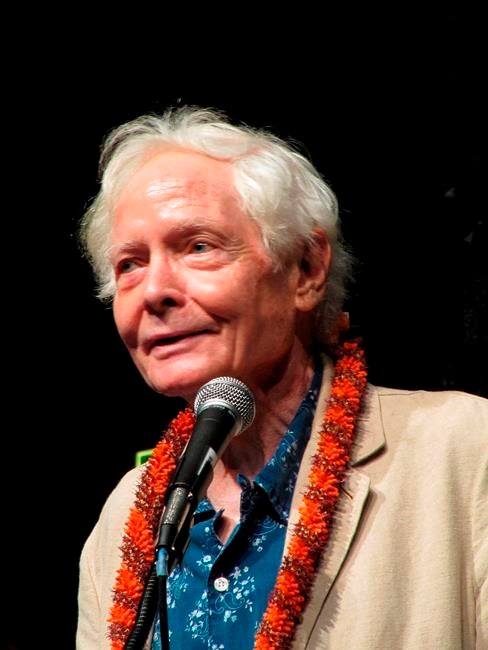
FILE - In this Aug. 2, 2011 file photo, poet W.S. Merwin speaks to the Hawaii Conservation Conference in Honolulu. Merwin, a prolific and versatile master of modern poetry who evolved through a wide range of styles as he celebrated nature, condemned war and industrialism and reached for the elusive past, died on Friday, March 15, 2019 at his home in Hawaii. A Pulitzer Prize winner and former U.S. poet laureate, Merwin completed more than 20 books and ranked high in the pantheon for decades, from early works inspired by myths and legends to late meditations on age and time. (AP Photo/Audrey McAvoy, File)

In the 1970s, he settled permanently in Hawaii and studied under the Zen Buddhist master Robert Aitken. Divorced years earlier from Dorothy Jeanne Ferry and from Dido Milroy, he married his third wife, Paula Schwartz, in a Buddhist ceremony in 1983. Paula died in 2017.

Merwin’s work became sparer, rooted in the Hawaiian landscape and his personal past — how it’s often forgotten, how it’s never understood at the moment it’s lived, how words themselves were imperfect bridges to lost time. In “Secrets,” he noted that “wherever our parents came from is another century/an age which they themselves could barely remember.”

A poem from 2010, “By the Front Door,” is a three-line tribute to simple wonder: “Rain through the morning/and in the long pool an old toad singing/happiness old as water.” His poem “Thanks” is another ode to the natural world:

Listen

with the night falling we are saying thank you

we are stopping on the bridges to bow from the railings

we are running out of the glass rooms

with our mouths full of food to look at the sky

and say thank you
Report Error Submit a Tip

More Stories

Puzzles Palace

1 minute read Monday, Jul. 27, 2026

To solve our puzzles, please subscribe with this special offer: |

W.S. Merwin, prize-winning poet of nature, dies at 91

Hillel Italie, The Associated Press 8 minute read Preview

W.S. Merwin, prize-winning poet of nature, dies at 91

Hillel Italie, The Associated Press 8 minute read Friday, Mar. 15, 2019

NEW YORK - W.S. Merwin, a prolific and versatile poetry master who evolved through a wide range of styles as he celebrated nature, condemned war and industrialism and reached for the elusive past, died Friday. He was 91.

A Pulitzer Prize winner and former U.S. poet laureate, Merwin completed more than 20 books, from early works inspired by myths and legends to fiery protests against environmental destruction and the conflict in Vietnam to late meditations on age and time.

He wrote rhymes and blank verse, a brief report on the month of January and a book-length story in verse about colonialism and the birth of modern Hawaii. Like his hero, Henry David Thoreau, he was inspired equally by reverence for the planet and anger against injustice.

He died in his sleep at his home on the Hawaiian island of Maui, according to publisher Copper Canyon Press and the Merwin Conservancy, which the poet founded.

Read
Friday, Mar. 15, 2019

Bombers offence stalls in 22-19 loss to Elks

Joshua Frey-Sam 8 minute read Preview

Bombers offence stalls in 22-19 loss to Elks

Joshua Frey-Sam 8 minute read Updated: Yesterday at 8:19 AM CDT

It was a microcosm of the Winnipeg Blue Bombers’ season to this point: a first half that burned bright only to be doused in cold water.

The Bombers began the first leg of their mid-season gauntlet with a 22-19 loss to the Edmonton Elks at Commonwealth Stadium in the Alberta capital on Friday night.

Elks quarterback Cody Fajardo orchestrated an eight-play, 54-yard drive that set up a 40-yard game-winning field goal by Vincent Blanchard that snuck inside the left upright with zeros on the clock.

The drive, which was plagued by poor tackling by the Bombers defence, came after Bombers kicker Sergio Castillo tied the game at 19-19 on a 53-yard boot with 1:41 remaining in the contest.

Read
Updated: Yesterday at 8:19 AM CDT

A downtown eatery has announced its closure.

Rudy's Eat and Drink, located on the main floor of the Manitoba Hydro building at 375 Graham Ave., posted on social media that the restaurant would be closing after "one last hurrah" on Friday, Aug. 21.

"With heavy hearts it is time to announce that Rudy’s will officially be closing its doors after an incredible 15 years," the post reads.

The post gave no reason for the closure. Rudy's and other restaurants in the building expressed concerns after an assault and resulting lockdown at Hydro Place in late January.

Svard wins Manitoba Open in playoff

Mike McIntyre 6 minute read Preview

Svard wins Manitoba Open in playoff

Mike McIntyre 6 minute read 8:55 PM CDT

History will show Daniel Svard won the 2026 Manitoba Open on the 73rd hole of play, sinking a nervy three-foot par putt in a playoff to claim his first professional victory on Sunday afternoon at Elmhurst.

But it was much earlier in his final round — which started with three bogeys in the first five holes — where the tournament really was won. Or, more precisely, not lost.

“Pretty wild, the range of emotions I went through,” said the 23-year-old PGA Tour Americas rookie from Sweden, who began the day with a two-shot lead but suddenly found himself in chase mode.

“I was feeling really good and really confident and then I had kind of a nightmare start. I actually had to make some big putts to not completely play myself out of it. Everything kind of worked out in the end, but it was a roller-coaster to get there. I’m pretty excited and proud of how I got there to fight back.”

Read
8:55 PM CDT

Canada vows dollar-for-dollar tariff retaliation, suspends trade talks with U.S.

Catherine Morrison, The Canadian Press 7 minute read Preview

Canada vows dollar-for-dollar tariff retaliation, suspends trade talks with U.S.

Catherine Morrison, The Canadian Press 7 minute read Updated: Yesterday at 8:27 AM CDT

OTTAWA - A last-ditch effort to reach a new trade deal before a midnight tariff deadline failed Friday, as Prime Minister Mark Carney suspended talks with the United States and summoned his negotiators back to Ottawa.

The decision meant new 50 per cent tariffs on billions of dollars in Canadian exports to the U.S. took effect at 12:01 a.m., and Carney vowed Canada would retaliate with equal measures of its own.

"In recent weeks, we made important progress toward improving Canada's position as having the best deal in the world with the U.S.," Carney said in a statement just before Trump's tariff deadline.

"However, that progress has not been enough to meet our objectives for Canadians."

Read
Updated: Yesterday at 8:27 AM CDT