A foolish history
The world has a grand tradition of April 1 pranks, and Winnipeg is no exception

Advertisement
Read this article for free:
or
Already have an account? Log in here »
To continue reading, please subscribe:

Digital Subscription
One year of digital access for only $205*
- Enjoy unlimited reading on winnipegfreepress.com
- Read the E-Edition, our digital replica newspaper
- Access News Break, our award-winning app
- Play interactive puzzles
*First annual payment billed as $205.00 + GST for one year. This annual subscription will automatically renew at $233.00 + GST every 52 weeks (10% off the regular annual price of $259.35). Offer available to new and qualified returning subscribers only. Cancel any time.
To continue reading, please subscribe:
Add Free Press access to your Brandon Sun subscription for only an additional
$1 for the first 4 weeks*
- Enjoy unlimited reading on winnipegfreepress.com
- Read the E-Edition, our digital replica newspaper
- Access News Break, our award-winning app
- Play interactive puzzles
*Your next Brandon Sun subscription payment will increase by $1.00 and you will be charged $17.95 plus GST for four weeks. After four weeks, your payment will increase to $24.95 plus GST every four weeks.
Read unlimited articles for free today:
or
Already have an account? Log in here »
Hey there, time traveller!
This article was published 01/04/2019 (2676 days ago), so information in it may no longer be current.
The origin of April Fools’ Day is convoluted at best. Some scholars trace it back to antiquity, linking the tradition to Hilaria, a springtime Roman festival that honoured the resurrection of the god Attis and involved wearing disguises.
Others prefer the calendar-change theory, which is rooted in the French calendar reform of the 16th century, when the country moved the start of the year to Jan. 1 rather than the previous date, at the end of March. Those who missed or forgot the change had jokes played on them, and, as many scholars have noted, pranksters would stick paper fish to their backs. The victims were given the name Poisson d’Avril, or April Fish, which is still the French term for April Fools’ Day to this day.
While that seems like a logical starting point, the details continue to be disputed.
Holly Everett, head of the department of folklore at Memorial University of Newfoundland, says many holidays have conflicting origin stories, and when it comes to April Fools’, there’s one possibility she finds the most interesting.
“One that I find particularly compelling is the link to the Feast of Fools observed in France and England in the Middle Ages, which folklorist Jack Santino writes about in his excellent book All Around the Year: Holidays and Celebrations in American Life. The Catholic church supported this festival, hoping that it gave people a chance to express anti-clerical sentiment and therefore ‘get it out of their system’ for a while,’ “ says Everett.
“Role reversal was a important feature of the festival, as was behaving in ways that fell outside daily norms. So subordinate clergy, who were generally poor peasants, took on roles such as king or bishop for the day. Rowdy parodies of the Mass were performed, which made the church quite nervous and uncomfortable. But again, they were hoping that by allowing this kind of behaviour once a year, people would be adhere to the usual routines of respecting the church the rest of the year.”
In 2019, April Fools’ Day can feel like a pretty antiquated idea. In an environment where fake news is circulated daily and most people participate in mini-hoaxes of their own via an ultra-curated social media presence, is April Fools’ relevant or even needed anymore?
“In general, holidays give us a chance to take a break, but also to transgress norms. Some scholars talk about holidays as ‘release valves’: a chance to blow off steam, to take a break from everyday routines and social expectations. St. Patrick’s Day is great example of this, a day on which it’s OK to start drinking alcohol at breakfast and continue throughout the day, not that that is healthy! Holidays give us licence to do things we might not normally do — drink and/or eat all day, often to excess; sleep half the day; wear a costume to work (on Halloween); etc.,” Everett says.
“So we can think of April Fools’ in the same way. We have this one day a year when it’s OK for us to jerk people around, sort of emphasizing that we don’t do such things as a general rule. But yes, if we consider that a sort of pranking culture has developed, April Fools’ Day might not carry the emotional charge it once did.”
If you’re looking for some solid advice on how to avoid April Fools’, look no further than the April 1, 1915, edition of the Winnipeg Free Press, and an article titled, Beware of the joker when attending your duties today.
“All Winnipeg should assume a guard of watchful wariness, should gratefully refuse chocolate-coated candies, a favourite medium of the unquenchable wit of the April fooler, and decline to look in unnatural directions or talk to mysterious persons on the telephone.”
Or, more brazenly put in the March 31, 1945 edition: “Don’t touch anything, don’t speak to anybody, don’t leave your home too long and don’t trust anybody.”
Despite those intense warnings, Winnipeggers have a history of embracing April 1 pranks; here’s a few classics we discovered while trolling through the Free Press archives.
No Nino, 1968
A local Italian newspaper published in the late 1960s, Messaggero Italo-Canadese, played a harsh prank on fans of Nino Benvenuti, an Italian who was the middleweight boxing champion at the time. In the March 28, 1969, issue, a front-page story read Benvenuti would stop over in Winnipeg on his way from Toronto to Seattle, spending around 50 minutes in town during a flight change. Around 200 members of the Italian community flooded Winnipeg’s airport on April 2, but Nino never came. When the crowd learned they had fallen for an April Fools’ joke, the Free Press reported, “everyone laughed and agreed they had really fallen for ‘a good one.’ “ Franco Gotti, editor of Messaggero Italo-Canadese, told the Free Press that April 1 is celebrated in Italy, and “the newspapers always take part in the fun and publish ‘false reports’ on that particular day.”
Pool “emergency”, 1980
According to a story by Barbara Cansino in the April 3, 1980 edition of the Free Press, a group of patients at the Manitoba Rehabilitation Centre, who had bonded over their arthritic aqua-rehab process, decided to pull a little prank on the staff. During one of their in-pool sessions, somebody pulled the emergency cord, which is meant to be tugged in the event of a medical emergency. As Cansino tells it, two attendants came rushing in to check on the situation, followed by 18 more attendants. Eighteen! They soon caught on that it was an April Fools’ Day joke, though it seems doubtful they would have found it funny.

On-air oversight, 1982
On April Fools’ Day 1982, a pair of “newsmen,” as the article refers to them, from the CFRW radio station in Winnipeg decided to have a little fun with their listeners, saying, on air, there had been an earthquake in northern Manitoba. Not long after, two other Manitoba stations picked up the report and were unknowingly disseminating the fake news as truth, running it as a top story. “The story described a quake near Thomas Lake, 720 km north of Winnipeg, registering 4.5 on the Richter scale, “enough to shake a three-storey building,” reporter Marilyn McKinnon wrote. “The story was filed from CFRW to Broadcast News Toronto under the name Logan McPhillips. When a description of the taped report came across the Winnipeg wire at 7:38 a.m., CP editor Nelle Oosterom questioned the item’s credibility.” The story was then cancelled, but the damage had already been done.
Can’t say “bomb” in an airport, 1986
An American man travelling through Winnipeg on April 1, 1986, decided it would be hilarious to tell airport officials he had a bomb in his bag. The man was, unsurprisingly, arrested on the spot by RCMP and charged with public mischief, wrote the Free Press’s Dan Lett in 1989. “Judge Arnold Connor, in convicting the man, said of the joke: ‘There’s nothing funny about it — the word that comes to mind is stupid,’” wrote Lett.
Richardson Building is falling down, date unknown
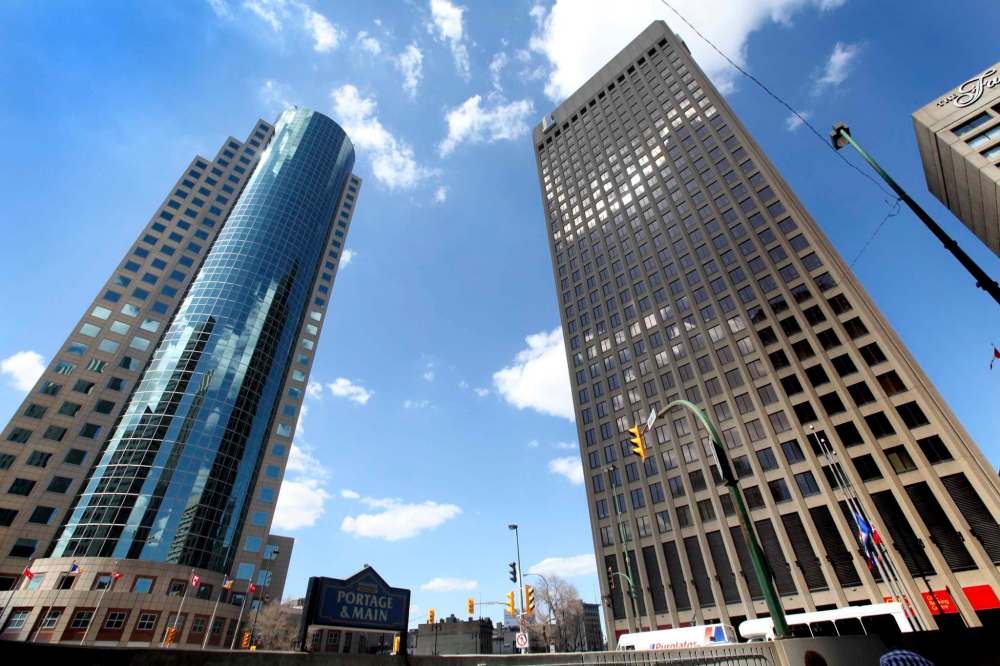
This particular April Fools’ Day prank doesn’t seem to have a paper trail, which leads this reporter to believe it is more lore than fact. In an “a friend of a friend of a friend told me” story, the Free Press’s Cheryl Binning reported in 2003 that Donald Benham, at the time the press secretary for former mayor Glen Murray, told her he heard a story of a local prank which happened years prior, when he was hosting the CBC radio show Questionnaire. Here’s how it went down: apparently a small group of people stood outside the Richardson Building downtown and began pushing one of the walls. As people walked by, in and out of the building, the group would ask them if they wouldn’t mind helping them push, because, as they explained, the building was “out of alignment” but with some brute strength, they could all push it back into place. A few hours later, a massive crowd could be seen pushing the wall. There’s no record of this, so it’s likely untrue, but funny none the less.
erin.lebar@freepress.mb.ca
Twitter: @NireRabel
Our newsroom depends on a growing audience of readers to power our journalism. If you are not a paid reader, please consider becoming a subscriber.
Our newsroom depends on its audience of readers to power our journalism. Thank you for your support.
BBC on the ball
When one thinks of the BBC, the first thing that comes to mind isn’t necessarily an aptitude for cheeky pranks, but the British Broadcasting Corporation has gotten away with some doozies in their day. Here’s a few April Fools’ Day favourites:
Spaghetti trees, 1957: In one of the most famous April Fools’ Day pranks of all time, the BBC television program Panorama conviced audiences that people from Switzerland harvest spaghetti from trees. Many viewers called the station asking how they could cultivate their own spaghetti trees.
Smell-o-vision, 1965: The BBC claimed to be testing a new technology allowing odours to be sent to viewers through the airwaves. According to the BBC, the network recieved calls from viewers who reported the Smell-o-vision test had been successful.
Flying penguins, 2008: In an elaborate video, the BBC claimed to have discovered a colony of flying penguins. The segment featured actor/comedian Terry Jones (of Monty Python fame) walking with the penguins in Antarctica, following their flight to the Amazon rainforest.
Prank purveyors
Scheme A Dream, a local event/entertainment company, offers an April Fools’ Day service allowing clients to pay them to pull pranks on friends, family and co-workers. They’ve been offering pranks-for-hire for decades, and here’s a few of their favourite
— A mock dental patient with an ultra sensitive molar sent to a dentist, who was the victim. When the dentist goes anywhere near the tooth, it sends the patient into profane expletives to the point of frustration and suggesting another dentist. By this time the gig is up and the dentist is informed of the prank.
— Arresting police officer so believable the victim gives the officer their full co-operation only to find out they have been pranked.
— An internal affairs VIP of a major corporation visiting an employee for questioning and reprimand.
— An irate customer complaining about a product or service at customer service.
Our newsroom depends on a growing audience of readers to power our journalism. If you are not a paid reader, please consider becoming a subscriber.
Our newsroom depends on its audience of readers to power our journalism. Thank you for your support.
Advertisement Advertise With Us
Advertisement Advertise With Us