Canada’s cannabis use rate up slightly post-legalization, stats show
Cannabis use rate is up 4 percentage points from a year ago
Advertisement
Read this article for free:
or
Already have an account? Log in here »
To continue reading, please subscribe:

Digital Subscription
One year of digital access for only $205*
- Enjoy unlimited reading on winnipegfreepress.com
- Read the E-Edition, our digital replica newspaper
- Access News Break, our award-winning app
- Play interactive puzzles
*First annual payment billed as $205.00 + GST for one year. This annual subscription will automatically renew at $233.00 + GST every 52 weeks (10% off the regular annual price of $259.35). Offer available to new and qualified returning subscribers only. Cancel any time.
To continue reading, please subscribe:
Add Free Press access to your Brandon Sun subscription for only an additional
$1 for the first 4 weeks*
- Enjoy unlimited reading on winnipegfreepress.com
- Read the E-Edition, our digital replica newspaper
- Access News Break, our award-winning app
- Play interactive puzzles
*Your next Brandon Sun subscription payment will increase by $1.00 and you will be charged $17.95 plus GST for four weeks. After four weeks, your payment will increase to $24.95 plus GST every four weeks.
Read unlimited articles for free today:
or
Already have an account? Log in here »
Hey there, time traveller!
This article was published 02/05/2019 (2717 days ago), so information in it may no longer be current.
About 18 per cent of Canadians over age 15 used cannabis at least once in the first quarter of 2019, according to Statistics Canada’s latest National Cannabis Survey.
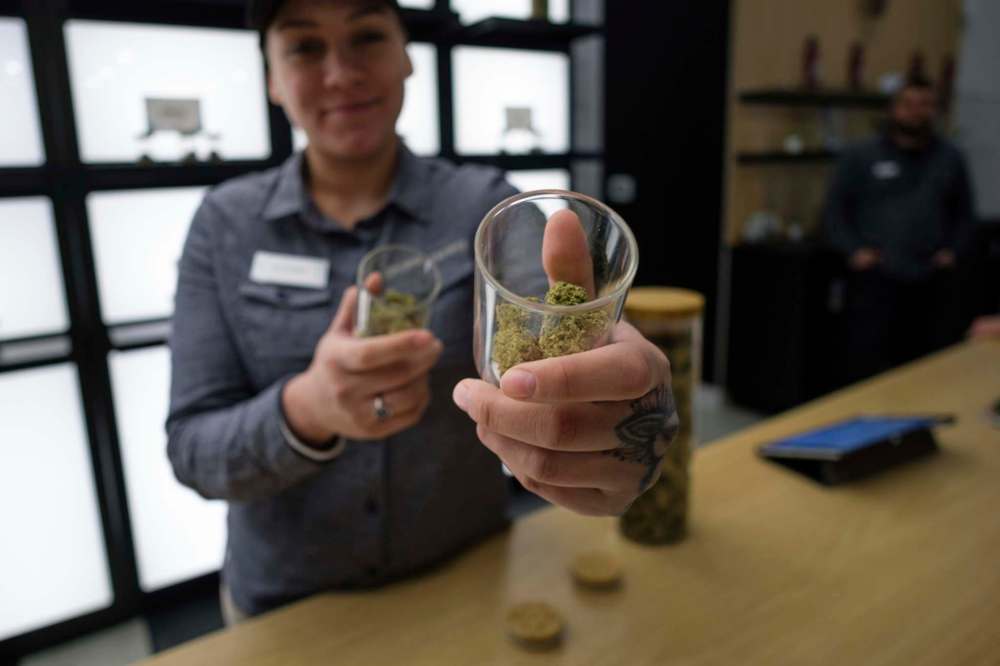
That figure, which represents about 5.3 million people, is a bump up from the 14 per cent cannabis use rate in the same period last year. It doesn’t distinguish between Canadians who use cannabis for medical purposes, for recreation, or both.
The national survey is meant to track rates of cannabis consumption among Canadians and suss out attitudes towards the drug, and kicked off in February 2018, well ahead of the legalization of non-medical cannabis in October of that year. The new data cover the first three months of 2019, and represent Statistics Canada’s first complete quarter of comparable cannabis data since legalization.
Changing cannabis use habits among Canadians aged 45 to 64 are part of the reason behind the increase in national cannabis use rates, wrote Canada’s national statistics authority in its Thursday release. Rates of cannabis use in that age group increased to 14 per cent, up from nine per cent a year earlier.

!function(e,t,s,i){var n=”InfogramEmbeds”,o=e.getElementsByTagName(“script”)[0],d=/^http:/.test(e.location)?”http:”:”https:”;if(/^/{2}/.test(i)&&(i=d+i),window[n]&&window[n].initialized)window[n].process&&window[n].process();else if(!e.getElementById(s)){var r=e.createElement(“script”);r.async=1,r.id=s,r.src=i,o.parentNode.insertBefore(r,o)}}(document,0,”infogram-async”,”https://e.infogram.com/js/dist/embed-loader-min.js”);
That finding doesn’t surprise Mike Babins, co-owner of Vancouver’s first provincially-licensed cannabis store, Evergreen Cannabis. In his experience, customers in that age bracket are especially keen on cannabis products with CBD, which is non-intoxicating.
"We do get a lot of people in that age group who come and say, ‘I can’t keep drinking every night, I want to try something different,’" said Babins.
"There’s a lot of people who were always curious about it and were waiting for it to be legal, either because of their jobs or becuase they wanted to make sure they were getting quality product. And there’s a huge curiousity factor — you know, there’s a new toy in town."
Nick Kuzyk, chief strategy officer with Calgary-based cannabis store operator High Tide Inc., thinks media coverage of legalization may have inspired older Canadians to take advantage of the new legal cannabis market.
"There’s a lot of demand for lower-THC, higher-CBD products, because frankly, the older demographic is looking for options when it comes to managing aches and pains," he said.
The new Statistics Canada data indeed suggests older Canadians were indeed interested in experimenting with cannabis after legalization, either for the very first time or for the first time in a long time. Among the 5.3 million Canadians who used cannabis in the first quarter, an estimated 646,000 tried it for the first time in the first quarter of 2019. That’s nearly double the corresponding figure for first-time users in 2018. About half of those new users were 45 or older.
Still, young Canadians and especially males remained the demographic groups most likely to consume cannabis in the first quarter of 2019. Among males aged 15 and up, rates of cannabis use grew to 22 per cent, up from 16 per cent in the first quarter of 2018. Females used cannabis at a rate of about 13 per cent, little changed from a year earlier.

!function(e,t,s,i){var n=”InfogramEmbeds”,o=e.getElementsByTagName(“script”)[0],d=/^http:/.test(e.location)?”http:”:”https:”;if(/^/{2}/.test(i)&&(i=d+i),window[n]&&window[n].initialized)window[n].process&&window[n].process();else if(!e.getElementById(s)){var r=e.createElement(“script”);r.async=1,r.id=s,r.src=i,o.parentNode.insertBefore(r,o)}}(document,0,”infogram-async”,”https://e.infogram.com/js/dist/embed-loader-min.js”);
Despite the increase in the national cannabis use rate, the rate of daily or almost-daily cannabis use remained unchanged between the first quarter of 2018 and the first quarter of 2019. High-frequency cannabis use "is often regarded as a more informative indicator of the impact of legalization, due to its association with the risk of addiction, poor mental health, and lower academic achievement," Statistics Canada wrote. Rates of weekly and occasional cannabis use increased slightly on an annual basis.
The new data may be encouraging for the Liberal government, for whom diminishing the black market for cannabis is an explicit goal of legalization.
In the first quarter of 2018, 51 per cent of cannabis users told Statistics Canada they got their cannabis from an illegal source. That proportion shrank to 38 per cent during the same period this year. (Some Canadians get their cannabis from both legal and illegal sources, notes the national data agency; this practice is more common among daily or almost-daily cannabis users.) New cannabis users were more likely to get their cannabis from a legal source.
.jpg)
!function(e,t,s,i){var n=”InfogramEmbeds”,o=e.getElementsByTagName(“script”)[0],d=/^http:/.test(e.location)?”http:”:”https:”;if(/^/{2}/.test(i)&&(i=d+i),window[n]&&window[n].initialized)window[n].process&&window[n].process();else if(!e.getElementById(s)){var r=e.createElement(“script”);r.async=1,r.id=s,r.src=i,o.parentNode.insertBefore(r,o)}}(document,0,”infogram-async”,”https://e.infogram.com/js/dist/embed-loader-min.js”);
The National Cannabis Survey doesn’t measure rates of cannabis-impaired driving, but it does ask respondents about their attitudes towards cannabis and driving. Forty-nine per cent of Canadians believe it’s best to wait at least three hours after using cannabis before hitting the road, and only six per cent said it’s safe to drive within three hours of using cannabis.
The remaining 45 per cent said the safety of driving after using cannabis depends on individual factors, like the user’s weight or how the cannabis is used. That attitude was different among daily cannabis users, about 18 per cent of whom felt it’s safe to drive within three hours of using cannabis. Among cannabis users with a valid driver’s licence, 15 per cent said they had driven within two hours of using cannabis, the same as in the first half of 2018.
"Close to 20 per cent of those who reported driving after consuming cannabis indicated that they had also consumed alcohol," wrote Statistics Canada. That figure represents about three per cent of all cannabis users with a driver’s licence.
Statistics Canada also tracked the proportion of Canadian workers who use cannabis before or during their workday, which it pegs at about 13 per cent of workers who use cannabis, or 514,000 people. Daily or near-daily cannabis users were more likely to report this behaviour, at a rate of 27 per cent.
Those cannabis-using workers aren’t all necessarily stoned on the job, though — Statistics Canada’s data doesn’t capture whether cannabis users used non-intoxicating forms of the drug, as some people do for therapeutic purposes.
solomon.israel@theleafnews.com
@sol_israel