Study of ‘social suite’ shows cause for optimism
Advertisement
Read this article for free:
or
Already have an account? Log in here »
To continue reading, please subscribe:

Digital Subscription
One year of digital access for only $205*
- Enjoy unlimited reading on winnipegfreepress.com
- Read the E-Edition, our digital replica newspaper
- Access News Break, our award-winning app
- Play interactive puzzles
*First annual payment billed as $205.00 + GST for one year. This annual subscription will automatically renew at $233.00 + GST every 52 weeks (10% off the regular annual price of $259.35). Offer available to new and qualified returning subscribers only. Cancel any time.
To continue reading, please subscribe:
Add Free Press access to your Brandon Sun subscription for only an additional
$1 for the first 4 weeks*
- Enjoy unlimited reading on winnipegfreepress.com
- Read the E-Edition, our digital replica newspaper
- Access News Break, our award-winning app
- Play interactive puzzles
*Your next Brandon Sun subscription payment will increase by $1.00 and you will be charged $17.95 plus GST for four weeks. After four weeks, your payment will increase to $24.95 plus GST every four weeks.
Read unlimited articles for free today:
or
Already have an account? Log in here »
Hey there, time traveller!
This article was published 18/05/2019 (2678 days ago), so information in it may no longer be current.
At first, it might seem that a book about the “evolutionary origins of a good society” must be somewhat naïve. After all, it comes at a time when the headlines are full of news about hate groups, the rise of authoritarian governments and anthropogenic climate disasters.
However, Nicholas Christakis’s Blueprint presents a convincing argument that there is a scientifically demonstrable basis for our shared humanity — one that connects us profoundly not only with each other, but with animals as well.
For Christakis, this connection may be found in what he calls the “social suite”: the practices found in all human societies regarding the recognition of individuals; romantic and familial love; friendships and social networks; co-operation; group identity; social structures combining aspects of hierarchy and egalitarianism; and the ability to learn from others.

The bestselling and award-winning author of 2011’s Connected: The Surprising Power of Our Social Networks and How They Shape Our Lives (co-written with James H. Fowler), Christakis teaches social and natural sciences at Yale University and was named to Time magazine’s “Time 100” list of the world’s most influential people. In his fascinating and deeply informed Blueprint, he does an excellent job of explaining often-complex scientific principles for the lay reader.
To illustrate how the elements of the social suite operate, Christakis first examines cases of people thrown together by accident in shipwrecks — i.e., unintentional communities — as well as intentional utopias and communes. Here we learn that failures have as much to teach us about the social suite as successes: the dysfunctional colony on Pitcairn Island established by the mutineers of the Bounty, for example, fell into chaos and murder owing to the racism and drunkenness of the mutineers, while Ernest Shackleton helped 28 men survive co-operatively for nearly two years while stuck in the Antarctic ice.
Next, the author turns to cross-cultural studies by anthropologists to discover both universal practices (such as social networks) as well as some that are not so universal, such as kissing and monogamy. In his view, the bonds our species feel for our children and mates are the core of the blueprint, as they evolved to extend in ever wider circles to include kin and community.
Over the years, Christakis has conducted or led numerous large-scale studies through Yale University’s Human Nature Lab, and he refers to these frequently in the book. But he also relies heavily on the work of scientists from across the zoological sciences for evidence of the extent to which many of the features of the social suite may also be seen in the living arrangements of dolphins, whales, elephants and the great apes who, to varying capacities, demonstrate self-awareness, co-operation, empathy, grief and pair-bonding.
These discoveries bring us to his most controversial argument: that, if the strategies of the social suite are found in nature where they are attributed to advantageous genetic evolution, why then may we not also see these forces at work in ourselves?
He theorizes that our genetic makeup has “downstream effects” in shaping our physical and social environments to help ensure our survival — and thus the ability to pass on our genes — with the result that we are all influenced to some degree by other peoples’ genes.
While he acknowledges the dark and troubling history of citing genetics to claim distinctions between social groups, Christakis also points out that the opposite argument — that human social behaviour has nothing to do with genes and is therefore infinitely malleable — has also resulted in the deaths of millions at the hands of totalitarian leaders.
His Blueprint represents a third path: a positive counter-narrative to the seemingly dominant cloud of hatred and prejudice surrounding us to reveal that we are, in fact, hard-wired to live together and love one another, and to do both well.
Michael Dudley is a librarian at the University of Winnipeg.
Book review
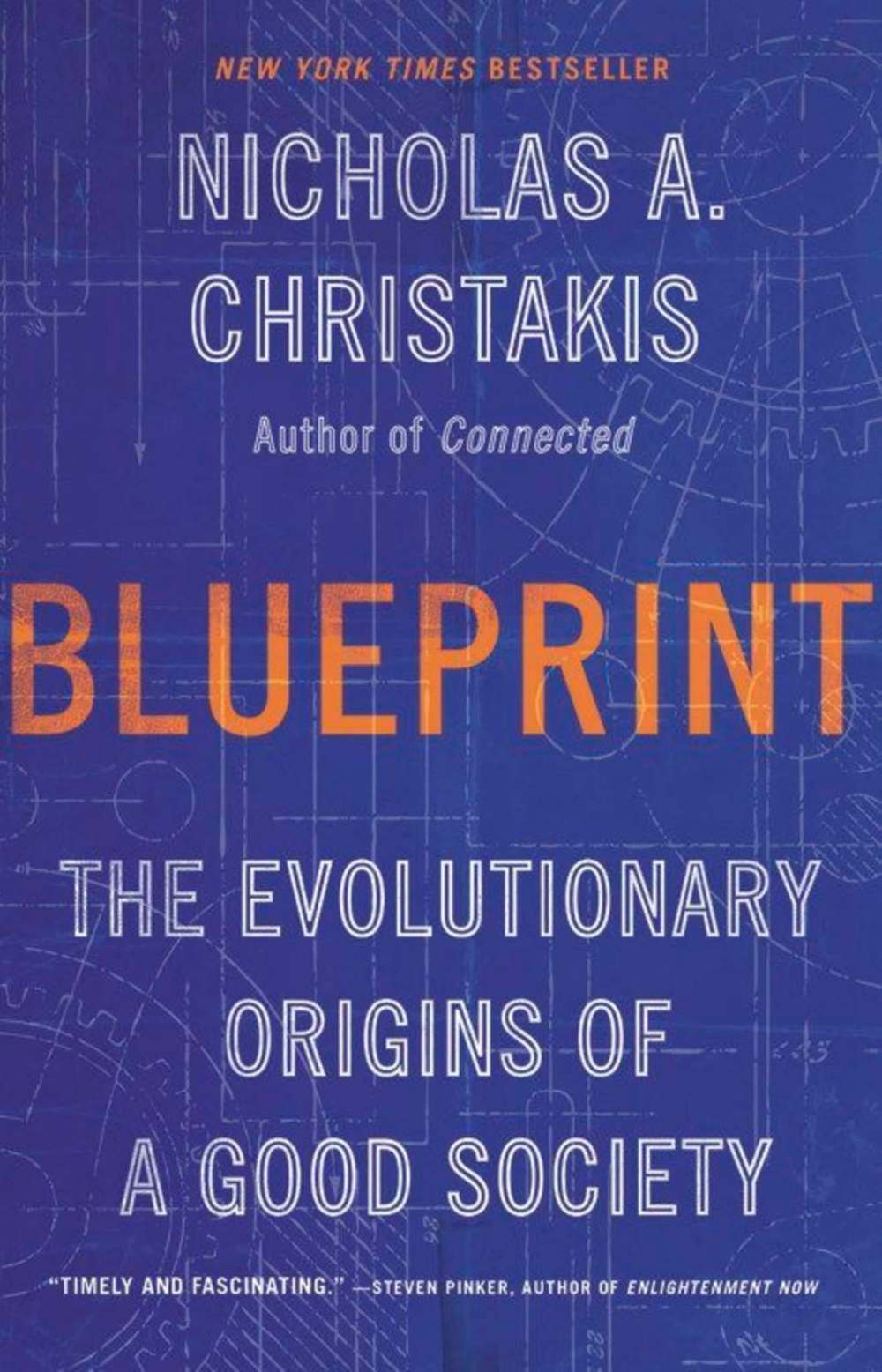
Blueprint: The Evolutionary Origins of a Good Society
By Nicholas A. Christakis
Little, Brown, 544 pages, $39
Related Articles
Antarctic explorer Shackleton’s ship found after a century
Advertisement Advertise With Us
Advertisement Advertise With Us