Behind the scenes of how Canada made its case for claiming the North Pole

Advertisement

Advertise with us

One minute, it was dangling off the back of an icebreaker into the waters of the High Arctic. The next, the crucial piece of gear was gone.

Read this article for free:


or

Already have an account? Log in here »

To continue reading, please subscribe:

Subscribe and receive a limited-edition Free Press branded hat or tote.

Digital Subscription

One year of digital access for only $205*

  • Enjoy unlimited reading on winnipegfreepress.com
  • Read the E-Edition, our digital replica newspaper
  • Access News Break, our award-winning app
  • Play interactive puzzles

*First annual payment billed as $205.00 + GST for one year. This annual subscription will automatically renew at $233.00 + GST every 52 weeks (10% off the regular annual price of $259.35). Offer available to new and qualified returning subscribers only. Cancel any time.

To continue reading, please subscribe:

Add Free Press access to your Brandon Sun subscription for only an additional

$1 for the first 4 weeks*

  • Enjoy unlimited reading on winnipegfreepress.com
  • Read the E-Edition, our digital replica newspaper
  • Access News Break, our award-winning app
  • Play interactive puzzles
Start now

*Your next Brandon Sun subscription payment will increase by $1.00 and you will be charged $17.95 plus GST for four weeks. After four weeks, your payment will increase to $24.95 plus GST every four weeks.

Hey there, time traveller!
This article was published 02/06/2019 (2654 days ago), so information in it may no longer be current.

One minute, it was dangling off the back of an icebreaker into the waters of the High Arctic. The next, the crucial piece of gear was gone.

“We got pinched,” recalls Mary-Lynn Dickson. “You’re clearing a path, but the ice moves in and we got pinched.”

Dickson was the lead scientist on a 2,100-page report just submitted to the United Nations that Canada will use to argue for control over a vast region of the Arctic sea floor.
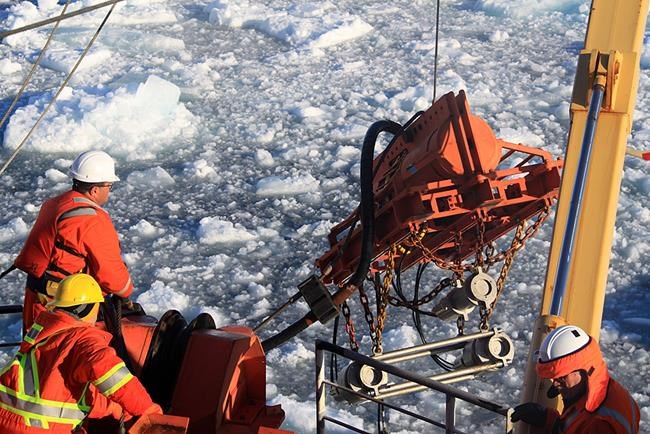
Seismic gear is deployed from the CCGS Louis S. St-Laurent in the Arctic Ocean in a 2015 handout photo. A 2,100-page report has been submitted to the United Nations that Canada will use to argue for control over a vast region of the Arctic sea floor. THE CANADIAN PRESS/HO- Geological Survey of Canada, Natural Resources Canada MANDATORY CREDIT

It was 2016. She was on her third expedition far north of Ellesmere Island, and the ice had just clipped the team’s last underwater microphone, called a streamer.

Without it, there was no way to record signals rebounding off the sea floor — the whole point of the trip.

They were hundreds of kilometres from anywhere. The first rule of Arctic science was in force: If something breaks, you fix it or you don’t have it.

Dickson threw the ball to her technical team.

“By the next morning they said, ‘We can build a new one out of spare parts,'” she says. “We called it the Frankenstreamer. It wasn’t pretty, but it worked.”

Thanks partly to the Frankenstreamer, Canada makes a strong case that the North Pole is part of its True North, Dickson says.

All coastal nations claim 200 nautical miles off their shores as exclusive economic zones.

Beyond that may lie something call the extended continental shelf. If a country can prove that the shelf exists off its coast and that it’s connected to the country’s land mass, it can be claimed.

Peering through sometimes thousands of metres of icy water to prod the bottom beneath was what Dickson and her colleagues on the Coast Guard’s Louis St. Laurent were trying to do.

The task was large and time was short. The science agenda was packed and almost every hour of the cruise was accounted for.

Researchers looked at the thickness and origin of sediment layers.

They made precise measurements of water depth.

They analyzed geochemistry.

They considered the type, age and structures of rocks hauled from the deep. “They’re so precious they’re like moon rocks,” Dickson says.

They reconstructed how the modern sea floor was built from ancient tectonic plates.

They compared the rocks they were finding with data collected on High Arctic islands.

“It all pulled it together in making a complete package and, I think, convincing arguments as to why this continental margin is part of the land mass,” Dickson says. “It’s connected to the Canadian continental margin off of Ellesmere Island — physically connected.”

All this happened through ice so tough it sometimes stymied two icebreakers and so unpredictable the team lost two locator beacons when the ice pan they were on drifted away. They were recovered nine months later east of Greenland by the Danish navy.

Scientists worked on the St. Laurent’s back deck through freezing winds, blizzards, thick fog and bright sun.

“It was beautiful,” Dickson says. “I loved it.”

Russia and Denmark, which have made competing submissions to the United Nations, also argue that two undersea ridges beneath the Arctic Ocean are connected to their land masses. Maybe they’re right, says Dickson.

“They can be. You can all be right. I don’t want to speak for the Russians or the Danes, but I think we all agree the Lomonosov Ridge is continental material.”

The work, which cost $43 million over the three cruises, is now before the UN commission that is to examine data from the three countries to ensure the science has been done correctly.

It will take years of negotiations between the three to draw any lines on the map. The action will move to meeting rooms and conference centres.

Dickson much preferred the rear deck of a windswept icebreaker. She calls her Arctic sailings a highlight of her career.

“I was 20 years old again on the back of that ship.”

— Follow Bob Weber on Twitter at @row1960
Report Error Submit a Tip

More Stories

Thousands are still without power in Winnipeg after high winds and thunderstorms knocked out power lines Sunday.

About 4,000 Manitoba Hydro customers were still dealing with outages this morning after crews worked to restore power in the Westwood and River Heights areas, Hydro spokesman Peter Chura said. On Sunday, Hydro reported outages affecting approximately 6, 700 customers.

The high winds and heavy rain brought down trees and broke power poles, causing "very severe damage," in River Heights, one of the hardest-hit neighbourhoods, while some of the damage in the Westwood area appeared to be caused by lightning strikes, Chura said.

Thunderstorms rolled in at about 6 p.m. Sunday and brought heavy rain and high winds to some areas of the province. Winnipeg received about 35 mm of rain, while some areas got almost double that. More than 62 mm was recorded at The Forks and 68.8 mm was recorded at Portage Southport, according to Environment Canada.

Today’s horoscope

Georgia Nicols 4 minute read 2:00 AM CDT

MOON ALERT: Avoid shopping (except food and gas) and important decisions from 8 a.m. until noon today. After that, the moon moves from Cancer into Leo.

ARIES (March 21-April 19)

Hang in there, because as this day progresses, it becomes more lighthearted and fun-loving. Admittedly, power struggles with a friend or member of a group might squelch things. Be patient with kids. Basically, this is a friendly and productive day.

TAURUS (April 20-May 20)

Today’s horoscope

Georgia Nicols 4 minute read Yesterday at 2:00 AM CDT

MOON ALERT: There are no restrictions to shopping or important decisions today. The moon is in Cancer.

ARIES (March 21-April 19)

Relations with parents and authority figures might be strained. Resist the urge to be too pushy. Likewise, avoid other people who are pushy. Your best choice is to work hard and get better organized. Fortunately, relations with partners are good.

TAURUS (April 20-May 20)

Canada has strong North Pole case: scientist

Bob Weber, The Canadian Press 4 minute read Preview

Canada has strong North Pole case: scientist

Bob Weber, The Canadian Press 4 minute read Sunday, Jun. 2, 2019

One minute, it was dangling off the back of an icebreaker into the waters of the High Arctic. The next, the crucial piece of gear was gone.

"We got pinched," recalls Mary-Lynn Dickson. "You're clearing a path, but the ice moves in and we got pinched."

Dickson was the lead scientist on a 2,100-page report just submitted to the United Nations that Canada will use to argue for control over a vast region of the Arctic sea floor.

It was 2016. She was on her third expedition far north of Ellesmere Island, and the ice had just clipped the team's last underwater microphone, called a streamer.

Read
Sunday, Jun. 2, 2019

Man injured in downtown shooting

1 minute read Yesterday at 2:40 PM CDT

A man in his 20s is in critical condition after he was shot in downtown Winnipeg early Sunday morning.

The Winnipeg Police Service's major crimes unit is investigating and no arrests have been made.

Police responded to the area of Portage Avenue and Balmoral Street, near the University of Winnipeg campus, at about 4:20 a.m. Sept. 6 for the report of a male suffering a gunshot wound. Police provided first aid to the victim, who was taken to hospital.

‘We belong… and we are giving back”: Sikh celebration enlivens downtown Winnipeg

Melissa Martin 3 minute read Preview

‘We belong… and we are giving back”: Sikh celebration enlivens downtown Winnipeg

Melissa Martin 3 minute read Updated: Yesterday at 5:59 PM CDT

Downtown Winnipeg came alive with vibrant sights, sounds, and scents on Sunday, as Manitoba’s Sikh community flocked to Memorial Park to celebrate its annual Nagar Kirtan procession and festival.

This year marked the 422nd anniversary of the completion of the Guru Granth Sahib, the holy scripture central to the Sikh faith. Shortly after 1 p.m., a palanquin bearing a copy of the scripture was led in parade through downtown Winnipeg, with musical accompaniment.

“This is a chance to tell the public and the whole community where we come from and who we are,” said volunteer Prabh Grewal shortly before the procession got underway. “In a community there are people from every race and every country, and our main objective is to have everybody live in peace and harmony together.”

Before, during, and after the procession, the park hummed with life. As many as 55,000 people converged on the site, with the majority dressed in festive traditional attire. Near the height of the day’s 30 C heat, families relaxed in patches of shade, enjoying plates of Punjabi cuisine dished out for free at dozens of tents sponsored by local businesses.

Read
Updated: Yesterday at 5:59 PM CDT