

Michel Platini, a soccer great now touched by scandal
Advertisement
Read this article for free:
or
Already have an account? Log in here »
To continue reading, please subscribe:

Digital Subscription
One year of digital access for only $205*
- Enjoy unlimited reading on winnipegfreepress.com
- Read the E-Edition, our digital replica newspaper
- Access News Break, our award-winning app
- Play interactive puzzles
*First annual payment billed as $205.00 + GST for one year. This annual subscription will automatically renew at $233.00 + GST every 52 weeks (10% off the regular annual price of $259.35). Offer available to new and qualified returning subscribers only. Cancel any time.
To continue reading, please subscribe:
Add Free Press access to your Brandon Sun subscription for only an additional
$1 for the first 4 weeks*
- Enjoy unlimited reading on winnipegfreepress.com
- Read the E-Edition, our digital replica newspaper
- Access News Break, our award-winning app
- Play interactive puzzles
*Your next Brandon Sun subscription payment will increase by $1.00 and you will be charged $17.95 plus GST for four weeks. After four weeks, your payment will increase to $24.95 plus GST every four weeks.
Read unlimited articles for free today:
or
Already have an account? Log in here »
Hey there, time traveller!
This article was published 18/06/2019 (2637 days ago), so information in it may no longer be current.
Affectionately nicknamed Le Roi, or The King, Michel Platini bestrode the soccer field with inimitable elegance as the world’s best player of the early 1980s, helping to bridge the gap between the eras of Pele and Diego Maradona.
Repeatedly voted Europe’s best player, the Frenchman instantly recognizable for his unruly mop of hair and his often grumpy demeanour in his later years went on to become European soccer’s top administrator as president of UEFA.
Now his lofty reputation in the so-called beautiful game has been tainted by corruption scandals.
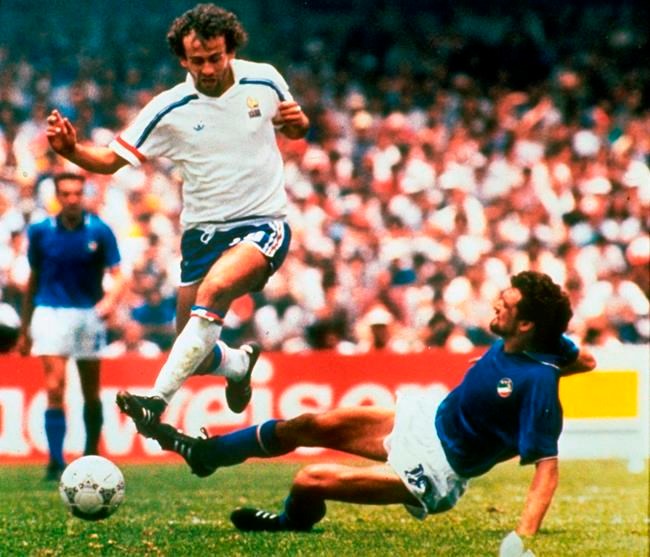
Banned from the sport four years ago for financial misconduct, the 63-year-old Platini was questioned by police Tuesday as part of a separate corruption probe into the vote that awarded the 2022 World Cup to Qatar. Platini denied any wrongdoing.
It is just the latest in a torrent of scandals in recent years that have brought down dozens of soccer officials, particularly from world governing body FIFA, over such offences as vote-buying, kickbacks and bribery.
“Of all those that have been either arrested, indicted etc, Michel Platini is the saddest and most depressing,” former England captain Gary Lineker tweeted. “He was a footballer, one of us.”
___
CLUB CAREER
Born in 1955 into a family of Italian immigrants living in northeastern France, Platini played the first 10 years of his professional career in his native country, first for nearby Nancy (1972-79) and then for Saint-Etienne (1979-82), with whom he won the French league title in 1981.
He later joined the Italian giant Juventus, where he became a global star in the iconic black-and-white jersey between 1982 and 1987.
With his graceful technique, peerless passing, pinpoint set-pieces and unhurried style of play, Platini led Juventus to two Italian league titles, the European Cup Winners’ Cup in 1984 and the European Cup in 1985.
Platini’s winning penalty shot in the final against Liverpool is largely forgotten, overshadowed by the death of 39 people — mostly Juventus fans — in a crush at the start of the game at Heysel Stadium in Brussels.
He was the top scorer in the Italian league for three consecutive seasons, an astonishing feat for a midfielder, before retiring in 1987 at just 32.
INTERNATIONAL CAREER
For the French national team, Platini’s finest hour came at the European Championship in 1984, when the country won its first major international soccer title.
He scored a tournament-high nine goals in five matches, a haul that included two hat tricks, and was the heartbeat of a famous midfield that also comprised Alain Giresse, Jean Tigana and Luis Fernandez.
Platini was awarded the Ballon d’Or as Europe’s footballer of the year. He also won the award in 1983 and 1985.
One of his biggest regrets was never winning the World Cup with France, which lost semifinals against West Germany in 1982 and 1986. He scored 41 goals in 72 games for France.
COACHING
Platini’s sole coaching stint was with France’s national team, and it didn’t go well.
He took charge in 1988, and the team failed to qualify for the World Cup in 1990, despite having the talents of Jean-Pierre Papin and a young Eric Cantona.
After France was eliminated from the European Championship in 1992 in the first round, Platini stepped down.
He would enjoy more success with the national team as an administrator.
ADMINISTRATOR
His first big off-the-field role was as joint president of the organizing committee for the 1998 World Cup, which was held in France and proved a big success for the host country. France’s multicultural team won the biggest prize in soccer for the first time.
Platini then became part of UEFA, European soccer’s governing body, first as a member of its executive committee and then as its leader after defeating incumbent Lennart Johansson in a presidential vote in 2007. He was the first former player to become UEFA president.
While overseeing the continued growth of the behemoth that was the Champions League — formerly the European Cup — Platini tried to curb spending and opposed the introduction of technology such as video review or goal-line cameras. Under his watch, from 2007 to 2015, more teams were added to the European Championship, and a minimum 10-game ban for racist abuse by players was introduced.
DOWNFALL
While organizing the 1998 World Cup, Platini worked closely with FIFA’s CEO-like top administrator, Sepp Blatter. He helped Blatter become FIFA president in an eve-of-tournament election dogged by claims of vote-buying by supporters of other candidates.
Platini served as Blatter’s adviser from 1998 to 2002, and those ties that bound the mentor and his protege would bring them both down in 2015 .
In 2011, Blatter signed off on paying Platini $2 million, a salary Blatter had no contractual authority to approve. Swiss authorities opened a criminal investigation, and FIFA’s ethics committee banned them both, just as Platini seemed to be about to achieve what he would say was his destiny — succeeding Blatter as president.
The latest investigation centres on Platini’s decision to vote for Qatar as 2022 World Cup host. Blatter has accused Platini of backing out of a secret “gentleman’s agreement” to support the United States’ bid to be the host country.
Platini changed his mind after meeting then-French President Nicolas Sarkozy at his official residence in Paris with Qatar’s crown prince, now emir.
___

More AP sports: https://apnews.com/apf-sports and https://twitter.com/AP_Sports
___
AP Sports Writer Graham Dunbar in Geneva contributed to this report.
___
Steve Douglas is at www.twitter.com/sdouglas80
Related Articles
Messi says it would be 'crazy' to see Argentina out of Copa





Advertisement Advertise With Us
Advertisement Advertise With Us