Fictional Chernobyl delivers chilling reality
Advertisement
Read this article for free:
or
Already have an account? Log in here »
To continue reading, please subscribe:

Digital Subscription
One year of digital access for only $205*
- Enjoy unlimited reading on winnipegfreepress.com
- Read the E-Edition, our digital replica newspaper
- Access News Break, our award-winning app
- Play interactive puzzles
*First annual payment billed as $205.00 + GST for one year. This annual subscription will automatically renew at $233.00 + GST every 52 weeks (10% off the regular annual price of $259.35). Offer available to new and qualified returning subscribers only. Cancel any time.
To continue reading, please subscribe:
Add Free Press access to your Brandon Sun subscription for only an additional
$1 for the first 4 weeks*
- Enjoy unlimited reading on winnipegfreepress.com
- Read the E-Edition, our digital replica newspaper
- Access News Break, our award-winning app
- Play interactive puzzles
*Your next Brandon Sun subscription payment will increase by $1.00 and you will be charged $17.95 plus GST for four weeks. After four weeks, your payment will increase to $24.95 plus GST every four weeks.
Read unlimited articles for free today:
or
Already have an account? Log in here »
Hey there, time traveller!
This article was published 22/06/2019 (2636 days ago), so information in it may no longer be current.
“What is the cost of lies? It’s not that we’ll mistake them for the truth. The real danger is that if we hear enough lies, then we no longer recognize the truth at all. What can we do then?”
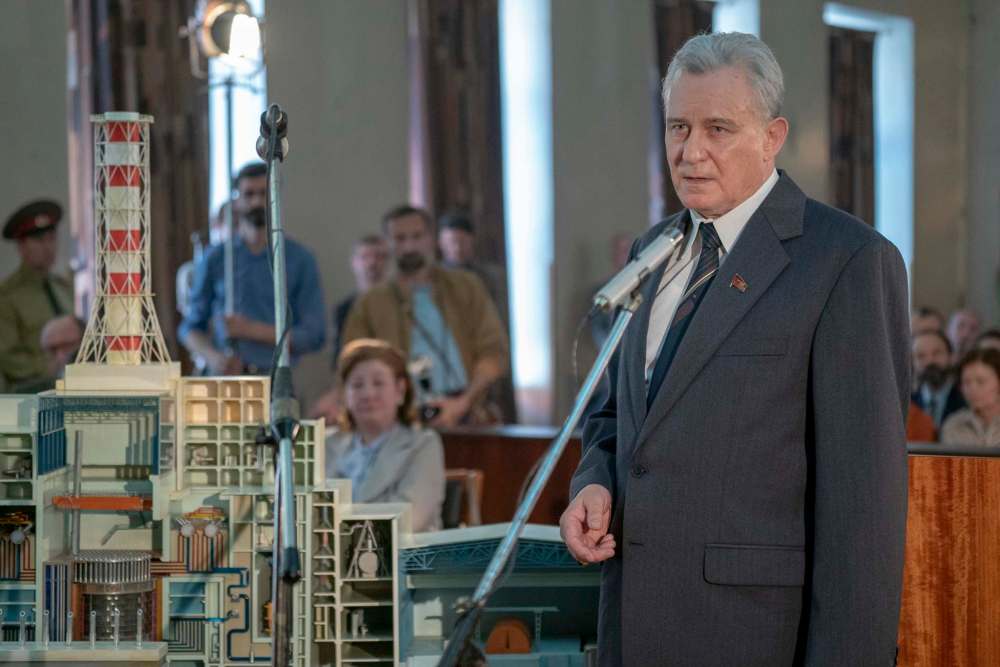
The opening scene of the HBO miniseries Chernobyl (streaming on Crave), in which a morose Valery Legasov (played by Jared Harris) is sitting at his kitchen table, speaking these dark words into a cassette recorder, declares quite plainly that something even bigger than the story of the 1986 nuclear disaster is being told here. Something important, something urgent. And a few minutes later, when Legasov stops the recorder and commits suicide, the viewer is faced with a human payment toward the cost, with the urgency of time run out.
As a piece of storytelling, Chernobyl is masterfully crafted and eminently binge-worthy, the acting chops of the cast providing numerous lenses into the late, unsteady period of the Soviet Union and an apocalyptic, throbbing and often monotone score preserving and even amplifying the slightest sounds — footsteps, whispers, the rustling of leaves — to heightened importance.
Naturally, the series also plays loose with creative license, as New York Times science writer Henry Fountain points out. “The first thing to understand is that a lot of it is made up,” he writes. But, he adds, “here’s the second, and more important thing: It doesn’t really matter.”
Umberto Eco, in The Name of the Rose, delivers one of literature’s most illuminating and succinct manifestos on metanarrative: “When we consider a book (or in this case a film), we mustn’t ask ourselves what it says but what it means.”
What does a five-part series detailing the horror of the accident in Chernobyl’s No. 4 reactor, the falsehoods told to downplay the damage and subsequent impact on tens of thousands of lives mean in the present? What is the urgency being conveyed, and action prescribed, by creator Craig Mazin and director Joan Renck? What, in contemporary life, is the cost of lies?
There is a scene in the first episode when a crowd of onlookers — families, mostly — stands on a bridge in Pripyat in northern Ukraine, near the Chernobyl Nuclear Power Plant, and watches a curious blaze and strange blue light (the latter a merely creative addition) coming from the facility where many of them work and props up their city of nearly 50,000. They just stand and watch, not knowing the danger they’ve innocently walked towards and, even if they did, are unable to do anything about it.
Those with the power to act initially deny a nuclear catastrophe has happened. Then, they downplay the severity of it. Finally, when it’s much too late for far too many, they evacuate Pripyat and surrounding communities and grudgingly, while still withholding the devastating reality of the situation from the international community, conscript divers, miners and ordinary labourers to clean up the site, essentially condemning them to early and mournfully unnecessary deaths.
It is not a happy story, and the denial, lies and inaction that are vital to the telling of it are enough to, and do, put the viewer in a rage. But it’s not to the former USSR that Chernobyl wants its audience to show its anger.
Renck, the director whose native Sweden was also effected by Chernobyl, hasn’t hid the fact that the series’ broader narrative is intended to address, and decry, inaction over climate change. “This show undeniably deals with how human actions affect the world around us,” he remarked in an interview with National Public Radio last month. “We have an acute urgent situation in which we’re killing this planet and we have people who deny that because it goes against their business ideas.” He added: “We’re in a climate right now in which there’s actually a war on truth and people are preferring their own opinions to those of experts.” Such as the real Legasov, whose early warnings as to the breadth of the desolation wrought by the disaster were dismissed by the Soviet Council of Ministers.
One has only to follow the political discourse in this country to bring Renck’s series, and frustration, into the here and now. In Ontario, Premier Doug Ford and his government have abandoned the province’s cap and trade program and are defying the federal carbon tax. Alberta Premier Jason Kenney has cancelled the tax and delayed the phase-out of coal power, among other regressive moves. Much of the rest of Canada, even if well-meaning, is bogged down in climate malaise or simply suffering from a collective lack of imagination.
South of the border, the current U.S. administration outright denies climate change through its policies, and lack thereof. The thing is, the migration issue that dominates their agenda is also a climate issue. Failing crops in agrarian regions of El Salvador and Honduras are forcing a mass exodus to cities, exacerbating the urban violence that is generally cited as the primary reason for the long journey north in the first place.

It’s a pattern being tragically replicated in parts of Africa, particularly the Lake Chad region, and in Southeast Asia, in places like the Indus, Mekong and Yangtze river basins.
There are millions of people standing now on that fateful bridge in Pripyat. Indeed, the entire world is on it, watching an explosion up close and then waiting, hopelessly waiting, while those with the power to help them — or at least contain the damage — selfishly ignore the experts already raising the alarm. Experts like Legasov, who faced the cost of lies two years to the day after Chernobyl.
“They’ll deny it of course. They always do,” he spoke into his tape recorder in the series’ final episode. “I know you’ll try your best.”
Will we?
Jerrad Peters is a Winnipeg writer.
Our newsroom depends on a growing audience of readers to power our journalism. If you are not a paid reader, please consider becoming a subscriber.
Our newsroom depends on its audience of readers to power our journalism. Thank you for your support.