

Habitat helps break cycle of poverty
Annual bike ride raises money for building projects in Winnipeg
Advertisement
Read this article for free:
or
Already have an account? Log in here »
To continue reading, please subscribe:
Monthly Digital Subscription
$0 for the first 4 weeks*
- Enjoy unlimited reading on winnipegfreepress.com
- Read the E-Edition, our digital replica newspaper
- Access News Break, our award-winning app
- Play interactive puzzles
*No charge for 4 weeks then price increases to the regular rate of $19.00 plus GST every four weeks. Offer available to new and qualified returning subscribers only. Cancel any time.
Monthly Digital Subscription
$4.75/week*
- Enjoy unlimited reading on winnipegfreepress.com
- Read the E-Edition, our digital replica newspaper
- Access News Break, our award-winning app
- Play interactive puzzles
*Billed as $19 plus GST every four weeks. Cancel any time.
To continue reading, please subscribe:
Add Free Press access to your Brandon Sun subscription for only an additional
$1 for the first 4 weeks*
*Your next subscription payment will increase by $1.00 and you will be charged $16.99 plus GST for four weeks. After four weeks, your payment will increase to $23.99 plus GST every four weeks.
Read unlimited articles for free today:
or
Already have an account? Log in here »
Hey there, time traveller!
This article was published 29/06/2019 (2347 days ago), so information in it may no longer be current.
Imagine an early morning in July as people in cycling gear and their helpers gather to start another leg of a long-distance ride. Cyclists stretch their limbs and don their helmets as members of the crew ensure they have enough inner tubes, water and snack food as they prepare to help another Winnipeg family find a good home in Habitat for Humanity’s Cycle of Hope.
The 2019 ride marks the 26th year that the Cycle of Hope has helped raise money for building projects in Winnipeg. Habitat for Humanity was founded in Americus, Ga., in 1976; the first Habitat house in Canada was built in 1985.
The housing situation has not improved since the organization’s founding. With one in seven Canadian households struggling to find affordable housing, helping people to find a good place to live helps not only them, but also the rest of the community.
The idea behind Habitat for Humanity, as the organization’s communications state, is to provide families with safe, affordable housing that allows them to build communities and to thrive in a way that would otherwise be difficult. Scholar Clarence Jordan from Koinonia Farm in Georgia first proposed the idea to help fulfil the biblical mandate to provide needy people with shelter, as indicated in chapters such as Isaiah 58 and Matthew 25. From that basis, the concept of partnership housing for low-income residents was born.
Partnership housing employs the idea that people need to be engaged in building both their homes and communities. Habitat for Humanity supplies the expertise needed for building a house, as well as volunteers to do a variety of tasks, while the families who will live in the homes provide “sweat equity” to help build the houses in exchange for interest-free mortgages and the chance to establish better lives for themselves and their children.
Building homes takes money, even with volunteers providing much of the labour. In 1993, when Winnipeg Habitat for Humanity volunteers hosted a Jimmy Carter Work Project, they encountered a group called Cycle 500, riding their bicycles in from Minneapolis to help raise money for Habitat’s work in Minnesota. When the group donated 10 per cent of the fundraising proceeds to Manitoba’s Habitat for Humanity projects, it sparked an idea.
Seeing what the Cycle 500 participants were accomplishing, volunteers Lorraine Petkau and Olenka Antymniuk thought a similar idea could work in Canada, and the Cycle of Hope was born. Olenka recalls the difficulty of letting people know and getting them engaged in supporting the event in the days before email.
She knew the project had to be appealing if greater public awareness was to generate support. The tangible nature of the project was helpful in this regard, as people could see the results of their donations and know they were helping real people to meet their everyday needs. The first year’s ride raised $36,000, enough to build foundations for four houses, and subsequent fundraisers have also helped to provide some of the basics necessary for the building projects to succeed.
Just as the first Cycle of Hope helped to fund the physical foundations of four houses, the entire event helps to establish the foundations of community and mutual support. Habitat for Humanity houses tend to be built in clusters to give new homeowners a support system of people who know how important the stability of a good home can be.
Donors and participants all need to be engaged in the fundraising efforts. For the Cycle of Hope, the route must be appealing in order to maintain participants’ interest and enthusiasm, and easy enough for cyclists at a variety of levels to participate, but challenging enough to attract skilled riders.
Connecting with other Habitat for Humanity volunteers has also been important, such as in the 1996 Cycle of Hope, when the route included Atlanta as a tribute to the organization’s Georgian origins while marking the 20th anniversary of Habitat for Humanity’s first project.
This year, the Cycle of Hope will follow a section of the Trans-American Trail from Baker City, Ore., through Idaho and Montana to Wyoming. Local communities will provide shelter and food as participants help raise money to house an Eritrean family settling in Winnipeg.
For some people, bicycles are a means of transportation or a fun recreational tool. For participants in Habitat for Humanity’s Cycle of Hope, bicycles can be a means to a whole new life for people in need.
Susan Huebert is a Winnipeg writer.
The Free Press is committed to covering faith in Manitoba. If you appreciate that coverage, help us do more! Your contribution of $10, $25 or more will allow us to deepen our reporting about faith in the province. Thanks! BECOME A FAITH JOURNALISM SUPPORTER
The Free Press is committed to covering faith in Manitoba. If you appreciate that coverage, help us do more! Your contribution of $10, $25 or more will allow us to deepen our reporting about faith in the province. Thanks! BECOME A FAITH JOURNALISM SUPPORTER
Related Articles
Cycle of Hope helps build Winnipeg home on Ontario roads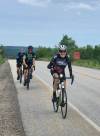
Advertisement Advertise With Us
Advertisement Advertise With Us
The Free Press acknowledges the financial support it receives from members of the city’s faith community, which makes our coverage of religion possible.