Sounding off
Arundhati Roy's weighty essay collection tackles India's caste system and more
Advertisement
Read this article for free:
or
Already have an account? Log in here »
To continue reading, please subscribe:
Digital Subscription
One year of digital access for only $1.44 a week*
- Enjoy unlimited reading on winnipegfreepress.com
- Read the E-Edition, our digital replica newspaper
- Access News Break, our award-winning app
- Play interactive puzzles
*Billed as $5.77 plus GST every four weeks. After 52 weeks, price increases to the regular rate of $19.95 plus GST every four weeks. Offer available to new and qualified returning subscribers only. Cancel any time.
To continue reading, please subscribe:
Add Free Press access to your Brandon Sun subscription for only an additional
$1 for the first 4 weeks*
- Enjoy unlimited reading on winnipegfreepress.com
- Read the E-Edition, our digital replica newspaper
- Access News Break, our award-winning app
- Play interactive puzzles
*Your next Brandon Sun subscription payment will increase by $1.00 and you will be charged $17.95 plus GST for four weeks. After four weeks, your payment will increase to $24.95 plus GST every four weeks.
Read unlimited articles for free today:
or
Already have an account? Log in here »
Hey there, time traveller!
This article was published 03/08/2019 (2635 days ago), so information in it may no longer be current.
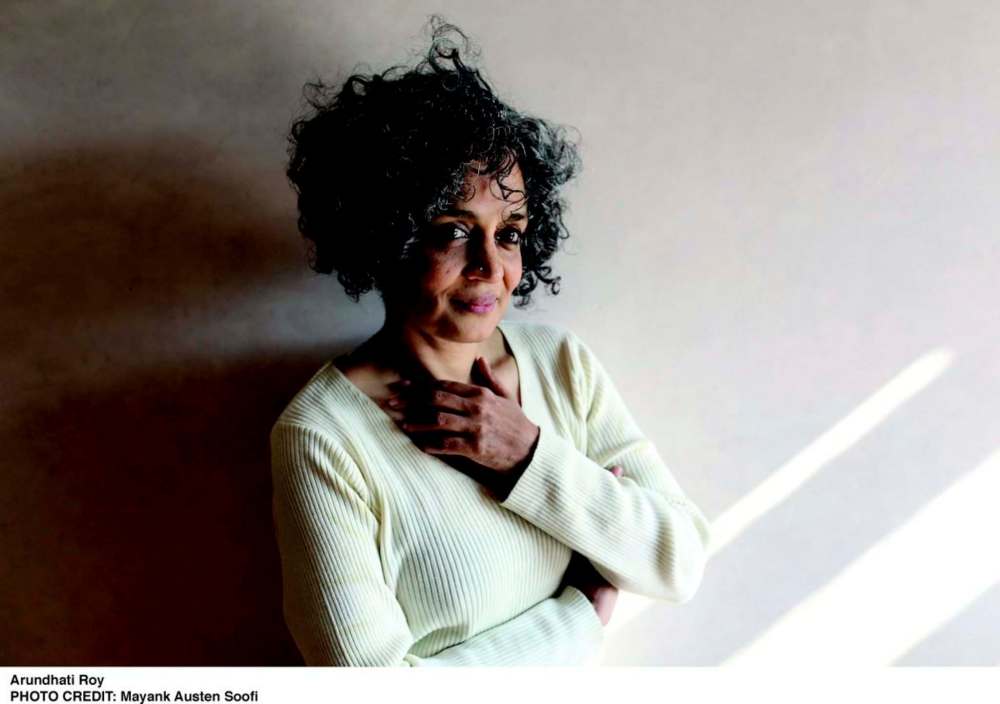
Since winning the Booker Prize in 1997 for her novel The God of Small Things, Arundhati Roy has devoted most of her time to writing articles for Outlook, the Guardian and occasionally the New York Times. Now all her essays and lectures from the period have been collected and published in this weighty tome.
And it is not just the length of this book that may weigh readers down — it is also Roy’s unrelenting criticism of India’s economic development and increasing nationalism, as well as everything the United States has ever done.
However, if you do persist, you may never look at the world in quite the same way again.
Her critique of American hegemony and all the spin leading up to the wars in Afghanistan and Iraq is mostly old news, but she is so thorough that readers are bound to learn something new and startling, and check her footnotes in disbelief.
Did you know, for example, that on the eve of the Iraq War in 2003, 42 per cent of Americans believed Saddam Hussein was responsible for 9/11? Or that American charities, including the Ford Foundation, sponsor a think tank called the Council on Foreign Relations that regularly produces World Bank presidents, as well as financial advisers to governments throughout the world? This may not be a conspiracy, as Roy seems to believe, but it is certainly relevant.
Those who persist will also learn a great deal about the negative side of India’s phenomenal economic growth in the past 20 years. With growth rates of seven to 10 per cent per year, the middle class of roughly 300 million is better off, but the 800 million at the bottom are still scrounging. The only country with a greater gap between rich and poor is Russia.
Roy is particularly interested in the displacement of India’s millions of tribal people and others whose lands are being taken over for the development of high dams and mining projects. She donated all of her Booker Prize money to a group resisting the building of high dams along the Narmada River, which flows through three Indian states. She writes a moving account of visiting a village in the process of destruction. People with land titles were being paid to dismantle their houses brick by brick. Those who lived in “improvised housing,” as so many of the poor do, would get nothing. And all were expected to start from scratch in an undeveloped space with no houses, utilities or jobs.
One of the best essays here, especially for foreign readers, is an introduction Roy wrote for a new edition of The Annihilation of Caste by B.R. Ambedkar. Ambedkar, himself an untouchable (Dalit), is one of India’s heroes. Starting from nothing, he managed to graduate in law and later draft the Indian Constitution.
Roy’s 100-page essay, The Doctor and the Saint, traces the historical debate on the caste system between Mahatma Gandhi and Ambedkar, as well as the importance of caste today. Ambedkar believed the caste should be abolished, while Gandhi preached that all castes were equal but should continue to do the jobs designated by their caste.
Although caste has not been recorded in census figures since 1931, Roy quotes estimates that high-caste Brahmins still hold most government jobs (70 per cent), and that 90 per cent of sweepers are Dalits — this, despite 70 years of affirmative action.
Hindu nationalism is another of Roy’s pressing concerns. She believes the rise of the ruling Bharatiya Janata Party (BJP), led by Narenda Modi, can be traced to the stirring up of anti-Muslim sentiment and the destruction of the Babri Majid (mosque) by a Hindu mob in 1991.
Modi spent his pre-political career working in a Hindu nationalist organization called the RSS, which Roy labels, with some pretty convincing evidence, fascist. She also skewers Modi for the 2002 massacre of 2,000 Muslims in Gujarat when he was chief minister there. Much has been written about that event, and while there is little doubt that Modi could have done more to prevent it, and that some high-profile BJP culprits got off much too lightly, Roy’s assertion that “Narenda Modi’s government planned and executed the Gujarat genocide” goes too far.
Indeed, Roy’s heart may be in the right place, but she does have her own spin. This book is well-named.
Faith Johnston spends time every year in India, rubbing shoulders with some of the 300 million whose incomes have improved in the past 20 years, and trying to decipher the news.