You really wouldn’t have wanted to know this couple

Advertisement
Read this article for free:
or
Already have an account? Log in here »
To continue reading, please subscribe:

Digital Subscription
One year of digital access for only $205*
- Enjoy unlimited reading on winnipegfreepress.com
- Read the E-Edition, our digital replica newspaper
- Access News Break, our award-winning app
- Play interactive puzzles
*First annual payment billed as $205.00 + GST for one year. This annual subscription will automatically renew at $233.00 + GST every 52 weeks (10% off the regular annual price of $259.35). Offer available to new and qualified returning subscribers only. Cancel any time.
To continue reading, please subscribe:
Add Free Press access to your Brandon Sun subscription for only an additional
$1 for the first 4 weeks*
- Enjoy unlimited reading on winnipegfreepress.com
- Read the E-Edition, our digital replica newspaper
- Access News Break, our award-winning app
- Play interactive puzzles
*Your next Brandon Sun subscription payment will increase by $1.00 and you will be charged $17.95 plus GST for four weeks. After four weeks, your payment will increase to $24.95 plus GST every four weeks.
Read unlimited articles for free today:
or
Already have an account? Log in here »
Hey there, time traveller!
This article was published 16/08/2009 (6243 days ago), so information in it may no longer be current.
A Day in the Life
One Family, the Beautiful People
& the End of the Sixties
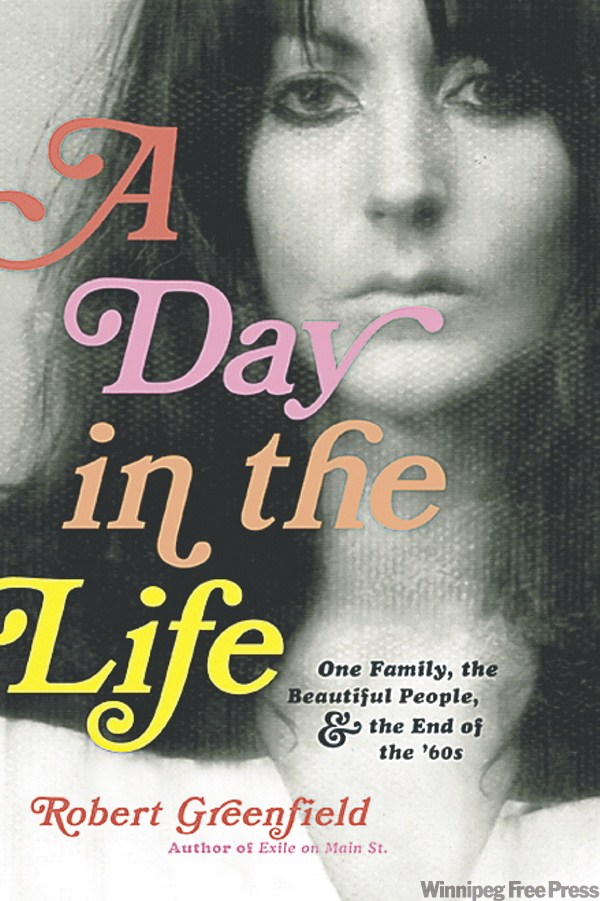
By Robert Greenfield
Da Capo Press, 338 pages, $29
IT’S no secret that Robert Greenfield relishes the SSRq60s. He’s written two books about the Rolling Stones, as well as biographies of the Grateful Dead’s Jerry Garcia and Timothy Leary.
In his latest non-fiction outing — a pointless slog that would be dreary were it not for all the salacious details — the former editor of Rolling Stone‘s London bureau uses the quasi-tragic story of Tommy Weber and his wife, Susan (Puss) Coriat, to illustrate the downside of his favourite decade — the loss of innocence as the Flower Power of the SSRq60s gave way to a horrible hangover.
With a charmed fairy-tale beginning and drug-fuelled descent into addiction, poverty and madness, the couple’s relationship does fit the bill quite nicely.
But why should we care about these specific people, two over-privileged types who squandered every advantage, engaged in stupid, self-destructive behaviour and subjected their sons to a lifestyle that would have them removed to custody by Child and Family Services today?
There’s no reason, really, other than the fact that Tommy and Puss are not dull normals. Puss was an heiress who romanced lords; Tommy lived with actress Charlotte Rampling, palled around with the Stones and Jimi Hendrix, and had a fling with Anita Pallenberg. (The couple’s oldest son, Jake Weber, went on to become an actor — he portrays Patricia Arquette’s husband on TV’s Medium.)
Beyond their fringe celebrity, there’s little compelling about the couple, except that their once-lofty status makes their fall seem more dramatic: Tommy a former "Debs’ Delight" who is a pathetic wreck by his death at 66; Puss a gorgeous society bird whose LSD use induces mental illness that leads to her suicide at 27.
Greenfield evidently met Tommy during the recording of Exile on Main Street at Villa Nellcotte in France and fell under his sway. There’s no other way to explain the way he seems at pains to paint Tommy as an insouciant charmer, a free spirit who, despite his many grave character flaws, is just too charismatic to resist.
In fact, Tommy comes across as an opportunistic slimeball who uses his looks and his upper-crust accent to get whatever he wants. One of the Stones’ staff recalls him as one of a coterie of sycophantic hangers-on, "a weasel."
This is a man whose reckless driving caused an accident that induced Puss’s early labour, a man who smuggled cocaine into France using his sons as mules, taping the drugs to their bodies.
Greenfield relates these anecdotes with a wink, as if to say, "Oh, what an irrepressible scamp."
The book is also sloppily written and edited: on one page, Greenfield quotes Timothy Leary; on the very next page, he refers to him again, but this time includes the introductory phrase "former Harvard psychology lecturer and acid guru."

He’s also prone to introducing minutiae that are entirely irrelevant to the narrative: the man has done his research, to be sure, but the way he makes the reader aware of it is intrusive.
We hardly need know that Tommy frequented "a wildly fashionable restaurant called the Bistro," let alone that the proprietor (who’s never mentioned again) worked as a courier for British military intelligence during the Second World War, smuggling messages in her vagina.
Despite all the detail Greenfield provides about their lives — the sadness, the schizophrenia, the scandals — Puss and Tommy remain ciphers, except for the vague sense that one would not have really wished to know them.
Jill Wilson is a Free Press copy editor.
Jill Wilson is the editor of the Arts & Life section. A born and bred Winnipegger, she graduated from the University of Winnipeg and worked at Stylus magazine, the Winnipeg Sun and Uptown before joining the Free Press in 2003. Read more about Jill.
Jill oversees the team that publishes news and analysis about art, entertainment and culture in Manitoba. It’s part of the Free Press‘s tradition, since 1872, of producing reliable independent journalism. Read more about Free Press’s history and mandate, and learn how our newsroom operates.
Our newsroom depends on a growing audience of readers to power our journalism. If you are not a paid reader, please consider becoming a subscriber.
Our newsroom depends on its audience of readers to power our journalism. Thank you for your support.
Jill Wilson is the editor of the Arts & Life section. A born and bred Winnipegger, she graduated from the University of Winnipeg and worked at Stylus magazine, the Winnipeg Sun and Uptown before joining the Free Press in 2003. Read more about Jill.
Jill oversees the team that publishes news and analysis about art, entertainment and culture in Manitoba. It’s part of the Free Press‘s tradition, since 1872, of producing reliable independent journalism. Read more about Free Press’s history and mandate, and learn how our newsroom operates.
Our newsroom depends on a growing audience of readers to power our journalism. If you are not a paid reader, please consider becoming a subscriber.
Our newsroom depends on its audience of readers to power our journalism. Thank you for your support.
Advertisement Advertise With Us
Advertisement Advertise With Us