Doc celebrates former Soviet leader

Advertisement
Read this article for free:
or
Already have an account? Log in here »
To continue reading, please subscribe:

Digital Subscription
One year of digital access for only $205*
- Enjoy unlimited reading on winnipegfreepress.com
- Read the E-Edition, our digital replica newspaper
- Access News Break, our award-winning app
- Play interactive puzzles
*First annual payment billed as $205.00 + GST for one year. This annual subscription will automatically renew at $233.00 + GST every 52 weeks (10% off the regular annual price of $259.35). Offer available to new and qualified returning subscribers only. Cancel any time.
To continue reading, please subscribe:
Add Free Press access to your Brandon Sun subscription for only an additional
$1 for the first 4 weeks*
- Enjoy unlimited reading on winnipegfreepress.com
- Read the E-Edition, our digital replica newspaper
- Access News Break, our award-winning app
- Play interactive puzzles
*Your next Brandon Sun subscription payment will increase by $1.00 and you will be charged $17.95 plus GST for four weeks. After four weeks, your payment will increase to $24.95 plus GST every four weeks.
Read unlimited articles for free today:
or
Already have an account? Log in here »
Hey there, time traveller!
This article was published 23/08/2019 (2566 days ago), so information in it may no longer be current.
This new documentary project from prolific German auteur Werner Herzog is mesmerizingly dull.
That sounds paradoxical, I know, but hear me out. Meeting Gorbachev’s unhurried pace and granular detail probably won’t appeal to a general audience, but for hardcore Herzog fans and political junkies, this doc will exert a steady gravitational pull.
Herzog can be uneven, but he’s never just average. Here we see his strengths as a filmmaker: intense curiosity, deadpan delivery and a few sudden flashes of sublime Herzogian weirdness.
By looking at one man, the last leader of the former Soviet Union, Herzog crafts a world-historical examination of the second half of the 20th century, tracking, among other things, the trajectory of the Cold War, the rise of perestroika and glasnost, the push for denuclearization and the ultimate breakup of the Soviet Union.
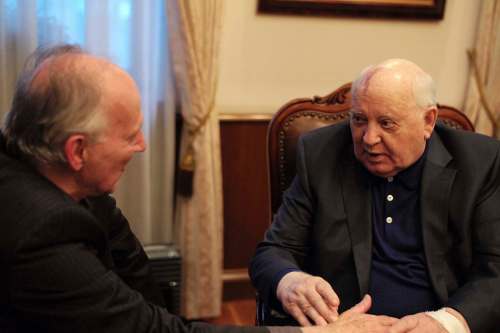
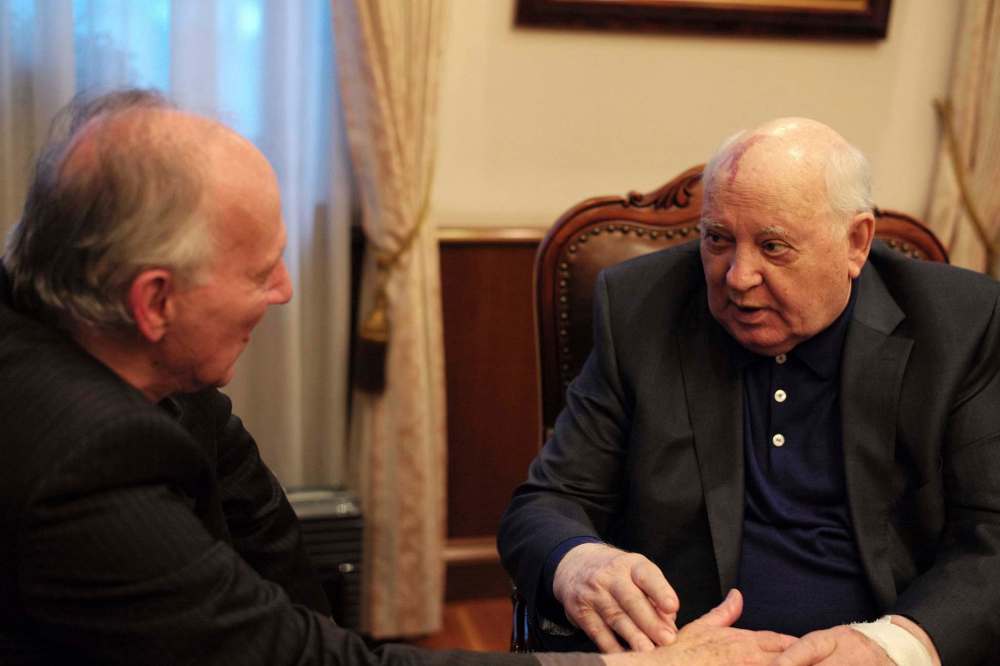
The film centres on three long conversations between Herzog and the then-87-year-old Mikhail Gorbachev, conducted over the course of six months, as well as archival material given new life with Herzog’s distinctive voice-over narrative.
Meeting Gorbachev is resolutely subjective. Herzog is upfront about his socio-political crush on the former Soviet leader, and in fact, kicks off the film by presenting him with a birthday present of diabetic-friendly chocolate. The chocolate “G” has fallen off, but never mind.
Herzog sees a bond between himself and Gorbachev.
Both men have been shaped by the Second World War, the Russian marked by its devastating losses and the German by the burden of the Nazi past. For Herzog, the reunification of Germany is one of Gorbachev’s central achievements.
The only moment of tension comes when Herzog brings up the issue of Chernobyl, the 1986 nuclear disaster facing renewed scrutiny after the recent HBO series.
The usually frank, measured Gorbachev becomes evasive, and Herzog doesn’t press.
The rest of the doc unabashedly celebrates Gorbachev’s leadership abilities: his humility, his sincerity and his belief in co-operation rather than dominance.
He came to power when Soviet citizens faced endless lineups for shops that had almost nothing on their shelves.
Relatively young, outward-looking and open to change, he confronted a Soviet system that had become corrupt and moribund.
“More democracy, that was first and foremost our goal,” Gorbachev says. “I also wanted more socialism.”
Herzog is not advancing a Great Man theory of history, instead suggesting the ways one remarkable individual found a way to respond to massive social forces.
This is a serious film, but there are flashes of comedy, as with Herzog’s interest in oddball tidbits. At one point, he underlines what he sees as western European indifference by giving a deadpan description of an Austrian news broadcast’s piece on garden slugs, which was given top billing over momentous changes in the Soviet Union.

With the archival material, as well, there are scenes that could have come straight out of the bitter farce The Death of Stalin, including footage of Konstantin Chernenko, the Soviet leader who spent his tenure battling terminal cancer. Chernenko’s physical frailty meant that, at one point, his hospital room was disguised as a polling station. At other times, aides had to invisibly prop him up for photo ops.
There are glimpses of Gorbachev’s personal life, including his love for his wife, Raisa, and his connections to his peasant roots.
In the end, Herzog — who has dealt with doomed idealists throughout his film career, from Fitzcarraldo to the Grizzly Man — sees Gorbachev as a tragic figure, whose hopes for a better world lead to some unforeseen consequences.
Largely left unspoken is what has come since the end of Soviet communist rule. Though Russian President Vladimir Putin is mentioned only once and U.S. President Donald Trump not at all, this whole film comes off as a subtle but savage critique of those two men.
alison.gillmor@freepress.mb.ca
Studying at the University of Winnipeg and later Toronto’s York University, Alison Gillmor planned to become an art historian. She ended up catching the journalism bug when she started as visual arts reviewer at the Winnipeg Free Press in 1992.
Our newsroom depends on a growing audience of readers to power our journalism. If you are not a paid reader, please consider becoming a subscriber.
Our newsroom depends on its audience of readers to power our journalism. Thank you for your support.
Movie Review
Meeting Gorbachev
- Starring Mikhail Gorbachev, Werner Herzog
- Cinematheque
- 90 minutes
★★★1/2 out of five
Studying at the University of Winnipeg and later Toronto’s York University, Alison Gillmor planned to become an art historian. She ended up catching the journalism bug when she started as visual arts reviewer at the Winnipeg Free Press in 1992.
Our newsroom depends on a growing audience of readers to power our journalism. If you are not a paid reader, please consider becoming a subscriber.
Our newsroom depends on its audience of readers to power our journalism. Thank you for your support.
Advertisement Advertise With Us
Advertisement Advertise With Us