

Med students try to boost diversity in health field
Symposium attracts minorities interested in careers in medicine

Advertisement
Read this article for free:
or
Already have an account? Log in here »
To continue reading, please subscribe:
Monthly Digital Subscription
$1 per week for 24 weeks*
- Enjoy unlimited reading on winnipegfreepress.com
- Read the E-Edition, our digital replica newspaper
- Access News Break, our award-winning app
- Play interactive puzzles
*Billed as $4.00 plus GST every four weeks. After 24 weeks, price increases to the regular rate of $19.95 plus GST every four weeks. Offer available to new and qualified returning subscribers only. Cancel any time.
Monthly Digital Subscription
$4.99/week*
- Enjoy unlimited reading on winnipegfreepress.com
- Read the E-Edition, our digital replica newspaper
- Access News Break, our award-winning app
- Play interactive puzzles
*Billed as $19.95 plus GST every four weeks. Cancel any time.
To continue reading, please subscribe:
Add Free Press access to your Brandon Sun subscription for only an additional
$1 for the first 4 weeks*
*Your next subscription payment will increase by $1.00 and you will be charged $16.99 plus GST for four weeks. After four weeks, your payment will increase to $23.99 plus GST every four weeks.
Read unlimited articles for free today:
or
Already have an account? Log in here »
Hey there, time traveller!
This article was published 07/09/2019 (2411 days ago), so information in it may no longer be current.
Barriers must be broken to encourage more diversity among Manitoba’s future doctors, black medical students say, and now they’re doing what they can to help other young people learn more about medicine.
More than 100 Manitoba youth, who have an interest in health care, have signed on to be part of the province’s first Black Health Symposium on Sunday. After hearing keynote speeches from prominent black and Indigenous health-care professionals and politicians, Helen Teklemariam, a fourth-year student at the University of Manitoba’s Max Rady College of Medicine, hopes youth may be more informed and inspired to apply for medical school.
Teklemariam is one of about 12 black medical students at U of M. She and three other fourth-year students formed the Black Medical Students Association and decided to organize a public symposium after seeing that so few local doctors — practising and prospective — looked like them.
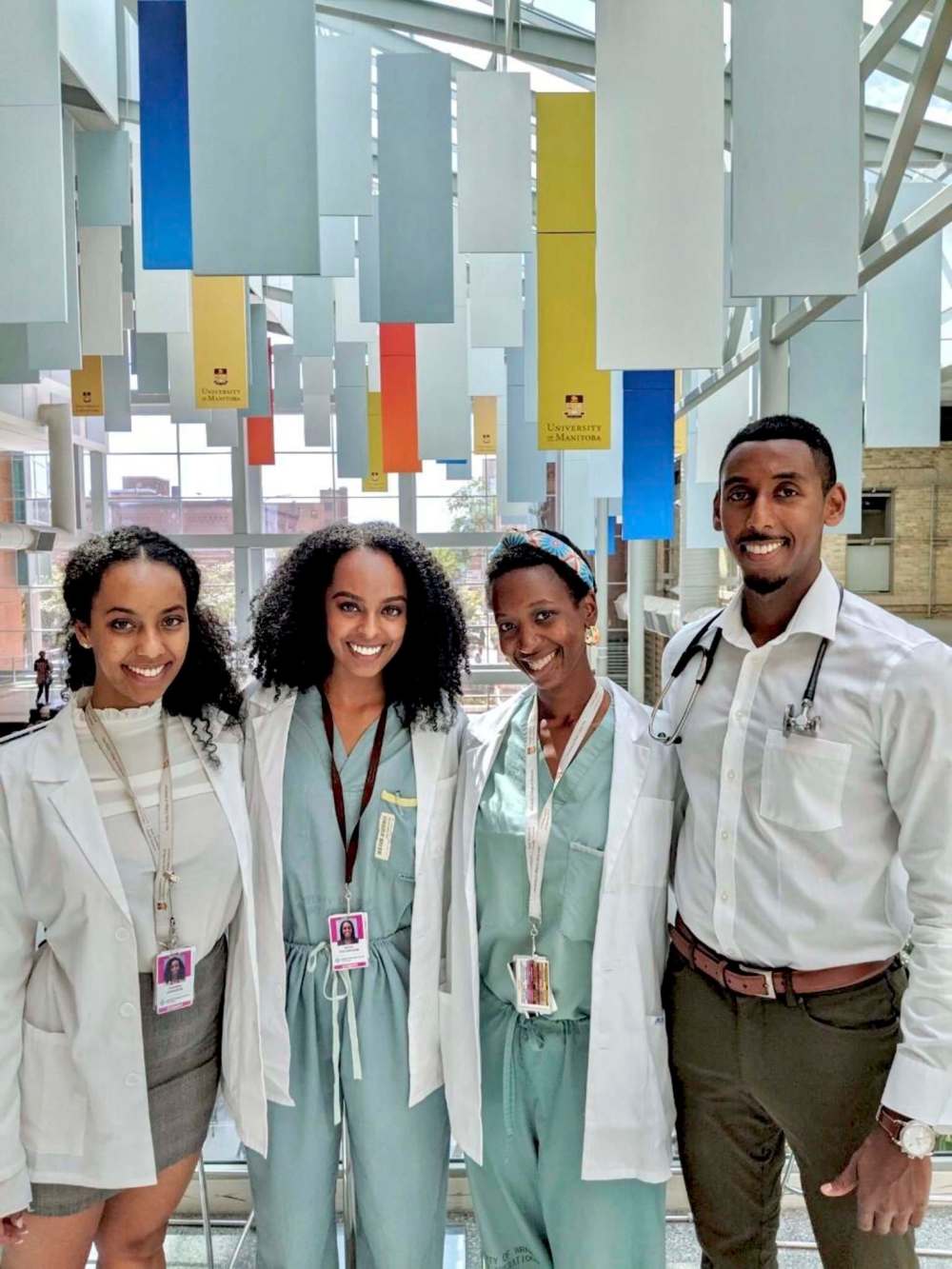
“We realized that there has been a lack of representation in Manitoba in terms of the health-care field in the black community, and we know from research that increased representation actually leads to better outcomes for patient care,” Teklemariam said. They were encouraged that 123 attendees (youth between 15-25) had registered as of Friday afternoon.
“The desire to enter the health-care field is clearly there in the black youth population. We realize now that the interest is there, but there is a bit of a disconnect between becoming interested in the field and actually being admitted into the field, and we’re hoping to bridge some of those gaps that exist,” she said.
Many of the barriers that exist for minorities who want to apply to medical school may seem invisible to those who grew up with parents who also went to post-secondary school or had the means to do so. The event, to be held at U of M’s Bannatyne campus Sunday, aims to answer prospective students’ questions.

Greater representation is good for patient care and for the medical system as a whole, said Dr. Biniam Kidane, a Winnipeg thoracic surgeon who was a refugee from Eritrea.
“There are a lot of cultural aspects to interpreting symptoms and delivering care, and getting people to engage in their own health care, that is hard to do if you don’t have access to a specific cultural background,” said Kidane, who is one of the keynote speakers.
“It’s just about trying to increase representation by actually bringing it to the youth, by showing them that the health-care system can be responsive to your needs, but you need to participate in it, and you can participate in it.”
katie.may@freepress.mb.ca
Twitter: @thatkatiemay
Katie May is a multimedia producer for the Free Press.
Our newsroom depends on a growing audience of readers to power our journalism. If you are not a paid reader, please consider becoming a subscriber.
Our newsroom depends on its audience of readers to power our journalism. Thank you for your support.
Katie May is a multimedia producer for the Free Press.
Our newsroom depends on a growing audience of readers to power our journalism. If you are not a paid reader, please consider becoming a subscriber.
Our newsroom depends on its audience of readers to power our journalism. Thank you for your support.
Advertisement Advertise With Us
Advertisement Advertise With Us