2020 Mazda3: suspending disbelief
Popular model shows improved handling on rough and smooth terrain

Advertisement
Read this article for free:
or
Already have an account? Log in here »
To continue reading, please subscribe:

Digital Subscription
One year of digital access for only $205*
- Enjoy unlimited reading on winnipegfreepress.com
- Read the E-Edition, our digital replica newspaper
- Access News Break, our award-winning app
- Play interactive puzzles
*First annual payment billed as $205.00 + GST for one year. This annual subscription will automatically renew at $233.00 + GST every 52 weeks (10% off the regular annual price of $259.35). Offer available to new and qualified returning subscribers only. Cancel any time.
To continue reading, please subscribe:
Add Free Press access to your Brandon Sun subscription for only an additional
$1 for the first 4 weeks*
- Enjoy unlimited reading on winnipegfreepress.com
- Read the E-Edition, our digital replica newspaper
- Access News Break, our award-winning app
- Play interactive puzzles
*Your next Brandon Sun subscription payment will increase by $1.00 and you will be charged $17.95 plus GST for four weeks. After four weeks, your payment will increase to $24.95 plus GST every four weeks.
Read unlimited articles for free today:
or
Already have an account? Log in here »
Hey there, time traveller!
This article was published 27/09/2019 (2514 days ago), so information in it may no longer be current.
One of the realities of automotive public relations is hosting an event where the manager of vehicle dynamics speaks eloquently to journalists about how the new suspension allows for stiffer springs without sacrificing ride quality, and then everybody jumps into the cars and drives them on nearly perfect roads.
That was our experience earlier this year in Sacramento, Calif., where Mazda hosted an event to show off the new Mazda3. The roads were outstanding: curvy, hilly and almost silken in their smoothness. Not a frost heave or pothole in sight.
We got to experience how well the new Mazda3 handles, and how the seemingly incongruous decision to abandon an independent rear suspension in favour of a torsion beam actually offers a surprising improvement in handling over the previous generation. Can’t say we noticed the cleaned-up inputs, however.
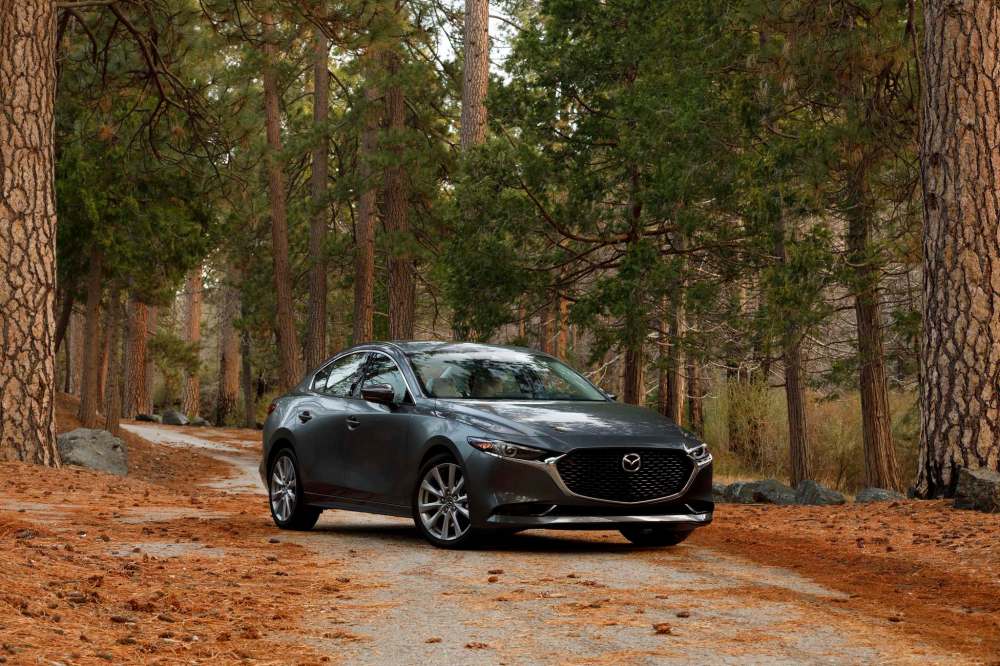
So when Mazda Canada popped two models — a sedan and a hatchback — into the press fleet and sent them to Manitoba, it was interesting to drive them on Winnipeg’s roads, which are far from optimal.
On Thomas Avenue in Elmwood, there are unpatched gouges almost every eight feet. Gouges that are patched were done poorly. Given its poor condition, it’s an excellent road. For testing suspensions, that is.
You do feel every little crevice, every little ravine. Considering Thomas Avenue is the location of the city’s East Yards, it’s ironic this road in particular is so bad. But what sets the Mazda3 apart, even with significantly stiffer springs, is how normal the ride is. It’s not the least bit harsh the way most stiffly sprung cars can be.
Dave Coleman, the manager of vehicle dynamics mentioned earlier, said Mazda spent considerable time studying the effect of bumps on vehicle occupants and found that on the previous Mazda3, hitting a bump not only caused occupants’ heads to rise, a slight deceleration on impact also caused them to move forward.
Engineers traced this to two bushings on the front suspension control arm: a softer lower bushing and a cylindrical upper bushing were transmitting deceleration forces to the cabin instead of absorbing them. Putting a stiffer bushing down low and a ball-joint style bushing up top means these deceleration forces are absorbed without adding upward force to the chassis.
“It can flex, but it can’t move up,” Coleman said.
“As we get these inputs cleaner and cleaner, we can make the suspension tuning stiffer and stiffer and still be comfortable.”
How they managed to get a torsion beam at the rear to work as well as or better than an independent is as surprising as the decision to go with a torsion beam in the first place: by reducing the number of bushings.
Reducing the number of bushings made the movement of the torsion beam more predictable and reduced the extent to which the rear wheels steer in reaction to movement in the suspension, something engineers call “compliance steering.” Mazda experimented with this concept deliberately in versions of the RX-7 sports car to provide a passive rear-steering system, but generally, having the rear wheels change direction in response to flexing in the suspension isn’t desirable.

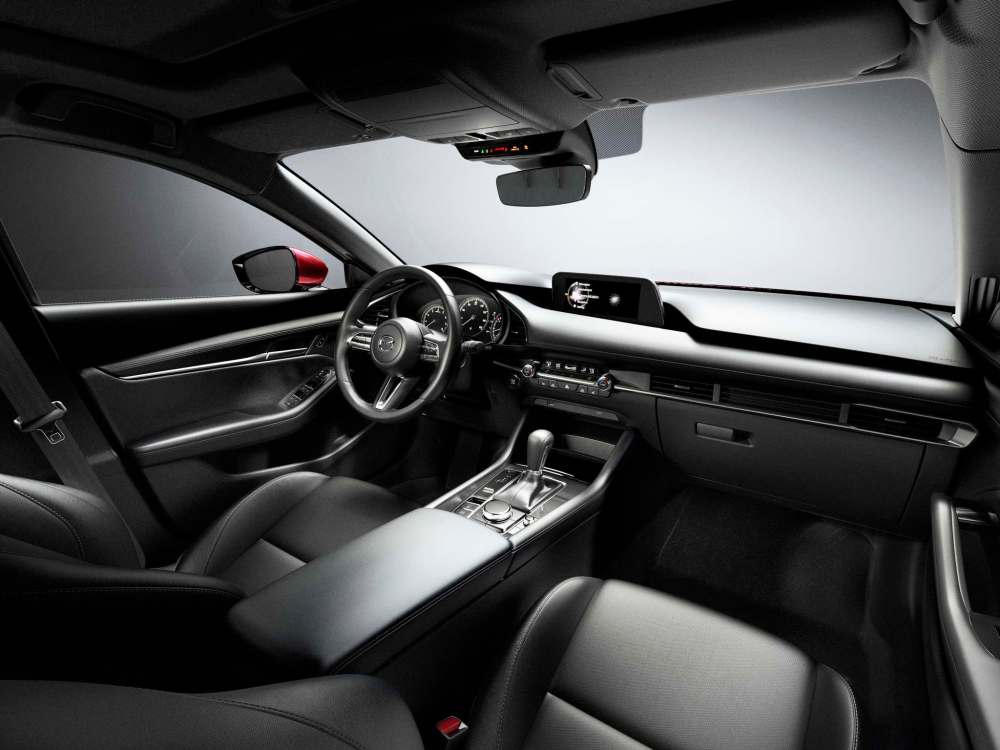
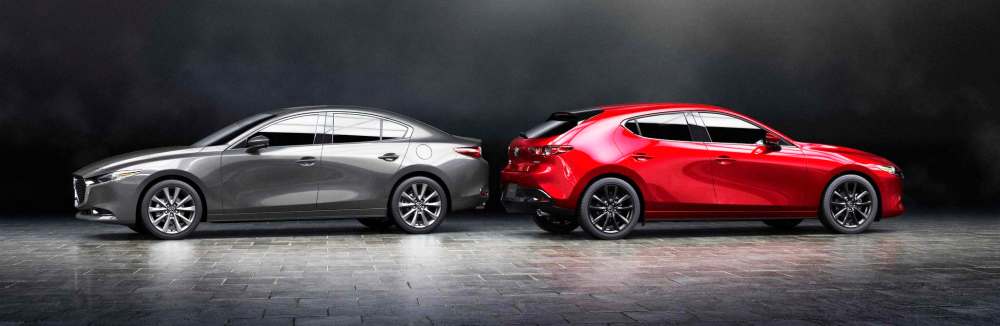
Mazda, as has been its practice, rolled out two versions of the new Mazda3: a sedan, and a Sport or five-door. Typically, this means the really cool-looking one is the five-door while the sedan comes out looking frumpy. Not so here: the sedan may actually be prettier. On the Mazda3 Sport, one design feature could be a bit polarizing, and it’s how the rear fenders flare out. The sedan has no such feature: indeed, very few body pieces are shared between the two cars.
The sedan loses a bit of practicality, with a trunk lid where there’s still cargo space in the five-door. It’s not that much, however: sure, it means you can’t haul items quite as big, but in terms of smaller items that you shouldn’t leave unrestrained above the level of the rear seatbacks, not so much. It gains a bit of quiet, however, with the seatback and rear-window shelf providing a sort of seal between the cargo bay and passenger cabin.
Mazda makes available both styles of transmissions, and while I’d never pass up the chance to drive stick, Mazda’s work on developing its automatic means it’s fun to drive as well. The secret here, since Mazda doesn’t believe in eight, nine or even 10-speed transmissions, is in the engine, actually. Managing the torque curve has been key to achieving good fuel economy with six speeds and no engine start/stop feature.
All-wheel drive is available on both body styles, but the stick is just available in front-wheel drive. To get a stick in a higher trim level, you have to go to the Sport, where a six-speed manual is available on all trim levels.
kelly.taylor@freepress.mb.ca
Kelly Taylor
Copy Editor, Autos Reporter
Kelly Taylor is a copy editor and award-winning automotive journalist, and he writes the Free Press‘s Business Weekly newsletter. Kelly got his start in journalism in 1988 at the Winnipeg Sun, straight out of the creative communications program at RRC Polytech (then Red River Community College). A detour to the Brandon Sun for eight months led to the Winnipeg Free Press in 1989. Read more about Kelly.
Every piece of reporting Kelly produces is reviewed by an editing team before it is posted online or published in print — part of the Free Press‘s tradition, since 1872, of producing reliable independent journalism. Read more about Free Press’s history and mandate, and learn how our newsroom operates.
Our newsroom depends on a growing audience of readers to power our journalism. If you are not a paid reader, please consider becoming a subscriber.
Our newsroom depends on its audience of readers to power our journalism. Thank you for your support.
The specs
Engine: 2.0-litre Skyactiv-G; 2.5-litre Skyactiv-G (opt.)
Power: 155 hp @ 6,000 r.p.m. (2.0); 186 hp @ 6,000 r.p.m. (2.5)
Torque: 150 lb.-ft. @ 4,000 r.p.m. (2.0); 186 lb.-ft. @ 4,000 r.p.m. (2.5)
Layout: front-engine, front- or all-wheel drive
Transmission: six-speed manual, six-speed automatic (opt.)
Suspension: Macpherson strut with stabilizer bar (front); torsion beam (rear)
Brakes: four-wheel discs
Fuel economy (l/100 km, city/highway): 8.7/6.4 (2.0, 6MT); 8.4/6.6 (2.0, 6AT); 8.8/6.4 (2.5, FWD, 6AT); 8.8/6.6 (2.5 with cylinder deactivation, FWD, 6AT); 9.2/7.0 (2.5 with cylinder deactivation, AWD).
Price: $18,000, base MSRP, to $30,400, base MSRP (sedan), $21,300, base MSRP to $31,500, base MSRP (Sport)
Kelly Taylor
Copy Editor, Autos Reporter
Kelly Taylor is a copy editor and award-winning automotive journalist, and he writes the Free Press‘s Business Weekly newsletter. Kelly got his start in journalism in 1988 at the Winnipeg Sun, straight out of the creative communications program at RRC Polytech (then Red River Community College). A detour to the Brandon Sun for eight months led to the Winnipeg Free Press in 1989. Read more about Kelly.
Every piece of reporting Kelly produces is reviewed by an editing team before it is posted online or published in print — part of the Free Press‘s tradition, since 1872, of producing reliable independent journalism. Read more about Free Press’s history and mandate, and learn how our newsroom operates.
Our newsroom depends on a growing audience of readers to power our journalism. If you are not a paid reader, please consider becoming a subscriber.
Our newsroom depends on its audience of readers to power our journalism. Thank you for your support.
Related Articles
2020 Mazda3 is beautiful inside and out
Advertisement Advertise With Us
Advertisement Advertise With Us