

Sobeys testing ‘smart’ shopping carts in Ontario

Advertisement
Read this article for free:
or
Already have an account? Log in here »
To continue reading, please subscribe:
Digital Subscription
One year of digital access for only $75*
- Enjoy unlimited reading on winnipegfreepress.com
- Read the E-Edition, our digital replica newspaper
- Access News Break, our award-winning app
- Play interactive puzzles
*Billed as $5.77 plus GST every four weeks. After 52 weeks, price increases to the regular rate of $19.95 plus GST every four weeks. Offer available to new and qualified returning subscribers only. Cancel any time.
Monthly Digital Subscription
$4.99/week*
- Enjoy unlimited reading on winnipegfreepress.com
- Read the E-Edition, our digital replica newspaper
- Access News Break, our award-winning app
- Play interactive puzzles
*Billed as $19.95 plus GST every four weeks. Cancel any time.
To continue reading, please subscribe:
Add Free Press access to your Brandon Sun subscription for only an additional
$1 for the first 4 weeks*
- Enjoy unlimited reading on winnipegfreepress.com
- Read the E-Edition, our digital replica newspaper
- Access News Break, our award-winning app
- Play interactive puzzles
*Your next Brandon Sun subscription payment will increase by $1.00 and you will be charged $17.95 plus GST for four weeks. After four weeks, your payment will increase to $24.95 plus GST every four weeks.
Read unlimited articles for free today:
or
Already have an account? Log in here »
Hey there, time traveller!
This article was published 24/10/2019 (2399 days ago), so information in it may no longer be current.
A Sobeys store in Oakville, Ont., is being used as the testing ground for an AI-powered “smart” shopping cart that essentially does the work of a cashier as customers stroll the aisles.
The cart–developed by Brooklyn-based tech firm Caper–is equipped with technology that both scans and weighs products as shoppers drop them in, displaying the items and their prices on a mounted screen. Customers can also pay for their haul with a built-in card reader, or through Apple Pay, and receive digital receipts: the customer becomes their own mobile cashier.
While Caper’s cart has already been used in several American grocery stores, the location in Oakville is the first Canadian retailer to deploy the technology, says Mathieu Lacoursiere, Sobeys’ vice-president of retail support. To start, 10 smart carts will be in the store.
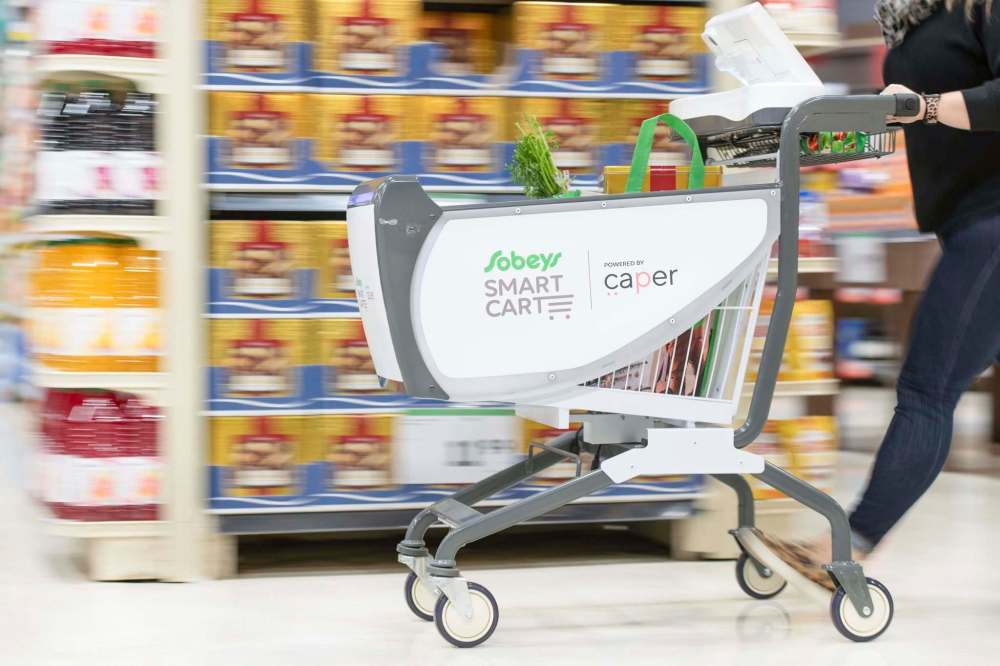
Lacoursiere said the pilot is a part of his company’s efforts to eliminate “friction points” in the grocery-shopping experience. Taking items off the shelves, putting them in the cart, removing them at the register, and putting them into bags were a few of those points, he said.
“Everything can be done from the cart,” he said.
“If you walked into a grocery store 100 years ago versus today, nothing has really changed,” Caper co-founder and CEO Lindon Gao told TechCrunch in January. “It doesn’t make sense that you can order a cab with your phone or go book a hotel with your phone, but you can’t use your phone to make a payment and leave the store. You still have to stand in line.”
Bruce Winder, a Toronto-based retail expert and consultant, who is currently writing a book on retail innovation, says that the move by Sobeys to embrace AI and machine learning is a part of an industry-wide trend to get an edge on competitors through technology. Amazon, the e-tail giant, is at the forefront, with its cashless store system.
“Everyone in groceries knows they have to come up with their own version,” he said.
Winder said that a few United Kingdom companies, as well as North American ones, such as Kroger and Walmart, have experimented with smart carts, but its too early yet to say whether the idea will thrive or fizzle. “The jury is out, and we aren’t even sure how many people would want to use them,” he said. “The technology is not cheap.”
It’s too expensive for small grocers to even consider as they fight to stay successful. But for Sobeys–which enjoyed a fiscal revenue of $24.2 billion across its 1,500 stores in 2018–that barrier doesn’t seem to be a problem. Lacoursiere wouldn’t say how much each cart cost, and Caper could not be reached for comment. “We look at this from an investment perspective,” Lacoursiere said. “It’s a check-out on wheels,” he added.
But the carts aren’t without some risk. Carts are already a consistently stolen or damaged item, and the smart ones have more expensive tech to repair. Lacoursiere said that risk has been considered, and there are security options–like tracking and wheel-locking technology–that will be assessed as the pilot goes on.

Winder said much of the reasoning for the shift to automated technology in the retail space is meant to cut labour costs, while also increasing speed.
“It’s really not about eliminating jobs,” Lacoursiere said. “Our focus is really on customer experience,” he added.
For the first week of the pilot, staff will actually be the ones pushing the carts around stores as they get familiarized with the technology. In three weeks, Lacoursiere said, customers will be using them, and the staff will be knowledgable.
For now, the company has no solid plans to roll out the technology in other stores–including Safeway, IGA and FreshCo locations–but is not ruling it out.
ben.waldman@freepress.mb.ca
Ben Waldman is a National Newspaper Award-nominated reporter on the Arts & Life desk at the Free Press. Born and raised in Winnipeg, Ben completed three internships with the Free Press while earning his degree at Ryerson University’s (now Toronto Metropolitan University’s) School of Journalism before joining the newsroom full-time in 2019. Read more about Ben.
Every piece of reporting Ben produces is reviewed by an editing team before it is posted online or published in print — part of the Free Press‘s tradition, since 1872, of producing reliable independent journalism. Read more about Free Press’s history and mandate, and learn how our newsroom operates.
Our newsroom depends on a growing audience of readers to power our journalism. If you are not a paid reader, please consider becoming a subscriber.
Our newsroom depends on its audience of readers to power our journalism. Thank you for your support.
Ben Waldman is a National Newspaper Award-nominated reporter on the Arts & Life desk at the Free Press. Born and raised in Winnipeg, Ben completed three internships with the Free Press while earning his degree at Ryerson University’s (now Toronto Metropolitan University’s) School of Journalism before joining the newsroom full-time in 2019. Read more about Ben.
Every piece of reporting Ben produces is reviewed by an editing team before it is posted online or published in print — part of the Free Press‘s tradition, since 1872, of producing reliable independent journalism. Read more about Free Press’s history and mandate, and learn how our newsroom operates.
Our newsroom depends on a growing audience of readers to power our journalism. If you are not a paid reader, please consider becoming a subscriber.
Our newsroom depends on its audience of readers to power our journalism. Thank you for your support.
Advertisement Advertise With Us
Advertisement Advertise With Us