‘Meditation in motion’
Tai chi boasts myriad health benefits

Advertisement
Read this article for free:
or
Already have an account? Log in here »
To continue reading, please subscribe:
Digital Subscription
One year of digital access for only $1.44 a week*
- Enjoy unlimited reading on winnipegfreepress.com
- Read the E-Edition, our digital replica newspaper
- Access News Break, our award-winning app
- Play interactive puzzles
*Billed as $5.77 plus GST every four weeks. After 52 weeks, price increases to the regular rate of $19.95 plus GST every four weeks. Offer available to new and qualified returning subscribers only. Cancel any time.
To continue reading, please subscribe:
Add Free Press access to your Brandon Sun subscription for only an additional
$1 for the first 4 weeks*
- Enjoy unlimited reading on winnipegfreepress.com
- Read the E-Edition, our digital replica newspaper
- Access News Break, our award-winning app
- Play interactive puzzles
*Your next Brandon Sun subscription payment will increase by $1.00 and you will be charged $17.95 plus GST for four weeks. After four weeks, your payment will increase to $24.95 plus GST every four weeks.
Read unlimited articles for free today:
or
Already have an account? Log in here »
Hey there, time traveller!
This article was published 28/10/2019 (2554 days ago), so information in it may no longer be current.
Martial arts for your insides.
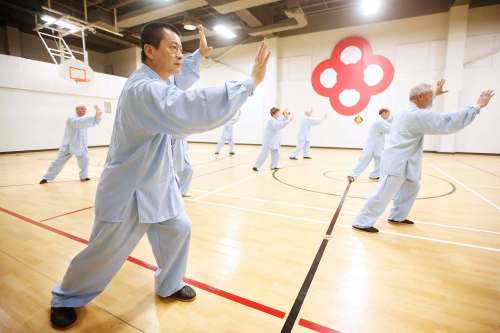
That’s how Master Shao Lei describes tai chi. The local legend is a firm believer in tai chi’s wide range of health benefits.
Often described as meditation in motion, tai chi is a martial art that has been practised in China for centuries. It consists of a series of several gentle movements that strengthen the body and calm the mind. The more formal name is T’ai Chi Ch’üan, which translates loosely to “supreme ultimate boxing.”

Tai chi requires you to gradually move from one pose to another, shifting your weight and extending your limbs to challenge your balance. It combines aspects of martial arts, philosophy and ancient Chinese medicine.
There are five main styles of tai chi: Chen, Yang, Wu, Sun and Hao. All five share similarities such as flexibility, mindfulness and structural alignment, but each has its own unique characteristics — some focus on health maintenance, while others focus on martial arts. If you’re a beginner looking for a style that’s easy to adopt, Yang and Wu styles are easier to learn than the others.
Lei, a fifth-generation lineage holder of Wu Style Taiji quan, began learning Chinese martial arts when he was nine years old. He immigrated to Winnipeg with his family in 2003 and has been perfecting his craft for more than 35 years. You can find him today teaching weekly classes at the Winnipeg Chinese Cultural and Community Centre.
“Tai chi is not only physical movements, it’s also the point of view of Chinese people towards the universe,” says Lei through his Mandarin translator and longtime student, Boon Su. “Tai chi teaches people how to change their thinking. For instance, when we stand up, we use the strength of our legs to push ourselves up. With tai chi, it’s a different way of thinking. To stand up, you have to relax and use your head to pull yourself up.”
If you’re someone who likes to pound the pavement training for a race or tackle high-intensity workouts, slowing down and reconnecting through tai chi may be a welcome addition to your routine.
Compared with conventional aerobic exercises that focus on muscular strength and endurance, tai chi involves mind-body learning through slow, voluntary movements, full-body stretching and relaxation, diaphragmatic breathing practice, a meditative state of mind and mental concentration.

The majority of people who practise tai chi are seniors, as they tend to lose flexibility and balance as they get older.
You learn to react to things in a very different way than you would in Western culture, says Keith Benson, a retired teacher who has been studying tai chi for more than 30 years and practising with Lei for a decade.
“Rather than tense up under stress, we learn to relax and use that relaxation to repel bad feelings,” Benson says. “If someone presses you, our normal reaction is to become tense. With tai chi, the reaction is to relax and allow that person’s strength to work against him or her.”
The health benefits of tai chi are numerous — so great that many hospitals hold classes for their patients. A 2012 study published in Disability and Health Journal found that tai chi was more effective than traditional physiotherapy at preventing falls among elderly hospital patients who had already sustained injuries from a fall.
Doctors and researchers in both China and the Western world have documented many health benefits from tai chi, including improvements in balance, flexibility, stamina, blood pressure and mental health.

“When people first come to learn tai chi, it’s because they’ve heard how good it is for your health and they want to learn because of health issues,” says Lei. “And then after a while and throughout the class teaching, their interest increases.”
Benson, who played hockey and squash when he was younger, suffered from chronic pain in his back and knees for years. He needed a more gentle activity that wouldn’t hurt his joints and read about tai chi in a City of Winnipeg leisure guide. He credits the slow, gentle movements with his improved posture and overall well-being. Now, three decades later, he feels like he’s in the best shape of his life.
“I was told when I was in my 30s that I would probably need knee surgery by the time I was 40. Here I am at 70 years old and I’ve never had any type of surgery and my knees don’t hurt,” says Benson. “And I can touch my toes. I could never do that before, not even as a teenager.”
For some, it’s the meditative quality of tai chi that makes it so compelling. You get all the benefits of meditation — focus, mental clarity, positive thinking and decreased stress — and at the same time, physical exercise.
“Having to remember the sequence of movements takes your mind off of everything you bring home from work. The movements are slow and the goal is to be very calm,” Benson says. “You develop strength and flexibility and you’re turning all the time so your spine is relaxed.”

And for those who want to practise meditation but struggle with sitting still and focusing on their breathing, tai chi may be more suitable, as attention is directed to your body and hand movements.
With the meditative movements come deep breathing and the conscious use of your diaphragm. When your body inhales deeply and exhales slowly, you activate your body’s parasympathetic nervous system, which signals to the brain that you are safe and can let your guard down.
“The difference between tai chi and other exercises is that with other exercises, you want to increase your heart rate and breathing so you move really fast,” says Lei. “You don’t get deep-breathing benefits. Deep breathing from your diaphragm is like a massage for your organs.”
According to the 2016 Journal of the College of Family Physicians of Canada, systematic reviews of tai chi for specific conditions showed benefits for preventing falls, osteoarthritis, Parkinson’s disease and improving cognitive capacity in older adults. There was also evidence that tai chi benefited mental health, cardiac and stroke rehabilitation, as well as dementia.
Mike and Shelagh Ralph have been doing tai chi for 35 years. The married couple incorporates the practice into their busy lifestyle, which includes walking daily and taking ballroom dancing classes.
Mike, an 84-year-old retired Manitoba Hydro worker, has had both hips replaced and says tai chi is not only good for his mobility, but it also helps clear his mind.

“All the moves mean something,” he says. “If you’ve got a lot on your mind when you come here, you forget about it once you start class.”
Shelagh, 77, says the class has taught her to be calm and practise her breathing.

“If you’re having a bad day, you just come here and relax because everyone is so quiet,” she says. “It also helps your legs with stretching and it’s good for your breathing.”
If you’re not ready or able to tackle strength training with weights, tai chi is a way to increase your stamina and help build muscle strength. The power of tai chi comes from muscular relaxation and not necessarily muscular effort. When the body is properly aligned and relaxed, you can generate quite a bit of power with seemingly little effort.
Though the movements are gentle, Lei says, the practice is impactful.

“While tai chi does not require muscle strength, the effect is very strong and powerful.”
People interested in learning more about tai chi classes at the Winnipeg Chinese Cultural and Community Centre, click here.
Sabrina Carnevale is a freelance writer and communications specialist, and former reporter and broadcaster who is a health enthusiast. She writes a twice-monthly column focusing on wellness and fitness.
Our newsroom depends on a growing audience of readers to power our journalism. If you are not a paid reader, please consider becoming a subscriber.
Our newsroom depends on its audience of readers to power our journalism. Thank you for your support.
Sabrina Carnevale is a freelance writer and communications specialist, and former reporter and broadcaster who is a health enthusiast. She writes a twice-monthly column focusing on wellness and fitness.
Our newsroom depends on a growing audience of readers to power our journalism. If you are not a paid reader, please consider becoming a subscriber.
Our newsroom depends on its audience of readers to power our journalism. Thank you for your support.
Related Articles
Treat yourself with a Winnipeg-themed Halloween get-up

Advertisement Advertise With Us
Advertisement Advertise With Us
History
Updated on Monday, October 28, 2019 10:36 AM CDT: adds link to chinese cultural centre, fixes typo