BoJack not horsing around with misery

Advertisement
Read this article for free:
or
Already have an account? Log in here »
To continue reading, please subscribe:

Digital Subscription
One year of digital access for only $205*
- Enjoy unlimited reading on winnipegfreepress.com
- Read the E-Edition, our digital replica newspaper
- Access News Break, our award-winning app
- Play interactive puzzles
*First annual payment billed as $205.00 + GST for one year. This annual subscription will automatically renew at $233.00 + GST every 52 weeks (10% off the regular annual price of $259.35). Offer available to new and qualified returning subscribers only. Cancel any time.
To continue reading, please subscribe:
Add Free Press access to your Brandon Sun subscription for only an additional
$1 for the first 4 weeks*
- Enjoy unlimited reading on winnipegfreepress.com
- Read the E-Edition, our digital replica newspaper
- Access News Break, our award-winning app
- Play interactive puzzles
*Your next Brandon Sun subscription payment will increase by $1.00 and you will be charged $17.95 plus GST for four weeks. After four weeks, your payment will increase to $24.95 plus GST every four weeks.
Read unlimited articles for free today:
or
Already have an account? Log in here »
Hey there, time traveller!
This article was published 09/11/2019 (2496 days ago), so information in it may no longer be current.
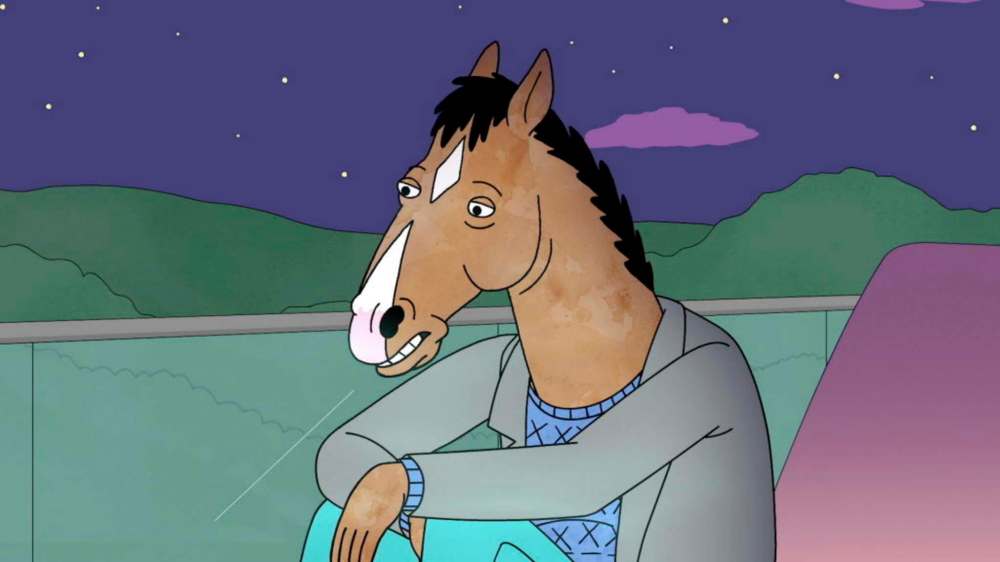
BoJack Horseman is sad.
As we head into the sixth season — the first eight episodes are now streaming on Netflix, with a second instalment to come in January — that’s not news.
Just watching the Season 5 plot summary that fronted the new season will probably give you feel-bad flashbacks. YouTube offers lots of Top 10 Most Depressing Moments on BoJack Horseman videos, and that number doesn’t even crack the deep and profound despair that drives this animated story. BoJack (voiced by Will Arnett) is a drug-addicted, alcoholic, half-horse, half-man former sitcom star who’s torn up with self-hatred and regret.
It’s not the quantity of sadness that sets this series apart, however, but its quality. A surreal adult cartoon set in an alternative Hollywood populated with an unexplained mix of animals and humans, it mostly avoids the wallowy clichés too often seen in faux-Prestige TV.
Burrowing into BoJack’s sadness, grief and trauma, the show packs an emotional wallop. But it also pulls off some stringent intellectual analysis. This season asks some hard questions: whose sadness matters in the current cultural moment? When dealing with trauma, whose stories get told and whose get silenced? Who gets punished for being difficult and who gets forgiven? Who gets a comeback narrative, and who deserves a comeback narrative?
Upset by rumours that Harvey Weinstein is a BoJack Horseman fan (presumably attracted to that men-behaving-badly vibe), showrunner Raphael Bob-Waksberg has become increasingly unsparing in his examination of BoJack’s self-destructive — and just plain destructive — behaviour. In recent seasons, the series has been explicitly asking what we should do with stories about sad toxic men (and horses) in the era of #MeToo.
In Season 5, BoJack starred in a True Detective knockoff called Philbert, all neo-noir style and cut-rate macho nihilism. This show-within-a-show played around with those TV tropes that ask audiences to sympathize with a dark, destructive, damaged male anti-hero even as he does absolutely awful things. But as Diane Nguyen (Alison Brie) told BoJack: “I don’t want you, or anyone else, justifying their sh–ty behaviour because of the show.” This statement seemed to address both Philbert and BoJack Horseman itself.
Bob-Waksberg’s penchant for self-criticism can be seen in this cracked-open sixth season. BoJack may be the titular character, but instead of spiralling in on his sadness as he finally enters rehab, the narrative has been expanding outwards. In a show where background is never just background and subplots are key, Season 6 goes even further in demonstrating the effect of BoJack’s selfishness, impulsivity and all-round bad boundaries on others.
What might seem like a comic sidebar — a sudden labour strike by Hollywood’s personal assistants that brings the town to a screeching halt — becomes an examination of the cult of celebrity and the ways money, power and bloated self-entitlement prop up and explain away the bad behaviour of stars such as BoJack.
The show also explores other kinds of sadness, less showy and spectacular than BoJack’s epic drug benders and sexual screwups, perhaps, but just as important.
Princess Carolyn (Amy Sedaris), who has spent several seasons being the enabling grown-up to BoJack’s misbehaving man-boy, is trying to balance motherhood and work and is so overwhelmed she can’t make it to a “Women Who Have It All” photoshoot.

Mr. Peanutbutter (Paul F. Tompkins), that preternaturally cheerful golden Lab, has just learned that — uh-oh — sometimes the people who seem the happiest are the most depressed. Diane, whose ghastly digital media employer has been bought up by an even more ghastly media conglomerate and renamed Content Spew, is dealing with her own depression. Even Todd Chavez (Aaron Paul), known more for his “goofy, whimsical mess-arounds,” as he calls them, has to confront his past.
But the most serious subplots look at the damage BoJack has done to the women around him, including Hollyhock (Aparna Nancheria), his heartbreakingly hopeful half-sister, Penny (Ilana Glazer), the girl he almost slept with on the night of her high school grad, and Gina (Stephanie Beatriz), whom he choked almost to unconsciousness on the set of Philbert while in a delusional haze of pills and booze. Gina, now dealing with unacknowledged post-traumatic stress, is getting a reputation for being “difficult” on set, which might be written off as bad-boy-genius behaviour for men but is career death for women.
And as we reach the end of this half of the season, we’re circling around what happened with Sarah Lynn (Kristen Schaal), the former child actor who saw BoJack as a surrogate father but who died of a heroin overdose on his watch.
Directly confronting not just the pain BoJack himself feels but the pain he has caused others, this final season seems to be heading toward a complicated moral reckoning, both for the title character and for the show itself.
Studying at the University of Winnipeg and later Toronto’s York University, Alison Gillmor planned to become an art historian. She ended up catching the journalism bug when she started as visual arts reviewer at the Winnipeg Free Press in 1992.
Our newsroom depends on a growing audience of readers to power our journalism. If you are not a paid reader, please consider becoming a subscriber.
Our newsroom depends on its audience of readers to power our journalism. Thank you for your support.
Studying at the University of Winnipeg and later Toronto’s York University, Alison Gillmor planned to become an art historian. She ended up catching the journalism bug when she started as visual arts reviewer at the Winnipeg Free Press in 1992.
Our newsroom depends on a growing audience of readers to power our journalism. If you are not a paid reader, please consider becoming a subscriber.
Our newsroom depends on its audience of readers to power our journalism. Thank you for your support.
Advertisement Advertise With Us
Advertisement Advertise With Us