Legalizing hard drugs not a ‘panacea’ to opioids crisis, Trudeau says

Advertisement

Advertise with us

OTTAWA - Prime Minister Justin Trudeau says he's unconvinced that decriminalizing hard drugs is a "panacea" to the country's ongoing opioids crisis, and other options need a chance before considering such a major policy shift.

Read this article for free:


or

Already have an account? Log in here »

To continue reading, please subscribe:

Subscribe and receive a limited-edition Free Press branded hat or tote.

Digital Subscription

One year of digital access for only $205*

  • Enjoy unlimited reading on winnipegfreepress.com
  • Read the E-Edition, our digital replica newspaper
  • Access News Break, our award-winning app
  • Play interactive puzzles

*First annual payment billed as $205.00 + GST for one year. This annual subscription will automatically renew at $233.00 + GST every 52 weeks (10% off the regular annual price of $259.35). Offer available to new and qualified returning subscribers only. Cancel any time.

To continue reading, please subscribe:

Add Free Press access to your Brandon Sun subscription for only an additional

$1 for the first 4 weeks*

  • Enjoy unlimited reading on winnipegfreepress.com
  • Read the E-Edition, our digital replica newspaper
  • Access News Break, our award-winning app
  • Play interactive puzzles
Start now

*Your next Brandon Sun subscription payment will increase by $1.00 and you will be charged $17.95 plus GST for four weeks. After four weeks, your payment will increase to $24.95 plus GST every four weeks.

Hey there, time traveller!
This article was published 19/12/2019 (2492 days ago), so information in it may no longer be current.

OTTAWA – Prime Minister Justin Trudeau says he’s unconvinced that decriminalizing hard drugs is a “panacea” to the country’s ongoing opioids crisis, and other options need a chance before considering such a major policy shift.

But Trudeau once felt the same way about marijuana — conceding it during an interview this week — before changing his mind.

During the wide-ranging interview with The Canadian Press, Trudeau said the epidemic requires a complex set of answers and not simply decriminalizing opioids to undercut a tainted black-market supply, as some jurisdictions have suggested.
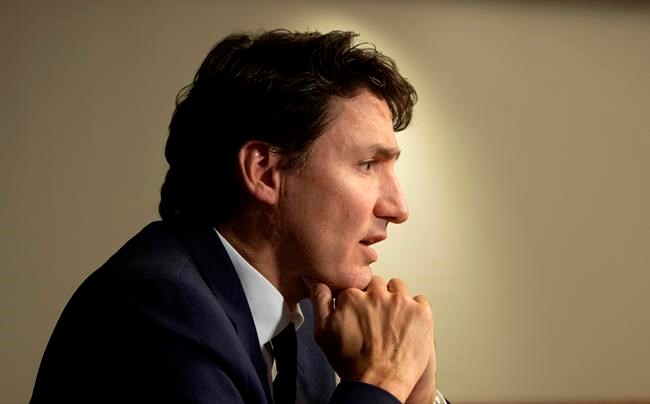
Prime Minister Justin Trudeau speaks with The Canadian Press during a year end interview in West Block on Parliament Hill in Ottawa, Wednesday December 18, 2019. Trudeau says he isn't convinced that decriminalizing hard drugs killing thousands of Canadians is a panacea to the country's ongoing opioid epidemic. THE CANADIAN PRESS/Adrian Wyld

The prime minister said his government plans to focus on solutions such as giving doctors more authority to prescribe alternatives to street drugs and creating more supervised consumption sites across the country.

However, opening supervised sites is more difficult in places where people are leery of supplying sterile drug paraphernalia and workers who can respond quickly to overdoses, he said, particularly in provinces headed by “capital-C conservative” governments.

The most recent figures from the Public Health Agency of Canada showed that nearly 14,000 Canadians have been killed by opioids since 2016.

Nearly all of those deaths are due to accidental overdoses. The composition of street drugs is practically impossible for users to tell, and the advent of powdered fentanyl — a super-potent opioid, easily hidden and transported, and often cut and then passed off as a less powerful drug — has been a major factor.

Besides the thousands who have died, thousands more have been hospitalized or treated by paramedics. Some have suffered permanent harm.

Trudeau said possible government responses “haven’t yet been fully deployed.” They will make a difference without having to “immediately jump to the biggest, perhaps biggest, lever in our arsenal,” he said, in reference to decriminalization.

Though he didn’t rule out that something could change his mind.

“I was absolutely opposed to decriminalization of marijuana for many years and opposed to legalization. I am now opposed to decriminalization of hard drugs,” Trudeau said — and stopped, leaving the implication hanging.

Pushed for clarity, Trudeau said, “It is not something that I would be convinced is — or even could be — the panacea.” Other moves are “more likely to have a quicker and more significant impact in the coming years.”

The Liberal platform included a promise to fund more in-patient rehab beds, expand supervised-consumption sites’ effectiveness by extending their hours, for instance, and allow first-time, non-violent offenders to go to drug-treatment courts when charged with simple possession of banned drugs.

The provincial courts, which are already funded by the federal government, allow people to get help for addictions as an alternative to being jailed.

But Trudeau has heard calls to work on safer opioid supplies. British Columbia’s provincial health officer made a request on Ottawa earlier this year and more recently Vancouver Mayor Kennedy Stewart made the pitch directly to the prime minister. Vancouver is asking Health Canada for $6 million for the safe distribution of the painkiller diamorphine, better known as heroin.

Conservative health critic Marilyn Gladu said the Liberals need to a have a full plan to address the epidemic, starting with prevention and ending with recovery. She cited mental-health supports, mandatory education in schools, pushing other countries like China to crack down on illegal drugs smuggled into Canada from abroad, and reducing the quantity of opioids prescribed in Canada.

Trudeau said any approach on hard drugs had to be different from that on marijuana.

Just over a year ago, the Liberals legalized the recreational use of cannabis, hoping to take a bite out of the illegal market for the drug and limit, to the extent possible, the ability of young Canadians to get their hands on marijuana.

More than a year later, and just as his government sets rules around cannabis edibles, Trudeau said many of the worries about the high-profile 2015 campaign promise didn’t materialize. Federal officials are keeping an eye on the new regime, he said.

“I’m not going to say that it has been without its challenges and there isn’t reason to continue to be very alert to it, but I think we can recognize that there was a level of rhetoric that was perhaps, in hindsight, unjustified.”

This report by The Canadian Press was first published Dec. 19, 2019.

Report Error Submit a Tip

More Stories

Manitoba delegation to join trade mission to India

Free Press staff 2 minute read 2:01 AM CDT

A delegation from Manitoba will travel to India seeking to bolster economic ties with the South Asia nation.

Manitoba e-scooter legislation changes set to impose speed limit, age restrictions, sidewalk ban

Matthew Frank 5 minute read Preview

Manitoba e-scooter legislation changes set to impose speed limit, age restrictions, sidewalk ban

Matthew Frank 5 minute read Updated: Yesterday at 11:26 AM CDT

People riding e-scooters and other personal electric vehicles in Manitoba will have to strap on a helmet, stay off sidewalks and follow new age limits once new provincial rules for the devices take effect next year.

The vehicles, which also include electric skateboards, hoverboards and unicycles, will fall under The Highway Traffic Act starting in 2027, according to the province’s website. E-bikes are excluded from the new rules, according to the province’s frequently-asked-questions page.

All riders must be at least 16 years old and wear properly fitting helmets — that goes for passengers, too, the province said.

The proposed new legislation sets a speed limit of 25 km/h and would prohibit personal electric vehicles from sidewalks unless signs specifically allow sidewalk use. Riders would be using shared paths or roads with speed limits of 50 km/hr or less. They won’t be allowed to operate the vehicles under the influence of alcohol or drugs and they must use hand signals and obey traffic signs.

Read
Updated: Yesterday at 11:26 AM CDT

Mayoral candidates share faves, test knowledge in Free Press culture quiz

Conrad Sweatman 5 minute read Preview

Mayoral candidates share faves, test knowledge in Free Press culture quiz

Conrad Sweatman 5 minute read 5:17 PM CDT

It’s been said that politics is downwind of culture. However true that is, where politicians stand on hot-button cultural debates such as artificial intelligence, whether they prefer sports over arts and what local restaurants they patronize can offer a window into their sensibilities and outlooks.

The Free Press invited the four leading mayoral candidates among decided voters — according to a recent Abacus poll — to take part in a cultural quiz. (Kevin Klein, who was polling second, did not respond.) While most of the questions are lighthearted, they speak to some of the personalities behind the heated rivalries over budgets, buses, business taxation and beyond.

What was the last book you finished?

● Scott Gillingham: I’m almost done Winnipeg author Paul Vincent Jacuzzi’s book Blind Eyes. It’s a Dalton Drake novel.

Read
5:17 PM CDT

Police, street groups looking to extend co-ordinated outreach-first approach to drug-use, trafficking crackdown

Chris Kitching 6 minute read Preview

Police, street groups looking to extend co-ordinated outreach-first approach to drug-use, trafficking crackdown

Chris Kitching 6 minute read Updated: Yesterday at 5:36 PM CDT

Winnipeg police and street outreach groups are discussing how to extend an initiative that tries to link people with addictions and homelessness services, while targeting open drug use and dealing.

Read
Updated: Yesterday at 5:36 PM CDT

White-supremacist highway sign casts pall on Steinbach city council campaign

Matthew Frank 4 minute read Preview

White-supremacist highway sign casts pall on Steinbach city council campaign

Matthew Frank 4 minute read Yesterday at 7:41 PM CDT

The RCMP is investigating a white-nationalist sign near Steinbach with racist messaging and alleged links to a known Canadian far-right group.

Read
Yesterday at 7:41 PM CDT

Tenants battling landlords find help in short supply from province

Scott Billeck 14 minute read Preview

Tenants battling landlords find help in short supply from province

Scott Billeck 14 minute read Yesterday at 6:00 AM CDT

For nearly three years, Quincy Houdayer and Avery Helm repeatedly pressed their landlord to address plumbing failures, water damage and other maintenance problems at their West Broadway apartment, with records showing some issues persisted until the couple turned to the Residential Tenancies Branch.

Emails and text messages between the tenants, Clearwater Management and the RTB reviewed by the Free Press document recurring leaks and flooding, periods without heat or hot water, concerns about mould and basement conditions and repeated followups from the couple seeking repairs.

“Most of the experiences we’ve had with them can be boiled down to, like, they either are very dismissive about it, they act like it’s not their problem… or they will just fully, blatantly ignore you,” Helm said, adding that the only way to get Clearwater to respond was to threaten going to the RTB, a provincial government agency.

RTB data obtained by the Free Press also shows 13 orders involving the three-building complex at 193-197 Furby St. in 2026 alone. All but one favoured the tenant, while the remaining order ruled in favour of both the tenant and landlord on different items.

Read
Yesterday at 6:00 AM CDT