

Order in the court
True story of wrongfully accused man could use more flash and fire

Advertisement
Read this article for free:
or
Already have an account? Log in here »
To continue reading, please subscribe:
Digital Subscription
One year of digital access for only $75*
- Enjoy unlimited reading on winnipegfreepress.com
- Read the E-Edition, our digital replica newspaper
- Access News Break, our award-winning app
- Play interactive puzzles
*Billed as $5.77 plus GST every four weeks. After 52 weeks, price increases to the regular rate of $19.95 plus GST every four weeks. Offer available to new and qualified returning subscribers only. Cancel any time.
Monthly Digital Subscription
$4.99/week*
- Enjoy unlimited reading on winnipegfreepress.com
- Read the E-Edition, our digital replica newspaper
- Access News Break, our award-winning app
- Play interactive puzzles
*Billed as $19.95 plus GST every four weeks. Cancel any time.
To continue reading, please subscribe:
Add Free Press access to your Brandon Sun subscription for only an additional
$1 for the first 4 weeks*
- Enjoy unlimited reading on winnipegfreepress.com
- Read the E-Edition, our digital replica newspaper
- Access News Break, our award-winning app
- Play interactive puzzles
*Your next Brandon Sun subscription payment will increase by $1.00 and you will be charged $17.95 plus GST for four weeks. After four weeks, your payment will increase to $24.95 plus GST every four weeks.
Read unlimited articles for free today:
or
Already have an account? Log in here »
Hey there, time traveller!
This article was published 10/01/2020 (2328 days ago), so information in it may no longer be current.
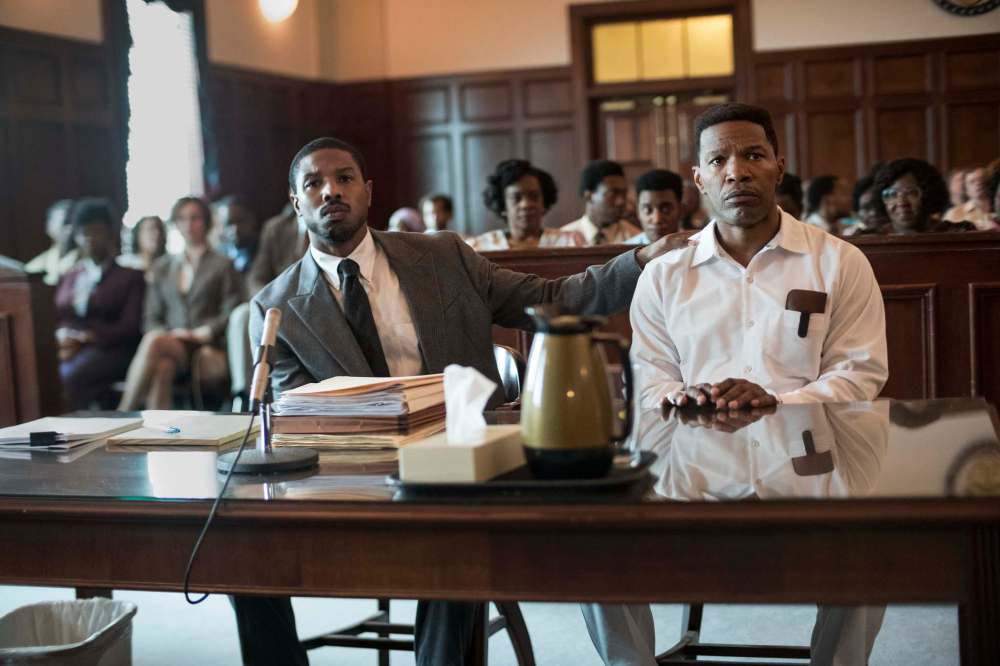
Just Mercy is a dramatization of a true story of a Harvard-educated lawyer coming to the aid of a wrongfully accused black man, facing the death penalty for a murder he obviously did not commit.
So… not a lot of laughs.
Yet there is something of a running joke in the film.
The lawyer is Bryan Stevenson, played by Michael B. Jordan. (Stevenson wrote the book on which the screenplay was based.) In 1989, Stevenson travelled to Monroe County in Alabama to offer legal help to death-row inmates who were either badly represented in court, or, in the case of Walter McMillian (Jamie Foxx), framed outright for a crime.
The joke: When Stevenson meets local prosecutor Tommy Champan (Rafe Spall), who’s handling the case, the southern gentleman recommends the northern newcomer visit a local museum dedicated to the Monroe County author Harper Lee and her book To Kill a Mockingbird.
The recommendation is intended to suggest the people of Alabama have evolved past the racism and bitter injustice depicted in the 1960 novel, set in the 1930s.
The facts of McMillian’s case assert otherwise.
In 1987, McMillian was pulled over and arrested, despite the alibi of about 25 family members who could attest he was at a family function at the time of the murder he was alleged to have committed.
The prosecution brings forth a white witness, lifelong petty criminal Ralph Myers (Tim Blake Nelson), who tells a ludicrous, hole-filled story in court about how he personally saw McMillian arrive at the scene of the crime.
Guess whose testimony is believed?
Local law enforcement and racists (more or less the same thing in this story) are upset Stevenson has come to town to renew the trauma of the 1987 murder. Before long, Stevenson’s local ally, Eva Ansley (Brie Larson), is receiving bomb threats at her home.
Director Destin Daniel Cretton (who directed the Larson movie Short Term 12) wisely doesn’t keep the McMillian case in a vacuum.
Another death-row inmate represented by Stevenson, a PTSD-suffering veteran named Herbert Richardson (Rob Morgan), was sentenced to die after leaving a bomb on his ex-girlfriend’s porch. His court-appointed legal counsel failed to bring to light the man’s profound psychological issues after his return home from Vietnam.

The director makes an admirable effort to portray Stevenson’s fight as somewhat more nuanced than the central McMillian case, which is an outright miscarriage of justice. Morgan’s performance, encompassing the character’s crushing guilt, is heartbreaking.
But the McMillian case stays centre stage, and Foxx brings an emotional fire to the proceedings in the role of the aggrieved accused. This is all the more necessary, since Jordan’s Stevenson is obliged to maintain a stoic resolve throughout the film, though hints of rage discreetly flash in pivotal moments.
It isn’t quite enough: The film hews too closely to the formal rhythms of the court proceedings, with little sense of the roiling chaotic forces that landed McMillian in jail… and remain stronger than ever in the year 2020, Harper Lee museum notwithstanding.
randall.king@freepress.mb.ca
Twitter: @FreepKing
Our newsroom depends on a growing audience of readers to power our journalism. If you are not a paid reader, please consider becoming a subscriber.
Our newsroom depends on its audience of readers to power our journalism. Thank you for your support.
MOVIE REVIEW
Just Mercy
Starring Michael B. Jordan and Jamie Foxx
● Grant Park, Polo Park
● PG
● 137 minutes
★★★1/2 stars out of five
Other voices
Despite its flaws, Just Mercy is that rarity — a movie that inspires; a story that brings light.
— Moira Macdonald, Seattle Times
From its smooth visuals and warm, swinging sounds to its magnificent performances, Just Mercy is masterfully constructed to keep us inside a story that otherwise would be too brutal to bear.
— Ann Hornaday, Washington Post
The real battle is still to be won. That’s the power of Just Mercy. It demands that you bear witness.
— Peter Travers, Rolling Stone
The film portrays the ferocious resistance of some people to the possibility that this man had nothing to do with the crime. And that’s when Just Mercy is at its best.
— Kenneth Turan, Los Angeles Times
The clear-cut morality of the plot necessitates dramatic tension or righteous fury, and Cretton delivers neither.
— Inkoo Kang, Slate
Our newsroom depends on a growing audience of readers to power our journalism. If you are not a paid reader, please consider becoming a subscriber.
Our newsroom depends on its audience of readers to power our journalism. Thank you for your support.
Advertisement Advertise With Us
Advertisement Advertise With Us
History
Updated on Friday, January 10, 2020 6:25 AM CST: Adds photo