Cosmic explosion leaves kids in charge
Advertisement
Read this article for free:
or
Already have an account? Log in here »
To continue reading, please subscribe:

Digital Subscription
One year of digital access for only $205*
- Enjoy unlimited reading on winnipegfreepress.com
- Read the E-Edition, our digital replica newspaper
- Access News Break, our award-winning app
- Play interactive puzzles
*First annual payment billed as $205.00 + GST for one year. This annual subscription will automatically renew at $233.00 + GST every 52 weeks (10% off the regular annual price of $259.35). Offer available to new and qualified returning subscribers only. Cancel any time.
To continue reading, please subscribe:
Add Free Press access to your Brandon Sun subscription for only an additional
$1 for the first 4 weeks*
- Enjoy unlimited reading on winnipegfreepress.com
- Read the E-Edition, our digital replica newspaper
- Access News Break, our award-winning app
- Play interactive puzzles
*Your next Brandon Sun subscription payment will increase by $1.00 and you will be charged $17.95 plus GST for four weeks. After four weeks, your payment will increase to $24.95 plus GST every four weeks.
Read unlimited articles for free today:
or
Already have an account? Log in here »
Hey there, time traveller!
This article was published 18/01/2020 (2431 days ago), so information in it may no longer be current.
In 2016 Cixin Liu’s tour de force novel, The Three-Body Problem, won the Hugo award for best novel for Liu and his Chinese-to-English translator, also named Liu (Ken, no relation). The science fiction epic had two sequels which were also in the hands of English readers the following year, and then his American publisher started work on bringing over the Chinese superstar’s back catalogue.
First was Ball Lightning, initially published in China in 2004, and then 2003’s Supernova Era. And while Liu’s first foray into English science fiction (and 20 other languages) risks overshadowing works from the genre giant’s younger self, these smaller novels, too, show his penchant (and knack) for myth-making and uncharted literary territory.
The premise of this latest release is easily summarized. A supernova explosion a dozen light years away — Earth’s backyard, cosmically speaking — changes the face of the night sky with the nebula it leaves behind. It also changes the face of humanity, as the radiation bath has ensured every person on the planet above the age of 13 will succumb to death by supernova sickness within the year.
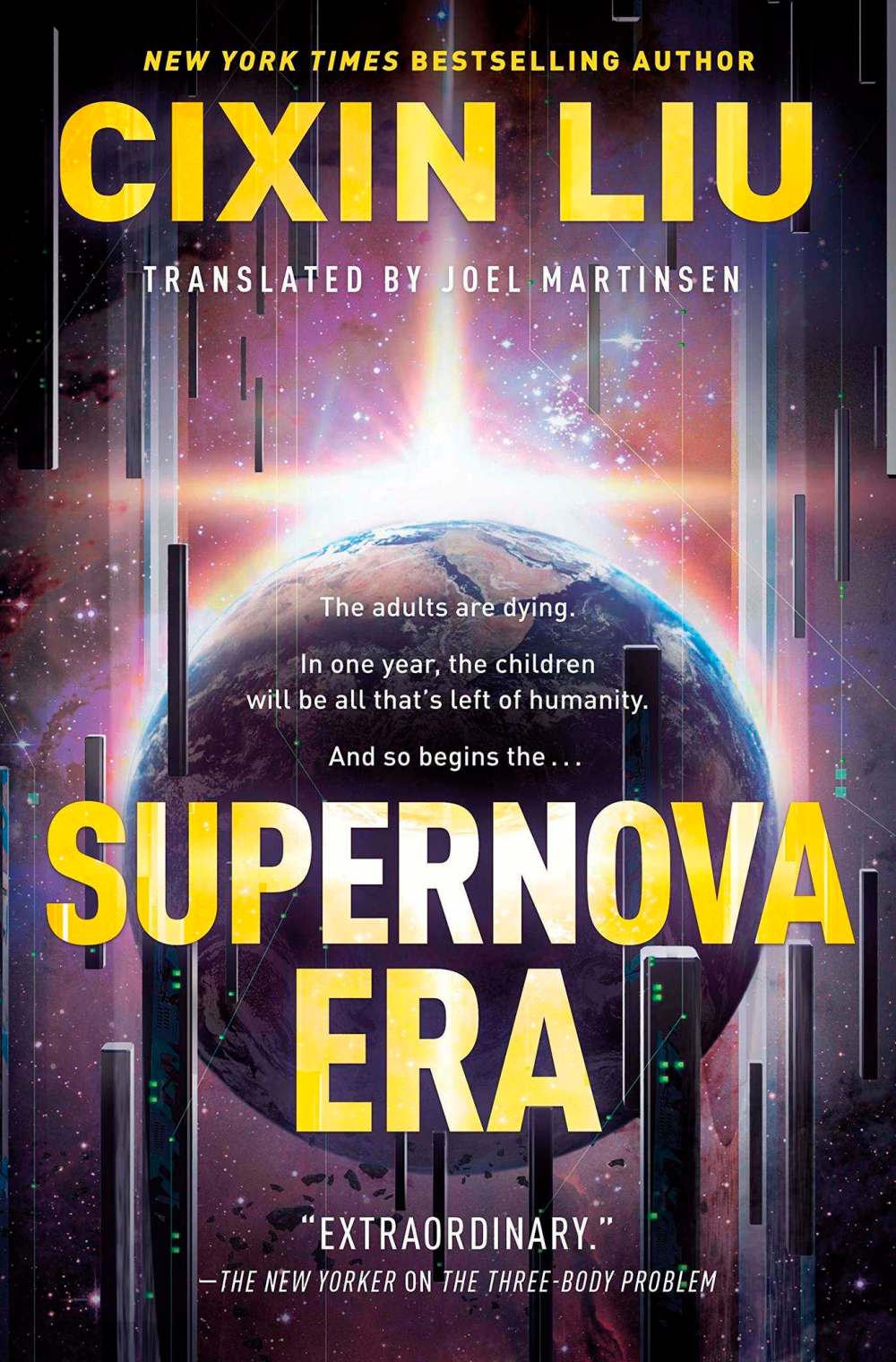
With humanity’s near-terminal diagnosis confirmed, the world’s governments scramble to put together a plan to train the largely pre-teen survivors to take over industry, commerce and government services so they can feed and care for themselves. The adults are understandably motivated — this is about the survival of the species, but also about protecting their own children and grandchildren.
The children have a tougher task, however. When their parents finally depart, despite all the precautions, contingency plans and dress rehearsals, an entire planet of abandoned children begins crying disconsolately, forgetting everything they were taught. And what else could you possibly expect?
The reader knows humanity will ultimately survive, as the novel is framed as a historical work, written decades after the initial event. As such, it frequently foreshadows upcoming crises but also ensures the species will carry on. What is less clear is what the cost will be.
Post-apocalyptic tales are a well-established genre. Even the specific situation of the adults disappearing and leaving a world of children occurred in Michael Grant’s 2008 book Gone, a young adult novel of a more supernatural bent, and John Christopher’s 1977 novel Empty World, where a disease kills 99 per cent of the world’s population, sparing only a fraction of the very young.
Typically such a scenario is framed as a sudden disaster, and focuses on the efforts of individuals to pick up the pieces. Focusing on the aftermath, these tales are character-driven and their emotional arc is one of recovery from tragedy. Liu is focused on the event itself, on the technical details of managing the crisis. So his tale is plot-driven and speculative, not unlike Isaac Asimov’s future history about civilizational collapse, Foundation.
But comparisons can also be made to William Golding’s Lord of the Flies, as the planet itself becomes an island on which the world’s children have been left shipwrecked and abandoned. And the shocking experience of reading Golding’s novel is paralleled in parts of Liu’s story. These are children, after all, and the idea of witnessing them uncared for and, indeed, unchecked, is squirm-inducing, despite the author’s efforts at clinical detachment.
Liu’s set-up here is original and thought-provoking. But as with his other works, there is a grimness to it. Not on the level of a more character-driven work like Cormac McCarthy’s The Road, of course, but readers would nevertheless be well advised to follow it up with something lighter and happier.
Joel Boyce is a Winnipeg writer and educator.