

Beethoven’s birthday celebration bridges classical and romantic eras
Advertisement
Read this article for free:
or
Already have an account? Log in here »
To continue reading, please subscribe:
Monthly Digital Subscription
$0 for the first 4 weeks*
- Enjoy unlimited reading on winnipegfreepress.com
- Read the E-Edition, our digital replica newspaper
- Access News Break, our award-winning app
- Play interactive puzzles
*No charge for 4 weeks then price increases to the regular rate of $19.00 plus GST every four weeks. Offer available to new and qualified returning subscribers only. Cancel any time.
Monthly Digital Subscription
$4.75/week*
- Enjoy unlimited reading on winnipegfreepress.com
- Read the E-Edition, our digital replica newspaper
- Access News Break, our award-winning app
- Play interactive puzzles
*Billed as $19 plus GST every four weeks. Cancel any time.
To continue reading, please subscribe:
Add Free Press access to your Brandon Sun subscription for only an additional
$1 for the first 4 weeks*
*Your next subscription payment will increase by $1.00 and you will be charged $16.99 plus GST for four weeks. After four weeks, your payment will increase to $23.99 plus GST every four weeks.
Read unlimited articles for free today:
or
Already have an account? Log in here »
Hey there, time traveller!
This article was published 18/01/2020 (2144 days ago), so information in it may no longer be current.
On a dark and stormy “Winterpeg” night — a perfect backdrop for an all-Beethoven program — the Winnipeg Symphony Orchestra kicked off its Beethoven 250 celebrations in honour of this year’s birthday boy, with the anniversary of Ludwig van Beethoven birth in 1770 being trumpeted around the world throughout 2020.
Friday night’s latest (A)bsolute Classics program titled Beethoven’s Triple and led by Daniel Raiskin featured its namesake Triple Concerto showcasing three of the city’s crème de la crème musicians: WSO concertmaster Gwen Hoebig; principal cellist Yuri Hooker; and pianist David Moroz, who stepped into the limelight as soloists.
Those with sharp eyes would have noted from the programme that both Hoebig and her husband Moroz, joined by the violinist’s cellist brother Desmond Hoebig, performed the three-movement piece under the baton of Bramwell Tovey during its last WSO performance back in 1995, thus marking the musical couple’s own silver anniversary playing it on this very stage.
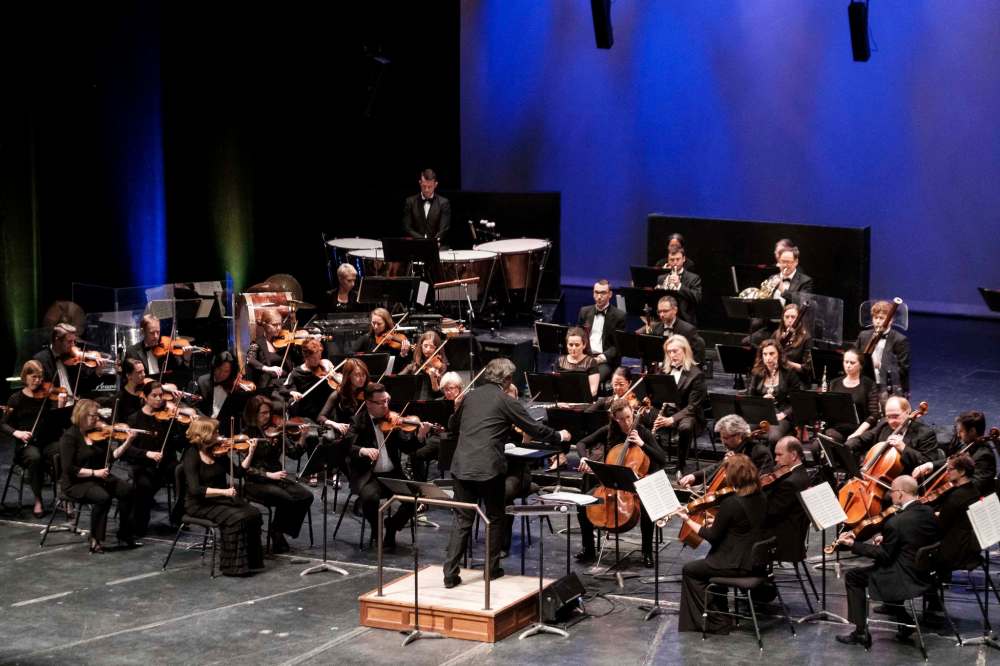
The engaging piece, ostensibly a piano trio with orchestral accompaniment, teems with wit and charm, as well as intricate passagework delivered by the three soloists with an immediately palpable mutual trust and rapport.
Hooker is given the lion’s share of thematic material including its opening statement and startling repeated notes linking the central Largo movement to rollicking Rondo alla Polacca finale, which he rendered with unabashed lyricism, especially effective when harmonizing with Hoebig’s fluid melodic lines, and often underpinned by Moroz’s gently rippling arpeggios that often became moments of sheer beauty.
A few early synchronization issues with the orchestra quickly settled, with a scaled down orchestra instilling a sense of intimacy into the performance. The well-balanced ensemble performing as an organic whole showed the colours and contrasts of the work while easily navigating its technical challenges, ranging from expressive liquidity to rugged, percussive accents and bursts of bravura, tossing snippets of melodic phrases back and forth like children’s play.
This kinder and gentler performance straddling both classical and romantic worlds quickly became an early New Year’s treat, with the attractive work clearly needing to be heard again before another 25 years passes, while receiving an enthusiastic standing ovation from the mostly older audience of 1,259.
The entire second half of the evening belonged to Beethoven’s mighty Symphony No. 3 in E-flat major, Op. 55, or Eroica, originally dedicated to Napoleon Bonaparte, with Beethoven furiously tearing up the inscription after his dedicatee crowned himself emperor in 1804.
Its nearly one-hour length and greatly expanded four movements also marked a seminal turning in musical history, bridging classical and romantic eras, as well as being a pivotal juncture in the composer’s own life as he grappled with the stark reality of his growing deafness.
Raiskin set a brisk, bright tempo for the opening movement, Allegro con brio, showcasing the orchestra’s brilliant, crisp strings and piercing brass. This maestro always has a clear vision of exactly where he wants to go with any given performance, including masterfully pacing this one’s overall trajectory that built from hushed interludes to enthralling, sudden outbursts of sound.

Its powerful second movement, Marcia funebre: Adagio assai, notably performed for state funerals and memorial services for such luminaries as Mendelssohn, Roosevelt, Toscanini and John F. Kennedy, among others, plunges the listener into the valley of despair, often evoking the emotional intensity of a keening wail for the dead, and wisely given wide berth by Raiskin and his players. Bravo to principal oboe Beverly Wang for her compelling solo, as well as the horn section for instilling a sense of noble gravitas and profundity, further punctuated by principal timpanist Mike Kemp’s ominous drum strikes. One can only imagine the composer shaking his fists at fate itself after hearing this deeply felt performance.
The Scherzo brings welcomed relief and contrast, including its central Trio section, once more showcasing the horns with their rising swells of sound; while the finale, Allegro molto, caps this work with a set of variations on a theme, growing increasingly insistent until reaching a triumphant, crashing coda, eliciting another ovation by the clearly enraptured crowd.
The program opened with the overture to Beethoven’s lone opera, Fidelio, that underscored the entire program’s thoughtful, fascinating context, with all three of the evening’s works composed roughly around the same time. Once again, Raiskin drove the musicians forward, their bristling performance, including plenty of pregnant pauses and syncopated accents, becoming an ideal launch to Beethoven 250, with much, much more to come.
The program repeats Saturday night, 8 p.m. at the Centennial Concert Hall.
Holly.harris@shaw.ca
Holly Harris writes about music for the Free Press Arts & Life department.
Our newsroom depends on a growing audience of readers to power our journalism. If you are not a paid reader, please consider becoming a subscriber.
Our newsroom depends on its audience of readers to power our journalism. Thank you for your support.