Artists are Indigenous, their art isn’t
From awards to marketing, conference explores how society puts First Nations art into a silo

Advertisement
Read this article for free:
or
Already have an account? Log in here »
To continue reading, please subscribe:

Digital Subscription
One year of digital access for only $205*
- Enjoy unlimited reading on winnipegfreepress.com
- Read the E-Edition, our digital replica newspaper
- Access News Break, our award-winning app
- Play interactive puzzles
*First annual payment billed as $205.00 + GST for one year. This annual subscription will automatically renew at $233.00 + GST every 52 weeks (10% off the regular annual price of $259.35). Offer available to new and qualified returning subscribers only. Cancel any time.
To continue reading, please subscribe:
Add Free Press access to your Brandon Sun subscription for only an additional
$1 for the first 4 weeks*
- Enjoy unlimited reading on winnipegfreepress.com
- Read the E-Edition, our digital replica newspaper
- Access News Break, our award-winning app
- Play interactive puzzles
*Your next Brandon Sun subscription payment will increase by $1.00 and you will be charged $17.95 plus GST for four weeks. After four weeks, your payment will increase to $24.95 plus GST every four weeks.
Read unlimited articles for free today:
or
Already have an account? Log in here »
Hey there, time traveller!
This article was published 29/01/2020 (2381 days ago), so information in it may no longer be current.
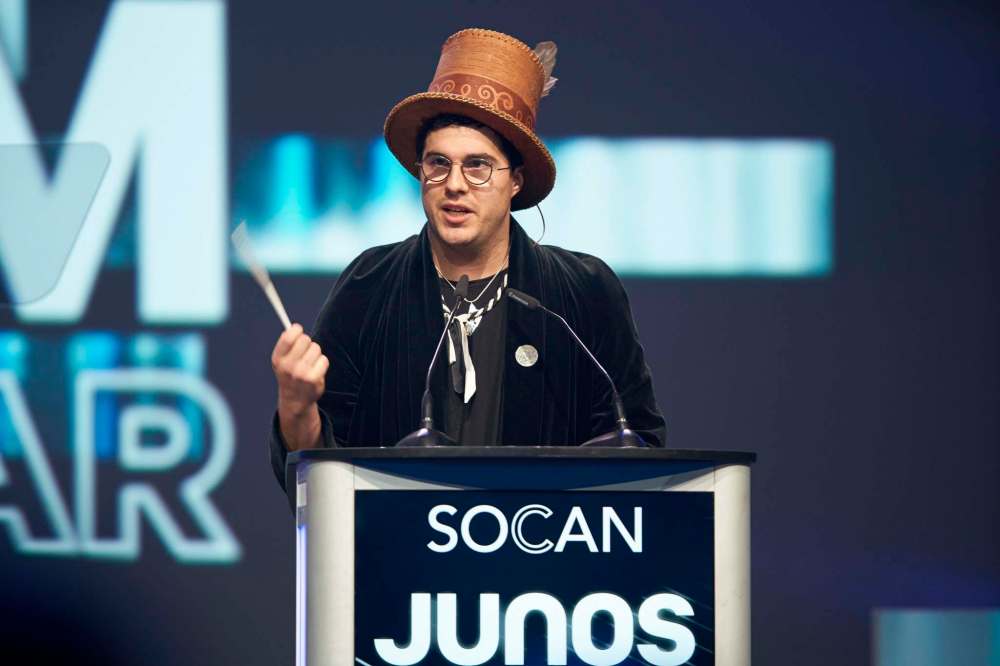
The idea of “Indigenous” being categorized as a music genre is one that has been on the minds of both Indigenous and non-Indigenous music makers and fans for decades. The issue was brought to the forefront once again last spring by Wolastoqiyik singer-songwriter Jeremy Dutcher, who won the 2019 Juno Award for Indigenous music album of the year.
“There are no Indigenous nominees outside of the Indigenous music category and it’s not because we’re not putting out excellent music… So for me, it’s a bit of a double-edged sword — I wish that we weren’t siloed into one category.” Dutcher said on CBC radio show Q in an interview ahead of the awards ceremony, where he made an impactful speech about the importance of recognizing Indigenous art outside of specialized categories.
This year, the Junos have changed the name of the award again, the fifth title change since its inception in 1994, to Indigenous Artist or Group of the Year, an attempt to put a brighter spotlight on the artists themselves and all of their work within a given year rather than one specific album. Nominations were announced Tuesday; Celeigh Cardinal, Digawolf, Northern Haze, Riit and Nêhiyawak are included in this year’s group.
So, it couldn’t be more timely for Manitoba Music’s annual January Music Meeting conference to host a free panel discussion on topic tonight at 7 p.m. in the south aisle of The Forks Market. Indigenous is Not a Genre: Indigenous Perspectives on the Music Industry will cover topics such as Indigenous identity and labels within music, marketing and presentation; the role of ceremony, elders, youth, children, family, community; and other discussions relating to cultural appropriation and reconciliation.
“Usually this conversation comes up and it’s shared through social media maybe when the Junos or when music awards come up and have categories around Indigenous people specifically… and then it kind of dies down and then it comes up again so we’ve kind of seen this over the years. So the idea with this conversation is to engage with Indigenous people and actually explore this, explore Indigenous as not a genre,” says Jade Harper, Indigenous music export co-ordinator at Manitoba Music.
“What we’re really going to try to do is actually build a conversation so that others in the audience can also participate and contribute to the conversation,” she says, explaining the panel discussion will be set up in a circle to encourage engagement.
One of the industry experts who will be in town to be part of the panel discussion is Vancouver-based artist manager Elaine Bomberry, who has been working in the Canadian music industry for more than 30 years and played an key role in developing the Indigenous category for the Junos 26 years ago.
She, along with Canadian music icons Shingoose and, later, Buffy Sainte-Marie, created the category from the ground up, working tirelessly behind the scenes to fulfil the Canadian Academy of Recording Arts and Sciences’ guidelines for a new award. Now, she says in “an ideal world,” she’d like to see the category broken up into two awards.
“It would be great to have two categories so that we could honour our traditional Indigenous musicians as opposed to contemporary. We knew that; Buffy and I knew that and Shingoose knew that way back in the day, that when we created the category that we’re not going to make everyone happy but let’s include everyone in the same font and eventually we’ll figure it out and how to split,” says Bomberry.
“And 26 years later it’s still a category, but eventually… I have faith (we’ll figure it out),” she says with a laugh.
“It’s funny because it’s come from Indigenous people and held by a non-Indigenous organization and then what’s happening is times are changing and our understanding of having those award categories are changing a bit, so I think that creating space specifically for Indigenous people, where we don’t hold space or it’s very challenging to access space there is still really important,” adds Harper.
“However the way that category is managed, I think we have to very careful with that. And at the same token, it’s really important to have an equitable representation in the awards, so equity would be having Indigenous artists flowing through all categories because our music is not just music because we are in Indigenous and we need to have our spaces, we actually make really good music, like incredible music by incredible musicians who are doing really great work who have their full-time livelihood based on and in music.”


Harper says the panel discussion is a great opportunity for both Indigenous and non-Indigenous people alike to hear directly from Indigenous voices about their experiences to be able to open the door to a more thorough and honest conversation.
“Being able to hear about this issue directly from Indigenous people, who experience or have thoughts on music, is really important so that you actually understand the context of what it is those conversations are about,” says Harper.
“I always find we talk about truth and reconciliation and often that truth part is what we’re missing, and that’s what you’re going to get at this panel, you’re going to get some truth. And I think that that’s going to enrich the lives of non-Indigenous people as well as Indigenous.”
erin.lebar@freepress.mb.ca
Twitter: @NireRabel
Our newsroom depends on a growing audience of readers to power our journalism. If you are not a paid reader, please consider becoming a subscriber.
Our newsroom depends on its audience of readers to power our journalism. Thank you for your support.
Event preview
Indigenous is Not a Genre: Indigenous Perspectives on the Music Industry
Tonight, 7 p.m.
The Forks Market, south aisle
Free admission
Our newsroom depends on a growing audience of readers to power our journalism. If you are not a paid reader, please consider becoming a subscriber.
Our newsroom depends on its audience of readers to power our journalism. Thank you for your support.
Advertisement Advertise With Us
Advertisement Advertise With Us