Mystical Mutton
Central panel of famed Ghent Altarpiece turns art world on its ear
Advertisement
Read this article for free:
or
Already have an account? Log in here »
To continue reading, please subscribe:
Digital Subscription
One year of digital access for only $1.44 a week*
- Enjoy unlimited reading on winnipegfreepress.com
- Read the E-Edition, our digital replica newspaper
- Access News Break, our award-winning app
- Play interactive puzzles
*Billed as $5.77 plus GST every four weeks. After 52 weeks, price increases to the regular rate of $19.95 plus GST every four weeks. Offer available to new and qualified returning subscribers only. Cancel any time.
To continue reading, please subscribe:
Add Free Press access to your Brandon Sun subscription for only an additional
$1 for the first 4 weeks*
- Enjoy unlimited reading on winnipegfreepress.com
- Read the E-Edition, our digital replica newspaper
- Access News Break, our award-winning app
- Play interactive puzzles
*Your next Brandon Sun subscription payment will increase by $1.00 and you will be charged $17.95 plus GST for four weeks. After four weeks, your payment will increase to $24.95 plus GST every four weeks.
Read unlimited articles for free today:
or
Already have an account? Log in here »
Hey there, time traveller!
This article was published 01/02/2020 (2460 days ago), so information in it may no longer be current.
“Behold the Lamb of God who takes away the sins of the world.” John 1:29.
It’s right there on the altar, in Latin: ECCE AGNUS DEI QUI TOLLIT PECCATA MUNDI. And above, on the right of the Deësis, Saint John the Baptist, identified by the camel-hair tunic and raised right hand, the preacher who pronounced these words and proclaimed that “this is the Son of God.” But it’s the lamb, itself, that is suddenly drawing the world’s attention — nearly 600 years after it was painted.
In this case, it is the Adoration of the Mystic Lamb, one of five lower panels of the Ghent Altarpiece, considered a masterpiece of European art, which was restored in various periods beginning in 2016 and concluding this past January. It resides in St. Bavo’s Cathedral in the Belgium city of Ghent.
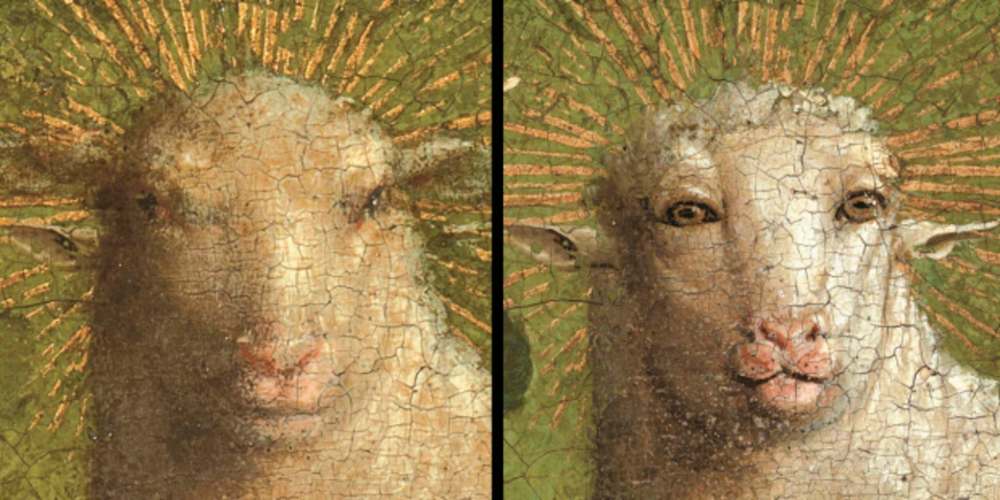
“Alarmingly humanoid” was how the Smithsonian Magazine described the lamb’s facial features in a December article, published shortly after the completed restoration. That it took almost exactly a month for the Adoration of the Mystic Lamb to go viral is somewhat surprising, given the haste of social media. But for whatever reason, people decided they wanted to gawk at a “cartoonish” ovine in late January. And, naturally, to make memes.
There’s a good one of the restored lamb next to actor Ben Stiller’s character from Zoolander making the rounds, and a popular TikTok post points out that “your chances of getting killed by a medieval painting are low,” showing the former, fuzzy-blurry lamb, before displaying the new one with the text: “but never zero.” Lol. This is great! Because the more people who see this artwork, the better.
For one thing, it has a cool back story. Napoleon transferred most of it to the Louvre in the early 19th century—”most of it” because, with 12 panels in all, you’re able to choose your favourite ones. More recently, the Nazis stored it in an Austrian salt mine and would have blown it up were it not for the heroics of the Monuments, Fine Arts, and Archives program. Or, as film remembers them, The Monuments Men, starring George Clooney.
Only once have people actually tried to destroy it. That was in 1566 when Protestant iconoclasts battered their way into its Saint Bravo Cathedral home, torches lit. Were it not for the quick action of a few Cathedral guards, they would have set it ablaze. In some cases, their descendants now spend their Sunday mornings in glorified warehouses bereft of art of any kind. Which is troubling. In the absence of artful expression, it can be easy to forget exactly what is being worshipped — a vacuum that weaponized ideology is often quite ready to fill.
Thankfully, the Ghent Altarpiece seems to have retained its element of fascination, just as it’s done ever since Jan van Eyck applied the final brushstroke in 1432. The meme mischief has only brought it back into the mainstream — a sort of borrowing or temporary repurposing of a portion of the work for popular consumption, even spectacle. And so enthusiasts are taking the opportunity to revisit and elucidate on Netherlandish painting of the Northern Renaissance.
For example, the van Eyck brothers who undertook the commission of the Ghent Altarpiece would probably have been right at home in the 21st century. Their inscription on a back panel refers to Hubert van Eyk, Jan’s older brother, as “greater than whom none was to be found” and Jan as “second in art.” It has the arrogance of a hip-hop track. A la Kanye West, Hubert might as well have called himself “the greatest artist resting or alive.”
Jan, meanwhile, might have personally introduced Renaissance painting to Western Europe with the Arnolfini Portrait and its use of shadow, mirror and geometry, never mind the application of the oils that were showing up in 15th century Bruges. He was smart (having studied Latin and Greek), trendy (as the Arnofinis’ haute couture can attest) and imaginative enough to mash it all together and launch a movement. He certainly wouldn’t have painted a defective lamb, and certainly not on the Ghent Altarpiece, on which he hailed himself as the second-greatest artist in history. Not a chance.
Some much-needed context is provided in other depictions of Christ from around the same period. In 1437, Filippo Lippi painted his Madonna and Child Enthroned for the archbishop of Florence. Look at the Child Jesus. He has the body of a baby but the face of an overfed teenager and thick, curly hair. Raphael’s Child Jesuses were mostly bald — one even had a receding hairline — until 1503, when he, too, gave the Baby a head of blonde curls. But the teenaged or adult facial features remained. Even a hundred years before the van Eycks, Duccio di Buoninsega was painting tiny adult-Baby Jesuses. The depiction goes all the way back to what is thought to be the very first image of Madonna and Child, the Salus Populi Romani, which is kept at Santa Maria Maggiore in Rome.

The point is, painters from the Renaissance through the Baroque struggled to depict Christ as anything but a full-grown man. To them, an illustration of a healthy, pudgy, generic baby was never going to cut it; they had to somehow indicate that “this” baby was the Christ. And so they essentially made him a man-child. Throughout Christian art, the main characters of the biblical narrative are identified through particular settings, postures or appearances. This, for better or worse, is that of the Child Jesus.
Such would have been the thoughts playing in van Eyck’s mind when he painted the Adoration of the Mystic Lamb. How to paint more than a lamb, because those are the rules; how to anthropomorphize just enough, because it’s still a lamb. He ended up going with frontal, human-set eyes, flared nostrils and full, pink lips.
Naturally, the Internet misses nothing and provided the means, however unintentionally, to clear up the confusion. What’s rather more concerning, however, is the reminder that knowledge is in no way permanent, that interpretations of artworks such as the Ghent Altarpiece rely on indicators that are no longer universally recognized. Who knows what else has been lost over time? For now, at least, one of the most iconic works of Western art is having a pop culture moment, and it’s not a problem in the least that memes are to thank. In fact, it’s quite appropriate.
Jerrad Peters is a Winnipeg writer.
Twitter @JerradPetersjerradpeters@gmail.com
Our newsroom depends on a growing audience of readers to power our journalism. If you are not a paid reader, please consider becoming a subscriber.
Our newsroom depends on its audience of readers to power our journalism. Thank you for your support.