In virus outbreak, fretting over a name that might go viral

Advertisement

Advertise with us

NEW YORK - West Nile virus, Lyme disease, Ebola virus.

Read this article for free:


By clicking the button above, an account will be created and you will begin to receive some of our recommended newsletters. You may opt out of any newsletter by visiting your Email and Communication Preferences page or by clicking "unsubscribe" at the bottom of any email.

or

Already have an account? Log in here »

To continue reading, please subscribe:

Digital Subscription

One year of digital access for only $1.44 a week*

  • Enjoy unlimited reading on winnipegfreepress.com
  • Read the E-Edition, our digital replica newspaper
  • Access News Break, our award-winning app
  • Play interactive puzzles

*Billed as $5.77 plus GST every four weeks. After 52 weeks, price increases to the regular rate of $19.95 plus GST every four weeks. Offer available to new and qualified returning subscribers only. Cancel any time.

To continue reading, please subscribe:

Add Free Press access to your Brandon Sun subscription for only an additional

$1 for the first 4 weeks*

  • Enjoy unlimited reading on winnipegfreepress.com
  • Read the E-Edition, our digital replica newspaper
  • Access News Break, our award-winning app
  • Play interactive puzzles
Start now

*Your next Brandon Sun subscription payment will increase by $1.00 and you will be charged $17.95 plus GST for four weeks. After four weeks, your payment will increase to $24.95 plus GST every four weeks.

Hey there, time traveller!
This article was published 04/02/2020 (2457 days ago), so information in it may no longer be current.

NEW YORK – West Nile virus, Lyme disease, Ebola virus.

And now: 2019-nCoV?

“Just rolls off the tongue, doesn’t it?” said Trevor Hoppe, a researcher at the University of North Carolina at Greensboro, who has studied the history of disease names.

The 2019 Novel Coronavirus (2019-nCoV) is seen in an illustration provided by the Centers for Disease Control and Prevention (CDC) in January 2020. Health officials hope to avoid stigma and error in naming the virus causing an international outbreak of respiratory illnesses. But some researchers say the current moniker, 2019 nCoV, which stands for 2019 novel coronavirus, probably won't stick in the public's mind. (CDC via AP, File)

The name, which stands for 2019 novel coronavirus, has been assigned to the virus behind the outbreak of flu-like illnesses that started in China late last year.

Scientists are still learning about the new virus, so it’s hard to come up with a good name, Hoppe said. The current one is likely temporary, said Dr. Nancy Messonnier of the U.S. Centers for Disease Control and Prevention.

“Once people have a chance to catch their breath, it might be changed,” Messonnier said.

Many media outlets have been skipping the clunky 2019-nCoV and just calling it the new virus or new coronavirus, which isn’t very specific. Coronavirus is the umbrella term for a large group of viruses, including ones that can cause the common cold.

Since the outbreak is centred in the central Chinese city of Wuhan, others have been using Wuhan virus or Wuhan coronavirus or even Wuhan flu — even though flu is an entirely different virus.

It’s consistent with a centuries-old tradition of naming new ailments after cities, countries or regions of the world where they first popped up. West Nile was first detected in the West Nile district of Uganda; Lyme disease in Old Lyme, Connecticut, and Ebola in a village near Africa’s Ebola River.

But that can sometimes be wrong or misleading. The 1918 pandemic was called Spanish flu, though researchers don’t think Spain is where it actually started.

“Now we have a much different sensibility and tolerance about how we refer to things,” said Dr. Howard Markel, a medical historian at the University of Michigan.

In 2015, the World Health Organization issued guidelines that discouraged the use of geographic locations (like Zika virus), animals (swine flu) or groups of people (Legionnaires’ disease).

Hoppe noted that AIDS, when it first emerged in the early 1980s, was called “gay-related immune deficiency.” That was dropped as it became clear that heterosexuals were also spreading the virus. AIDS stands for acquired immune deficiency syndrome.

With the guidelines, WHO was trying to bring an end to unnecessary stigma that could ostracize people and damage business. Demand for pork plunged in 2009 with so-called swine flu, first identified in a boy who lived on a pig farm in Mexico — even though it wasn’t spread through eating pork.
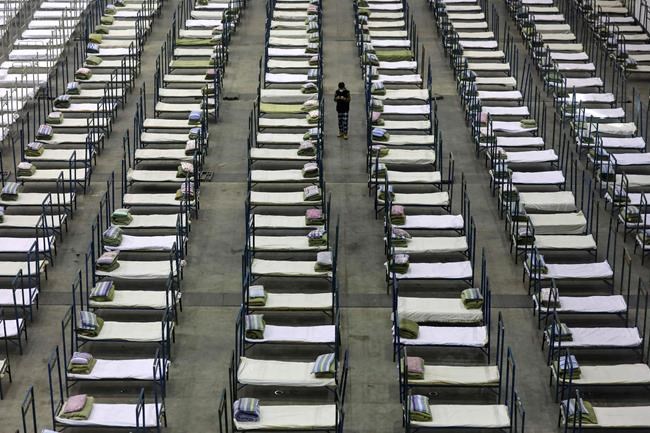
FILE - In this Feb. 4, 2020, file photo, a worker walks among beds in a convention center that has been converted into a temporary hospital in Wuhan in central China's Hubei Province. Health officials hope to avoid stigma and error in naming the virus causing an international outbreak of respiratory illnesses. But some researchers say the current moniker, 2019 nCoV, which stands for 2019 novel coronavirus, probably won't stick in the public's mind. (Chinatopix via AP)

Markel said he liked when diseases were named after the scientists who first described them. (Think Alzheimer, Parkinson and Tourette.) That’s problematic today with many scientists across the world working on a new ailment at the same time.

SARS was used for severe acute respiratory syndrome when another coronavirus caused a 2002-2003 outbreak. So maybe this one could be called CARS, Markel said.

“I can see why they want to name it something generic but it has to be something people use,” he said. “Otherwise the easier name will take over, and it’s naive to think otherwise.”

In the end, the WHO may have little control over what it’s called, he added.

“Wuhan virus is very catchy — no pun intended,” Markel said. “It’s a very contagious name.”

___

The Associated Press Health and Science Department receives support from the Howard Hughes Medical Institute’s Department of Science Education. The AP is solely responsible for all content.

Report Error Submit a Tip

More Stories

Man accused of assaulting unconscious woman has lengthy record of abuse

Erik Pindera 5 minute read Preview

Man accused of assaulting unconscious woman has lengthy record of abuse

Erik Pindera 5 minute read 2:01 AM CDT

A convicted sex offender accused of sexually assaulting an unconscious woman last week — only to be stopped in the process by police officers — has a lengthy history of abusing vulnerable victims.

Harley Aaron Okemow, 34, was arrested Oct. 21 on Stanley Street, near Henry Avenue, and charged with sexual assault causing bodily harm.

He had been released from provincial jail in mid-September, with a sentence of two years of supervised probation plus the time he served behind bars awaiting court, after pleading guilty to several breaches of court orders committed earlier this year.

“Mr. Okemow … does have a serious record … that includes sexually offending against six different victims, five of which were children,” said Crown prosecutor Katie Dojack at Okemow’s sentencing last month.

Read
2:01 AM CDT

Property tax hike included in Gillingham’s costed platform

Joyanne Pursaga 5 minute read Preview

Property tax hike included in Gillingham’s costed platform

Joyanne Pursaga 5 minute read Updated: Yesterday at 6:49 PM CDT

Mayoral candidate Scott Gillingham says property taxes will rise another 3.5 per cent in 2027, with no set cap on potential increases in each of the following three years, if he is re-elected as mayor on Wednesday.

A new property tax target would instead be determined by city council for the following three budget years, with a goal to keep annual hikes “close to inflation,” respect affordability and protect essential services, Gillingham said while releasing a costed election platform Monday.

“To say today we’re going to set a (property tax hike) target, set an amount without knowing where the inflationary rates would go would be irresponsible,” he said.

In his 2022 election campaign, Gillingham promised to raise taxes by 3.5 per cent per year. However, the city instead imposed a 5.95 per cent property tax hike in 2025, Winnipeg’s largest single-year increase since the 1990s.

Read
Updated: Yesterday at 6:49 PM CDT

Jets players glad to have Hellebuyck trade behind them

Mike McIntyre 6 minute read Preview

Jets players glad to have Hellebuyck trade behind them

Mike McIntyre 6 minute read Saturday, Oct. 24, 2026

Relief? Regret? Rage?

How are the Winnipeg Jets feeling following Friday’s Connor Hellebuyck trade — particularly those with deep roots and strong bonds with the franchise goaltender who now finds himself a member of the New Jersey Devils?

“It was a bit of a cloud hanging over our heads,” captain Adam Lowry admitted on Saturday. “It’s nice we can look forward now. We don’t have to keep talking about it. We’ve got guys that want to be here.”

That was a bit of a common theme around the room following an outdoor practice at Princess Auto Stadium ahead of Sunday’s Heritage Classic game against the Montreal Canadiens.

Read
Saturday, Oct. 24, 2026

Express the merry widow you truly are

Maureen Scurfield 5 minute read 2:00 AM CDT

DEAR MISS LONELYHEARTS: My husband died a while back, and I don’t miss him! He had grown old in a strange and cranky way, and I’m a cheerful person by nature. It was hard to hear him shoot down every idea I had to go out and do things together.

He wasn’t physically ill — just finished with having any fun. He had gotten depressed and wouldn’t take anti-depressants, although he was fine with getting drunk and critical towards me.

He was particularly negative about seeing friends and relatives, and living the active way we used to — always the first to get tickets to concerts and encouraging other friends to go with us for dinners at new restaurants. We also went to a lot of sports games, and visited friends and relatives. We arrive with lots of good food and drink.

So now when people ask me in that pitying voice used for widows, “Poor darling, how are you doing?” I respond, “He was miserable towards the end, and it was a relief when he died.” They look shocked, but it’s the truth, and they know it.

Letters, Oct. 27

7 minute read 2:01 AM CDT

Time for ranked ballots?

Re: Get out and exercise your franchise (Editorial, Oct. 24)

Declining turnout is indeed a threat to our democracy and, while I am grateful that the editorial mentioned proportional representation, the issue on the municipal level can be solved far more simply — using ranked-choice voting.

In the last Winnipeg municipal election, the mayor “won” the election with only 27 per cent of the vote. Multiply that by the turnout of 37.5 per cent and the mayor’s positive mandate — the portion of the electorate that voted for him as mayor — drops to a paltry 10 per cent. That number should shock us into an awareness that the single-mark ballot has failed us miserably.

Winnipeg put on a great event with Heritage Classic, Jets can’t hold up their end of the bargain

Mike McIntyre 7 minute read Preview

Winnipeg put on a great event with Heritage Classic, Jets can’t hold up their end of the bargain

Mike McIntyre 7 minute read Updated: Yesterday at 7:36 AM CDT

The Winnipeg Jets know how to throw a great outdoor party. Unfortunately for the club, they haven’t perfected the all-important hockey portion of the Heritage Classic.

A 2-1 loss to the Montreal Canadiens on Sunday night inside Princess Auto Stadium comes 10 years after a 3-0 downer against the Edmonton Oilers inside the same football facility.

Better luck in 2036, perhaps?

Hey, at least the Jets finally found a way to score a goal in this one as Isak Rosen broke Jacob Fowler’s shutout bid with just under five minutes left in regulation. But they were ultimately unable to finish off a memorable weekend with a much-needed win in front of a raucous, sold-out crowd of 32,343.

Read
Updated: Yesterday at 7:36 AM CDT