Climate change could open new land to farming, but caution needed: study

Advertisement

Advertise with us

Climate change could open a whole different area in Canada to farming, says newly published research.

Read this article for free:


or

Already have an account? Log in here »

To continue reading, please subscribe:

Subscribe and receive a limited-edition Free Press branded hat or tote.

Digital Subscription

One year of digital access for only $205*

  • Enjoy unlimited reading on winnipegfreepress.com
  • Read the E-Edition, our digital replica newspaper
  • Access News Break, our award-winning app
  • Play interactive puzzles

*First annual payment billed as $205.00 + GST for one year. This annual subscription will automatically renew at $233.00 + GST every 52 weeks (10% off the regular annual price of $259.35). Offer available to new and qualified returning subscribers only. Cancel any time.

To continue reading, please subscribe:

Add Free Press access to your Brandon Sun subscription for only an additional

$1 for the first 4 weeks*

  • Enjoy unlimited reading on winnipegfreepress.com
  • Read the E-Edition, our digital replica newspaper
  • Access News Break, our award-winning app
  • Play interactive puzzles
Start now

*Your next Brandon Sun subscription payment will increase by $1.00 and you will be charged $17.95 plus GST for four weeks. After four weeks, your payment will increase to $24.95 plus GST every four weeks.

Hey there, time traveller!
This article was published 12/02/2020 (2369 days ago), so information in it may no longer be current.

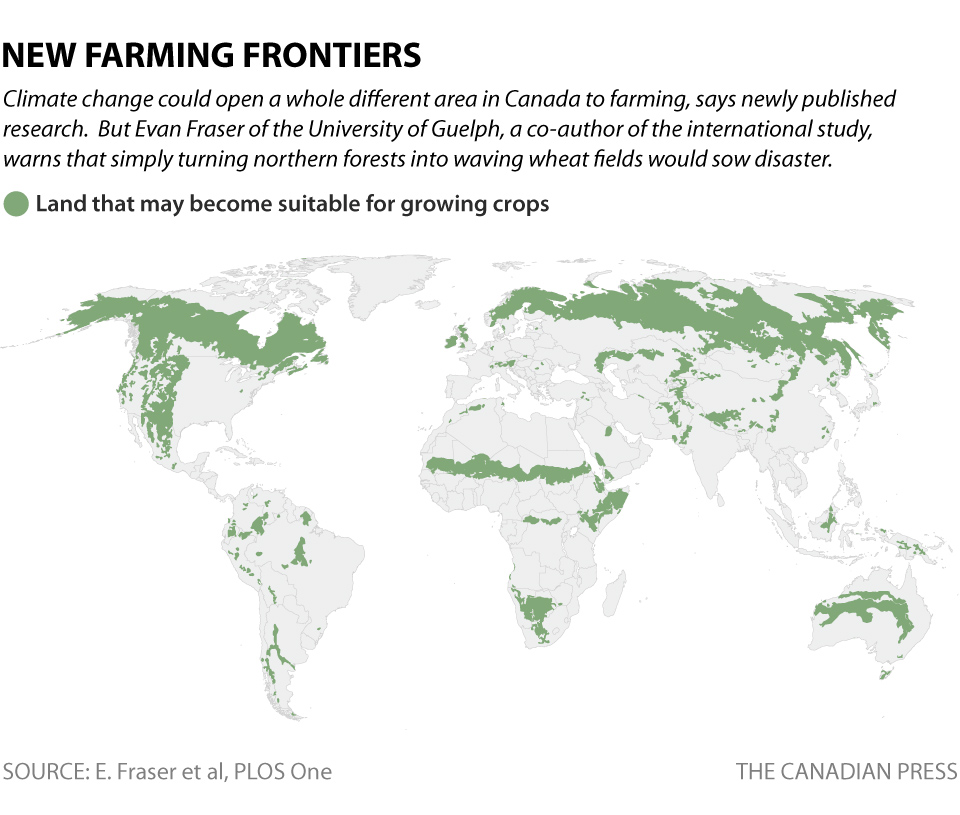
Climate change could open a whole different area in Canada to farming, says newly published research.

But Evan Fraser of the University of Guelph, a co-author of the international study, warns that simply turning northern forests into waving wheat fields would sow disaster.

“Canada is actually holding a good card when it comes to climate change, and one of the potentially positive changes is a longer growing season in our backyard,” he said. “There is an interesting opportunity to generate food in a world that needs more.
Climate change could open a whole different area in Canada to farming, says newly published research.  (The Canadian Press)
Climate change could open a whole different area in Canada to farming, says newly published research. (The Canadian Press)

“(But) there’s some very serious environmental consequences.”

Fraser and his colleagues looked at temperature and precipitation projections for large swaths of the globe currently unsuitable for growing crops. They found that, if only those two factors are considered and current international greenhouse gas policies continue, climate change could by 2060 open up land equal to about 30 per cent of that now under cultivation.

The big winners would be Canada and Russia, which could each see more than four million square kilometres of boreal forest become arable land that might be able to grow cold-tolerant plants such as potatoes, wheat, maize and soy.

That would make the 650,000 square kilometres Canada now harvests look like a farmyard.

It would also be great news for a hungry planet that some studies suggest needs to increase food production by 70 per cent within 30 years.

There’s a catch. Simply plowing the new land would release vast amounts of carbon to the atmosphere.

Fraser calculates that, globally, the top metre of the frontier soils could unleash up to 117 billion tonnes of greenhouse gases — about 119 years worth of all emissions in the United States.

“If we clear a lot of land and plow a lot of soil, what we could see is a huge release of carbon dioxide,” he said. “For Canada, a large-scale conversion of land in the North to agriculture would eliminate any chance we have as a country of meeting our Paris commitments.”

The study doesn’t account for how much land climate change could make unfarmable. The effect on lakes, rivers and wetlands of agricultural conversion is also unknown. Impact on biodiversity — for example, caribou herds or the billions of birds that depend on the boreal forest for nesting — has not been measured.

Fraser points out the land that could be transformed isn’t empty either. It’s the home for thousands of Indigenous people in Canada and around the world.

“We have to be mindful of the fact that these are the homes of people. Any land-use decisions and any opportunity that results has to be done very explicitly with Aboriginal people at the centre of it.”

If farming in northern latitudes seems far-fetched, remember the Amazon, said Fraser.
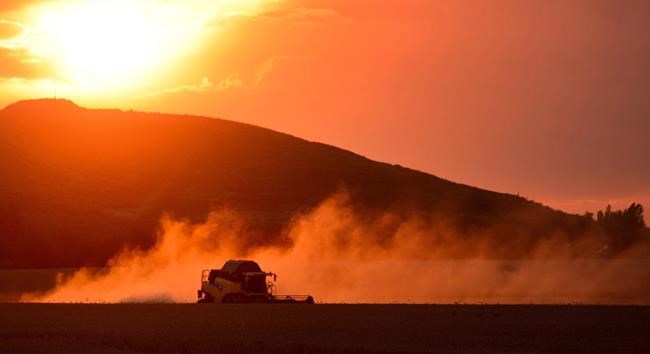
A farmer harvests wheat with a combine harvester against the light of the setting sun near Sehnde, Germany, August 11, 2014. Climate change could open a whole new Canadian farming frontier, says newly published research. THE CANADIAN PRESS/AP Photo/dpa, Julian Stratenschulte

“Thirty years ago, we didn’t think the Amazon would be converted to farms. Then a plot was cleared, and another little plot was cleared, and over a 20-year period, we now have a massive land-use change that’s had huge environmental and cultural impacts.”

He said the paper is preliminary and much more needs to be done to understand the possibilities and consequences of Arctic agriculture. Berry crops or caribou husbandry might be both sustainable and culturally appropriate, he suggested.

Still, Fraser said, some are already considering bigger things.

“There are casual conversations with policy-makers or casual conversations with industry … thinking, ‘Canada’s going to have this warmer growing season. We can do agriculture farther North.'”

The Northwest Territories has already adopted an agricultural strategy to increase the amount of food grown locally.

Yes, but, said Fraser.

“If we’re thinking of developing strategies for taking advantage of these new, longer growing seasons, we really have to do it in a way that’s mindful of the environment.”

This report by The Canadian Press was first published Feb. 12, 2020

— Follow Bob Weber on Twitter at @row1960
Report Error Submit a Tip

More Stories

$60M, six-storey Harbourview Terrace due to open in June 2028

Aaron Epp 4 minute read Preview

$60M, six-storey Harbourview Terrace due to open in June 2028

Aaron Epp 4 minute read Yesterday at 7:24 PM CDT

They donned high-vis vests and brandished shovels with gold-coloured blades Friday morning at the ceremonial groundbreaking for a multi-family residential development in northeast Winnipeg.

Concord Projects has started construction of Harbourview Terrace, the inaugural development by two-year-old real estate company Foxhill Properties. Located in North Kildonan at 1820 De Vries Ave., the $60-million, six-storey apartment building will contain 179 units.

Founder and president Frank Koch-Schulte, who runs the company with his wife Alisha, said Foxhill wants to develop and manage properties with integrity.

“This is kind of like my opportunity to try to do things our way, which I feel is a way that keeps tenants in mind,” Koch-Schulte said. “We live in this neighbourhood. We’re very much invested in seeing quality housing go here.”

Read
Yesterday at 7:24 PM CDT

Sending the wrong message

Andrea Charron 4 minute read 2:01 AM CDT

The U.S. State Department has announced plans to close five overseas diplomatic posts approved by Congress: Douala, Cameroon (a branch office); St. George’s, Grenada (an embassy); Nagoya, Japan (a consulate); Medan, Indonesia (a consulate); and Winnipeg, Canada (a consulate).

All are located in countries that are partners or allies of the United States.

It is unusual for the United States to reduce its diplomatic footprint. With the exception of some retrenchment efforts during the Trump administration, Washington has generally viewed diplomacy as a force multiplier. Diplomacy is not simply a matter of authority and leverage. It requires sustained local engagement, relationships and presence.

Consulates and branch offices are not the same as embassies. They are smaller missions, headed by consuls or consuls general rather than ambassadors and often provide a more limited range of services. Yet they play a vital political, economic and cultural role, supporting both local populations and American citizens abroad.

Kinder, gentler drug crackdown finds support, tempered expectations in Main Street area

Chris Kitching 9 minute read Preview

Kinder, gentler drug crackdown finds support, tempered expectations in Main Street area

Chris Kitching 9 minute read Yesterday at 7:11 PM CDT

Drawing a lighter from his pocket, a shirtless man perched on a concrete wall outside United Way Winnipeg’s Main Street headquarters heats a substance in a glass pipe and moves the tube toward his mouth.

Read
Yesterday at 7:11 PM CDT

Chrysler refines Pacifica and Grand Caravan as buyers return to practical family hauler

Kelly Taylor 5 minute read Preview

Chrysler refines Pacifica and Grand Caravan as buyers return to practical family hauler

Kelly Taylor 5 minute read Yesterday at 3:00 AM CDT

BURLINGTON, Ont. — The mighty minivan — relegated to the scrap heap by the rush to crossovers and SUVs — is making a comeback, and Chrysler hopes to lead the way with its top-selling, Canadian-made Grand Caravan and Pacifica models.

While many manufacturers — Mazda, Ford, GM, Hyundai and Nissan — abandoned the once-popular family hauler, Chrysler has continued to play in the segment since it was launched by Lee Iacocca in 1983.

For 2027, the Pacifica gets a cosmetic refresh and the Grand Caravan is a holdover, but new this year are price savings of up to $7,200, Chrysler product planner Mike Szymkiewicz told journalists assembled here for the launch of the two vehicles.

“It’s primarily that we’re taking less margin, but we’re also adding content,” he said. “So less margin but we hope more volume.”

Read
Yesterday at 3:00 AM CDT

The view from here: Phyllis Green. Boob Tree, 1975

2 minute read Preview

The view from here: Phyllis Green. Boob Tree, 1975

2 minute read 2:01 AM CDT

Staycation: The Art of Being Here feautres more than 100 Manitoba-related artworks from the Winnipeg Art Gallery-Qaumajuq collection, spanning the past 50 years. These pieces reveal how the places around us are layered with memory, story and lived experience. Over the coming weeks, the Free Press will spotlight works from this eclectic exhibition, each one offering a new way of seeing home. Experience it in person and enjoy some staycation time at the gallery, on view until December.

Phyllis Green. Boob Tree, 1975

(Yarn, wood. Collection of the Winnipeg Art Gallery; Acquired with funds from the Estate of Mr. and Mrs. Bernard Naylor, funds administered by The Winnipeg Foundation, 2014-128. Photo: Ernest Mayer.)

The year 1975 was designated International Women’s Year by the United Nations, and in celebration, the WAG staged the show Images of Women, which explored how women had historically been depicted, an impressive selection but by mostly male artists. Amid pushback from the community, Sharron Zenith Corne and Marian Yeo organized a second exhibition, Woman as Viewer, which challenged those portrayals by only featuring works by women. It was called the first Canadian exhibition of feminist art. American artist Phyllis Green’s Boob Tree, a four-foot-tall crochet sculpture of a cluster of breasts, adorned the exhibit posters, which were so popular they were snatched by passersby! The sculpture is playful and unsettling, re-appropriating the objectification of women’s bodies.

Read
2:01 AM CDT

Letters, Aug. 8

7 minute read 2:01 AM CDT

Where is the love?Re: The true costs of your pet — for everyone (Think Tank, Aug. 7)

Before I put Jerry Storie’s mean-spirited diatribe at the bottom of the cage of my precious lovebirds, Harry and Sally, they need to tell him that not only do pet birds add joy and song to a household, they also represent love for all in the pet kingdom.

Yes, pets cost money but they’re still cheaper than kids. Pets earn their keep just by being the lovable creatures they are. Even those with behaviour problems deserve our care.

The animal-human bond has been scientifically proven to reduce stress, blood pressure and, most importantly, loneliness. Pets can help children learn social skills and are crucial to society as therapy agents. They get folks out walking and talking to each other. Many unsheltered people have comfort pets, often feeding their pets before themselves. Manitoba Harvest gives out pet food when donations allow, and Bear Clan has held pet food drives.