

Mild weather bringing trophy-sized pike
Advertisement
Read this article for free:
or
Already have an account? Log in here »
To continue reading, please subscribe:
Monthly Digital Subscription
$0 for the first 4 weeks*
- Enjoy unlimited reading on winnipegfreepress.com
- Read the E-Edition, our digital replica newspaper
- Access News Break, our award-winning app
- Play interactive puzzles
*No charge for 4 weeks then price increases to the regular rate of $19.95 plus GST every four weeks. Offer available to new and qualified returning subscribers only. Cancel any time.
Monthly Digital Subscription
$4.99/week*
- Enjoy unlimited reading on winnipegfreepress.com
- Read the E-Edition, our digital replica newspaper
- Access News Break, our award-winning app
- Play interactive puzzles
*Billed as $19.95 plus GST every four weeks. Cancel any time.
To continue reading, please subscribe:
Add Free Press access to your Brandon Sun subscription for only an additional
$1 for the first 4 weeks*
*Your next subscription payment will increase by $1.00 and you will be charged $16.99 plus GST for four weeks. After four weeks, your payment will increase to $23.99 plus GST every four weeks.
Read unlimited articles for free today:
or
Already have an account? Log in here »
Hey there, time traveller!
This article was published 15/02/2020 (2153 days ago), so information in it may no longer be current.
As the winter progresses, fishing around the province remains strong. A big story this ice fishing season has been the number of trophy-sized pike caught. Much of that success can be attributed to the extended period of stable, mild weather. Most fish activity level is affected by cold fronts, or extreme changes in temperatures. We have been fortunate this year in that regard.
Big pike love this kind of stability, roaming constantly in search of food. There have been two bodies of water of note, Lake of the Prairies and the north basin of Lake Winnipeg. Last week Phil Paczkowski of Roblin caught and released his personal best pike from Lake of the Prairies. It measured 119 centimetres (47 inches) and by using the weight conversion chart, weighed approximately 15 kilograms (33 pounds). This is a true trophy anywhere in the world.
Paczkowski has proved it isn’t a fluke, having landed numerous trophies all winter long. He likes to set his tip-ups on a big sand flat next to the main river channel. This area is about three metres in depth. He prefers that area, because when the fish are up on this flat, he believes they are actively looking for food.
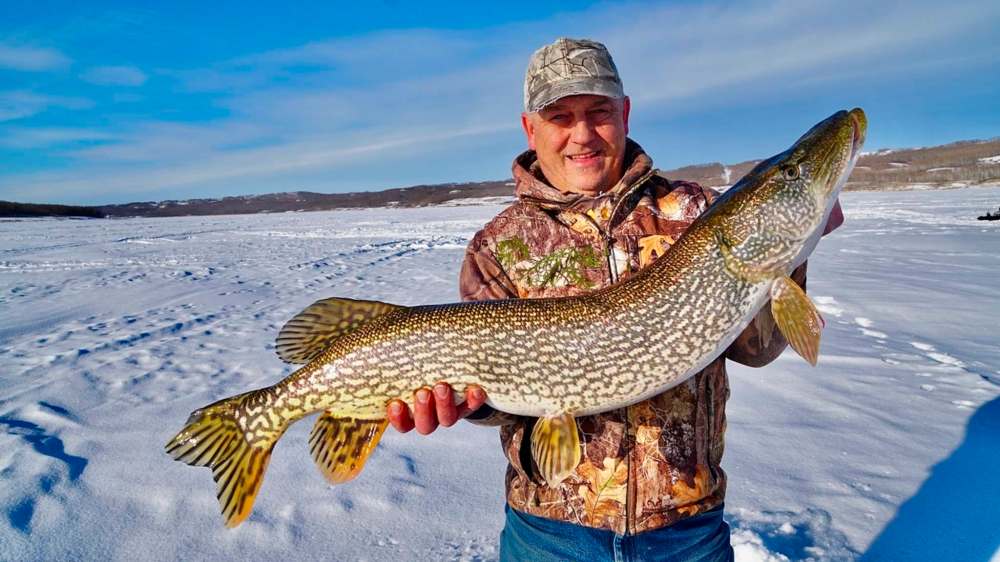
Professional angler Jeff Gustafson (Gussy) loves to target them on his home waters of Lake of the Woods. He agrees that by far the best method is by using tip-ups and dead bait. He can’t believe more anglers don’t use them or even own one.
He likes to use the Frabill Pro Thermal Round Tip-Up. While they have been around for years, he says they are great because they cover the hole. While they do provide some insulation to keep the hole from icing over as fast, they keep blowing snow and bright light from entering the hole, which he is a big fan of.
Gussy uses heavy line, usually 40-pound line designed for fishing on tip-ups, which is easy thick and easy to handle with gloves on. It’s strong and does not tangle. He prefers to use the Northland Predator Rig to hang his baits, but quick-strike rigs for hanging the bait can be made at home as well. He likes the Predator Rig because it hangs the bait horizontally in a natural fashion. Gussy just ties the rig directly to the heavy tip-up line and never seems to have any issues, the fish do not seem to care.
For bait, frozen Cisco is his favourite, which he catches through the ice while fishing other species They are aggressive and like to eat small panfish sized spoons — if you find them, they are easy to catch.
Gussy has tried live bait many times and it never works as well as dead bait does. On the quick strike rig you have two treble hooks on the rigs, so put one in the head of the bait and one in the back, usually around the dorsal fin. Gussy likes to let the bait hit the bottom then lift it up about one to two feet above bottom, and let it hang. When a fish bites, let it run briefly, then set the hook with a long sweep. If you let these fish run to long with the bait, they will swallow it and will often be hooked badly.
Anglers Notes: There was a storm on social media last week when anglers fishing Lake Winnipeg were checked by conservation officers enforcing the disposal of frozen bait. The department is in the process of conducting a five-year review of its aquatic invasive species (AIS) legislation as part of its overall strategic plan and concerns around this regulation from resource users will be included in this review. While the review is underway, the Manitoba government is clarifying the requirements for bait disposal.
Commercially-supplied dead bait that has not come into contact with water from a waterbody in an AIS control zone can be retained by anglers for future use. All live bait possessed in an AIS control zone must still be disposed in the trash before leaving the shore, as must any dead bait that has been handled (i.e. hooked) or come into contact with surface water from the lake.
This will take effect in trust that anglers will act responsibly in ensuring dead bait has not been hooked or has not come into contact with surface water from the lake and that contaminated bait is disposed of before leaving.
dlamont46@gmail.com