

Review addressing inquiry’s calls for justice ready for EPC
Those with lived experience must be involved in process, says local advocate

Advertisement
Read this article for free:
or
Already have an account? Log in here »
To continue reading, please subscribe:
Digital Subscription
One year of digital access for only $1.44 a week*
- Enjoy unlimited reading on winnipegfreepress.com
- Read the E-Edition, our digital replica newspaper
- Access News Break, our award-winning app
- Play interactive puzzles
*Billed as $5.77 plus GST every four weeks. After 52 weeks, price increases to the regular rate of $19.95 plus GST every four weeks. Offer available to new and qualified returning subscribers only. Cancel any time.
To continue reading, please subscribe:
Add Free Press access to your Brandon Sun subscription for only an additional
$1 for the first 4 weeks*
- Enjoy unlimited reading on winnipegfreepress.com
- Read the E-Edition, our digital replica newspaper
- Access News Break, our award-winning app
- Play interactive puzzles
*Your next Brandon Sun subscription payment will increase by $1.00 and you will be charged $17.95 plus GST for four weeks. After four weeks, your payment will increase to $24.95 plus GST every four weeks.
Read unlimited articles for free today:
or
Already have an account? Log in here »
Hey there, time traveller!
This article was published 12/03/2020 (2269 days ago), so information in it may no longer be current.
The City of Winnipeg is taking another step in its journey of reconciliation.
Shortly after the the final report of the National Inquiry into Missing and Murdered Indigenous Women and Girls was released early in June 2019, Winnipeg’s executive policy committee tasked public service staff with preparing a review that details the city’s existing responses to the report’s more than 200 calls for justice, and suggests further measures that can be taken to address the inquiry’s calls.
That report is now finished, and the document being brought before the committee next Tuesday outlines Winnipeg’s pre-existing and possible future responses to 108 calls for justice that fall under city jurisdiction.
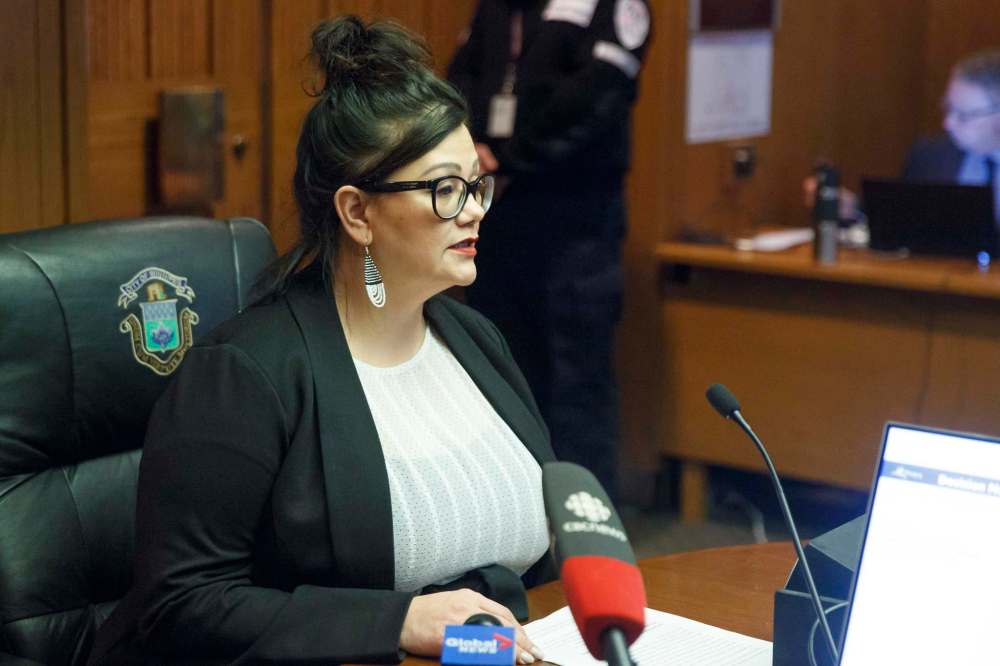
“Taking that step forward is really critical because many people have been silent on the final report and the calls for justice,” Hilda Anderson-Pyrz, MMIWG liaison unit manager at Manitoba Keewatinowi Okimakanak, said in an interview Thursday.
“I think the City of Winnipeg even committing to doing this and coming out with the document speaks volumes.”
Some measures discussed in the review have been in the works since 2015, when the city began responding to the Truth and Reconciliation Commission of Canada’s 94 calls to action aimed at redressing the legacy of residential schools in Canada. Now the city is looking into how it can expand on initiatives already in place, or add more programming within current budget limits.
“I want to see adequate programming to support especially vulnerable Indigenous women and girls that is culturally appropriate, to have those safe spaces for them to go to and to ensure that there’s adequately funded service providers who are there to strengthen and empower and support vulnerable Indigenous women, girls, two-spirit and gender-diverse people,” Anderson-Pyrz said about her hopes for the city’s response plan.
More than 9,400 city employees have already taken mandatory Indigenous awareness training, though this latest review recommends enhancing these training opportunities in the future.
The Indigenous Youth Strategy, Oshki Annishinabe Nigaaniwak, works to provide access to cultural programming, support, employment and literacy, and the review recommends finding ways to bolster the strategy’s programming and funding to better address the calls in the national inquiry report.
Under the policing banner, Winnipeg Police Service’s counter-exploitation unit has been working with several groups to ensure the agency and lived experience of Indigenous women and girls is taken into account, and has drafted a proposal to create and fund an ongoing social worker position in the 2020-23 budget.
Anderson-Pyrz hopes to see more of these specific financial commitments as the city develops more tangible plans.
“There’s already such a strain on the current services and supports that are provided within the City of Winnipeg, if they want meaningful action they have to be ready to commit those financial resources,” she said.
Beyond the initiatives the city has already started rolling out, the report offers a number of suggestions for future actions that city administration can get moving on right away, including the development of an employee campaign to garner awareness of the inquiry’s final report; improvements to Winnipeg’s current data collection methods; partnership with Winnipeg Transit to improve safety measures and staff training; and specific recommendations to support Inuit and Métis peoples in the city.
Mitch Bourbonniere, program director for grassroots Indigenous youth advocacy group Ogijiita Pimatiswin Kinamatawin, finds the report’s recommendations in line with a positive culture he’s seen among the city’s top brass in addressing the needs of Winnipeg’s Indigenous communities, but notes there’s always more work to be done, especially in educating the general public about the severity of the MMIWG crisis.
“These are people with lives and families. I think we need to keep in the forefront that this city still has a lot of issues we need to deal with,” Bourbonniere said in an interview Wednesday. “We’re never doing all that we can.”
In his work, largely with the community’s at-risk youth and youth in care, Bourbonniere said there are opportunities for low-cost measures to help keep vulnerable community members safe. Transit, as an example, is “underused as a resource,” he said.
These kinds of suggestions, coming directly from community members with lived experience of the issues facing Indigenous people in Winnipeg, are what Anderson-Pyrz wants to see more of as the city continues to respond to the inquiry’s report.

“It really needs to be emphasized that the families and survivors, and two-spirited and gender-diverse people who are impacted need to be part of the process because they have the answers, they know the solutions, they have the lived experience,” she said.
“If you don’t have that lived experience and you don’t know exactly what’s happening on the ground…you could be missing a lot of really important factors that come into play.”
If the report is approved by executive policy committee next week, the Indigenous relations division will begin consultation with other departments and community members to explore ways to implement the recommendations in the near future, a spokesperson for the city said in an email Wednesday.
julia-simone.rutgers@freepress.mb.ca
Twitter: @jsrutgers
Julia-Simone Rutgers is the Manitoba environment reporter for the Free Press and The Narwhal. She joined the Free Press in 2020, after completing a journalism degree at the University of King’s College in Halifax, and took on the environment beat in 2022. Read more about Julia-Simone.
Julia-Simone’s role is part of a partnership with The Narwhal, funded by the Winnipeg Foundation. Every piece of reporting Julia-Simone produces is reviewed by an editing team before it is posted online or published in print — part of the Free Press‘s tradition, since 1872, of producing reliable independent journalism. Read more about Free Press’s history and mandate, and learn how our newsroom operates.
Our newsroom depends on a growing audience of readers to power our journalism. If you are not a paid reader, please consider becoming a subscriber.
Our newsroom depends on its audience of readers to power our journalism. Thank you for your support.
Julia-Simone Rutgers is the Manitoba environment reporter for the Free Press and The Narwhal. She joined the Free Press in 2020, after completing a journalism degree at the University of King’s College in Halifax, and took on the environment beat in 2022. Read more about Julia-Simone.
Julia-Simone’s role is part of a partnership with The Narwhal, funded by the Winnipeg Foundation. Every piece of reporting Julia-Simone produces is reviewed by an editing team before it is posted online or published in print — part of the Free Press‘s tradition, since 1872, of producing reliable independent journalism. Read more about Free Press’s history and mandate, and learn how our newsroom operates.
Our newsroom depends on a growing audience of readers to power our journalism. If you are not a paid reader, please consider becoming a subscriber.
Our newsroom depends on its audience of readers to power our journalism. Thank you for your support.
Advertisement Advertise With Us
Advertisement Advertise With Us