

Dollapalooza!
Doll collectors, vendors transforming Viscount Gort into giant annual dollhouse of memories
Advertisement
Read this article for free:
or
Already have an account? Log in here »
To continue reading, please subscribe:
Monthly Digital Subscription
$0 for the first 4 weeks*
- Enjoy unlimited reading on winnipegfreepress.com
- Read the E-Edition, our digital replica newspaper
- Access News Break, our award-winning app
- Play interactive puzzles
*No charge for 4 weeks then price increases to the regular rate of $19.00 plus GST every four weeks. Offer available to new and qualified returning subscribers only. Cancel any time.
Monthly Digital Subscription
$4.75/week*
- Enjoy unlimited reading on winnipegfreepress.com
- Read the E-Edition, our digital replica newspaper
- Access News Break, our award-winning app
- Play interactive puzzles
*Billed as $19 plus GST every four weeks. Cancel any time.
To continue reading, please subscribe:
Add Free Press access to your Brandon Sun subscription for only an additional
$1 for the first 4 weeks*
*Your next subscription payment will increase by $1.00 and you will be charged $16.99 plus GST for four weeks. After four weeks, your payment will increase to $23.99 plus GST every four weeks.
Read unlimited articles for free today:
or
Already have an account? Log in here »
Hey there, time traveller!
This article was published 14/03/2020 (2118 days ago), so information in it may no longer be current.
You probably don’t want to kick back and watch old movies with Lorraine Iverach, one of close to 70 vendors and collectors taking part in the seventh Winnipeg Doll Extravaganza Sunday from 10 a.m. to 4 p.m. at the Viscount Gort Hotel.
Iverach, a mother and grandmother, collects a wide variety of dolls: everything from modern-day American Girls to 19th-century china dolls to long-limbed boudoir dolls — also called flapper dolls— which, when they first became popular more than a century ago, weren’t playthings as much as they were decorative pieces for the home, often positioned on a bed or chaise lounge in the same manner as a throw pillow or seat cushion.
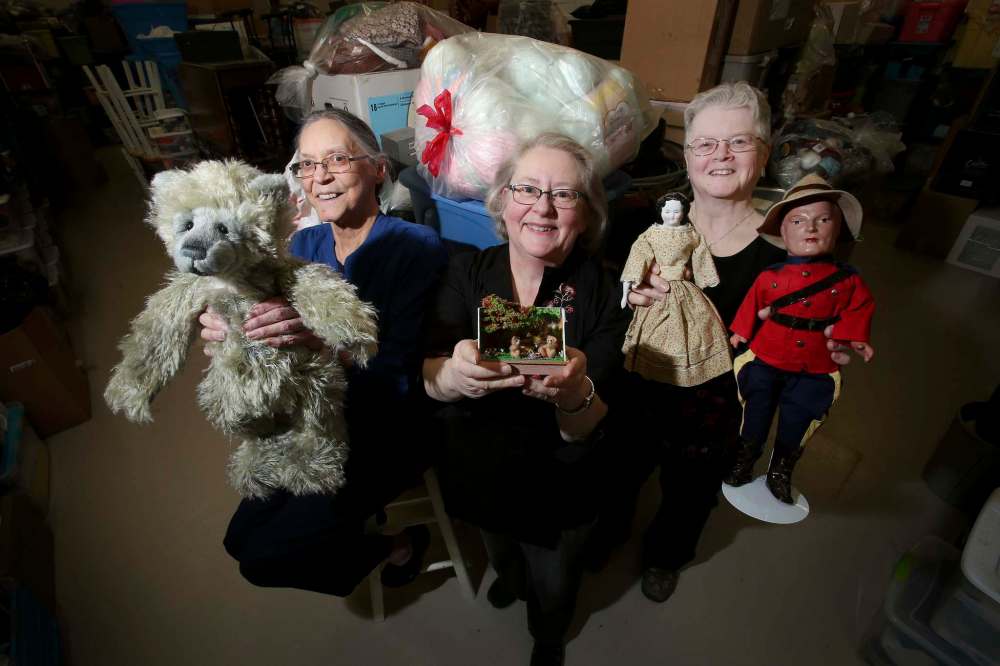
“You spot them quite often in films from the 1930s and ‘40s, which can make it frustrating to watch TV with me at times,” Iverach says, seated next to Kimberly Scutchings and Hedy McClelland, the Winnipeg Doll Extravaganza’s chief organizers.
“My husband and I will be enjoying a show when I’ll suddenly grab the remote and pause the screen. He’ll ask what I’m doing and I’ll point to a doll in the background. If there’s one thing I’ve learned in all the time I’ve been collecting, it’s that it’s very important to have a patient spouse.”
● ● ●
For years, the decades-old Manitoba Doll Club held semi-annual events for members who wanted to share their treasures with the general public. As that organization’s numbers dwindled, their get-togethers got fewer and further between. While the club still meets on a regular basis, it ceased staging shows entirely about 10 years ago.
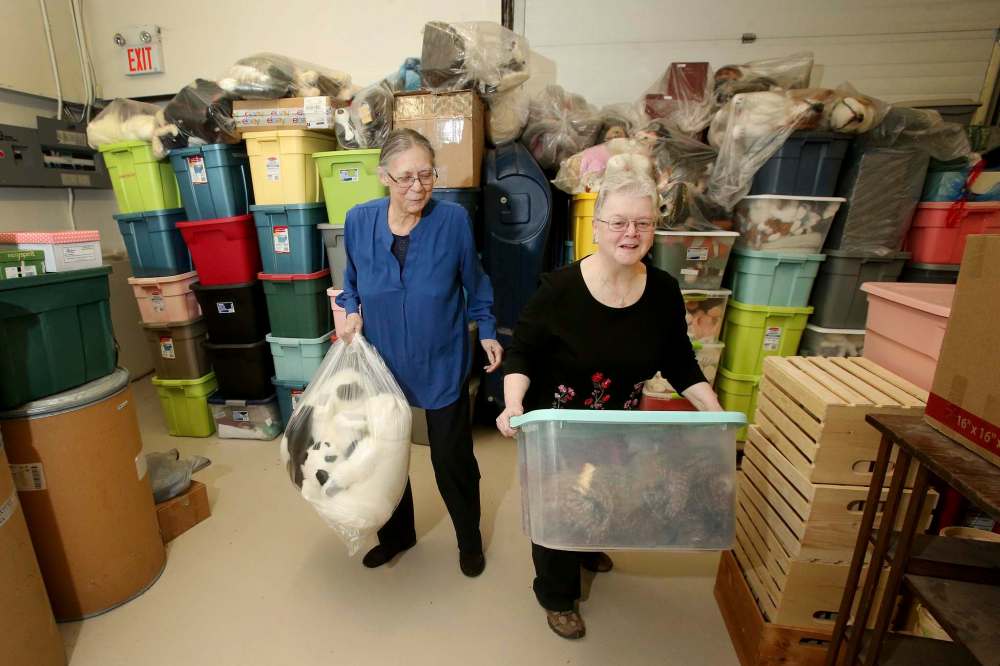
That set of events didn’t sit well with McClelland, whose personal doll collection is so massive she keeps the majority of it inside the 2,500-square-foot storage facility she rents.
“A lot of us who have bigger collections felt it was a shame we weren’t able to show off what we had any longer,” she says. “Even though it’s not what it once was, there’s still an enthusiasm for dolls in the city. So seven years ago, Kim and I decided to resurrect the (doll) show on our own, without any help from the club. We started with 40 tables. The next year we were up to 50, and this year we’ll almost be spilling out into the hallway.”
McClelland says a big part of the fun — for adults at least — is being able to poke through the thousands of collectible and handmade dolls on display or for sale, remarking, “That reminds me of a doll I had when I was a kid.” Just as interesting is the opportunity to chat with individual collectors and artisans, discovering how and why they got into the hobby in the first place, and what they focus on, specifically.
Scutchings, for example, has fond memories of growing up in the West End and being on the receiving end of multiple dolls every time Christmas or her birthday rolled around.
“I had them all, Barbie, Chatty Cathy, you name it, but back then it wasn’t like I was actively collecting. It was more a case of, ‘Oh great, another doll,’” says Scutchings, who belongs to the Miniature Enthusiasts of Winnipeg, an organization devoted to dollhouses and scale-model dioramas.
Her mindset began to change at age 11 when one of her aunts, a serious doll collector, told her it was important to take good care of her toys, as they could be worth a pretty penny one day.
Did she listen? For the most part, although there were always a few dolls she couldn’t bear not to play with, despite her aunt’s advice, she says.
Iverach says she was lucky growing up, because she had two older sisters who routinely turned over their dolls to her when they grew tired of them.
“I didn’t get a lot of new dolls as a child; it was mostly hand-me-downs. But I cherished those as much as the ones I was given directly,” she says.
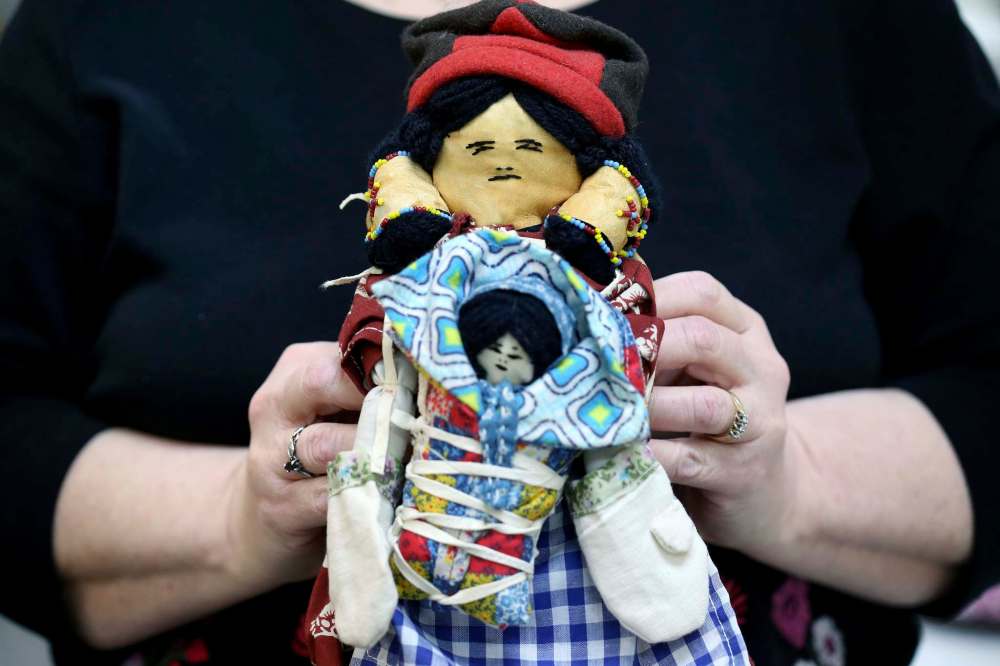
Besides the aforementioned boudoir dolls, Iverach, who studied archeology in university, also has a strong interest in dolls that carry historical or social significance. Reaching into a bag behind her chair, she fetches out an attractive specimen she’ll have with her at the show: a tea doll made by the Innu, the Indigenous inhabitants of a northern area in present-day Labrador.
For hundreds of years, the Innu led a nomadic existence, Iverach explains. With only so much room for supplies when they travelled to their hunting grounds, children’s dolls would be stuffed with extra reserves of tea bags. When the tea was used up, the parents restuffed the dolls, which were usually made out of caribou hide, with moss so the children could continue playing with them.
“The dolls aren’t necessarily used by the communities any longer, but in the ‘70s and ‘80s they became a craft, a way for Innu women to earn some money by showing off their traditional ways.”
Iverach also collects Canadiana dolls, such as a 40-centimetre tall Royal Canadian Mounted Police doll fashioned in 1936 and a so-called celebrity doll depicting Barbara Anne Scott, the 1948 Olympic figure skating champion who was referred to as “Canada’s Sweetheart.”
“It’s funny because my sister had a Barbara Anne Scott doll when she was little, but by the time it came to me, all that was left was her hat,” Iverach says, primping the doll’s skating outfit. “I bought this one from another collector in Winnipeg and am lucky it’s in such good shape. It’s made out of something called composition, which was basically paper maché and glue, so very few ‘survived.’”
McClelland, responsible for an elaborate teddy bear display that will be the first thing people see when they enter the hall, says something else attendees from as far as Saskatchewan appreciate about their event is the opportunity, a bit like Antiques Roadshow, to learn more about a vintage doll they may have inherited from a loved one or picked up at an estate sale.

“They may not necessarily be looking to sell the doll — though there is that opportunity — but rather find out when it was made, that sort of thing,” she says.
“Usually though, we avoid placing monetary values on people’s dolls, mostly because it’s a buyer’s market,” Iverach pipes in. “When Beanie Babies were all the craze in the ‘90s, people were practically mortgaging their homes to buy as many as they could, thinking they were going to be worth a fortune one day. Now you see them at Value Village two for a dollar.”
More than anything else, the three women hope the show will introduce a whole new generation of youngsters to the world of dolls, regardless of gender.
“When I was growing up, gender roles were often reflected in the types of toys we played with and the terms we used: dolls for girls, action figures for boys. I mean, how sexist is that?” Iverach says. “Nowadays, instead of just flaunting her assets, Barbie can be an astronaut or video-game designer, which is great because girls and boys can see a reflection of society changing with the way toys are produced.”

Finally, we couldn’t let Scutchings, McClelland and Iverach go without asking the million-dollar question: what about that percentage of the population that suffers from pediophobia, the fear of dolls.
Wouldn’t they be a little freaked out by Sunday’s goings-on?
“I think you’ve watched too many horror movies,” Scutchings says with a laugh. “No, there won’t be any Chuckys at the show. We promise this will be a safe, family event.”
For more information, go to the show’s Facebook page, Winnipeg Doll Extravaganza.
david.sanderson@freepress.mb.ca
Dave Sanderson was born in Regina but please, don’t hold that against him.
Our newsroom depends on a growing audience of readers to power our journalism. If you are not a paid reader, please consider becoming a subscriber.
Our newsroom depends on its audience of readers to power our journalism. Thank you for your support.