Trudeau says refusing to self-isolate after travelling is ‘dangerous’

Advertisement

Advertise with us

OTTAWA - Canadians who ignored the government's request to isolate at home after coming back from a trip abroad endangered the lives of others, Prime Minister Justin Trudeau said Thursday.

Read this article for free:


or

Already have an account? Log in here »

To continue reading, please subscribe:

Subscribe and receive a limited-edition Free Press branded hat or tote.

Digital Subscription

One year of digital access for only $205*

  • Enjoy unlimited reading on winnipegfreepress.com
  • Read the E-Edition, our digital replica newspaper
  • Access News Break, our award-winning app
  • Play interactive puzzles

*First annual payment billed as $205.00 + GST for one year. This annual subscription will automatically renew at $233.00 + GST every 52 weeks (10% off the regular annual price of $259.35). Offer available to new and qualified returning subscribers only. Cancel any time.

To continue reading, please subscribe:

Add Free Press access to your Brandon Sun subscription for only an additional

$1 for the first 4 weeks*

  • Enjoy unlimited reading on winnipegfreepress.com
  • Read the E-Edition, our digital replica newspaper
  • Access News Break, our award-winning app
  • Play interactive puzzles
Start now

*Your next Brandon Sun subscription payment will increase by $1.00 and you will be charged $17.95 plus GST for four weeks. After four weeks, your payment will increase to $24.95 plus GST every four weeks.

Hey there, time traveller!
This article was published 26/03/2020 (2357 days ago), so information in it may no longer be current.

OTTAWA – Canadians who ignored the government’s request to isolate at home after coming back from a trip abroad endangered the lives of others, Prime Minister Justin Trudeau said Thursday.

Trudeau, in his daily briefing to Canadians, said while many Canadians heeded the request, there were too many people who played fast and loose with the rules, and because of them, the government had no choice but to turn what had been a request into an order.

“If you’ve just returned from abroad, you have to go home and stay home for 14 days,” Trudeau said. “But some people have not been taking this seriously. They’re stopping by the grocery store on their way home from the airport. They’re getting together with friends after being away for March break. This kind of conduct is not just disappointing, it’s dangerous.”
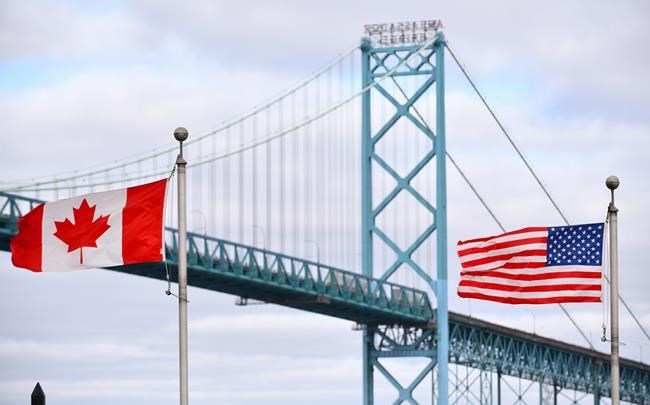
Canadian and American flags fly near the Ambassador Bridge at the Canada/USA border crossing in Windsor, Ont. on Saturday, March 21, 2020. THE CANADIAN PRESS/Rob Gurdebeke

Outbreaks of the novel coronavirus are much more widespread in other parts of the world, including the United States, Europe and parts of Asia. This raises the risk that people returning to Canada from a trip were exposed to the virus and more likely to spread the illness to others after arriving home.

Newfoundland and Labrador is proof of how one person can have a significant impact on the caseload. That province reported 44 people with COVID-19 were linked to a single individual who attended a visitation at a funeral home after returning from a foreign trip. That man returned before Newfoundland issued its own order to enforce quarantine for people arriving in the province but had been asked to self-isolate voluntarily.

Cabinet passed an order Tuesday to use the powers under the Quarantine Act to require people arriving in Canada by land, air or sea, to self-isolate for 14 days. Defying the order could result in fines of up to $1 million or three years in prison.

Enforcing the order is a work in progress and will be updated or changed if circumstances require it, said Dr. Theresa Tam, Canada’s chief public health officer. It will start with random checks for people allowed to quarantine at home, including phone calls from federal and local public health officials. Police can and will be called on to help if someone is found to be violating the quarantine order, said Tam.

“That hopefully will not happen very frequently,” she said.

“That is what we are looking for. But under the Quarantine Act we can engage, potentially, peace officers if needed but again, this is more, this is a deterrent, if you like, a serious reminder of how absolutely important it is to undergo self-isolation.”

Canada Border Services Agency agents will be the first line of enforcement, screening arrivals for symptoms of COVID-19 and issuing orders to all of them depending on their health status.

Travellers must report any signs of a cough or fever to the border guards, and people with symptoms will be treated slightly differently than people without, said Tam.

A traveller with COVID-19 symptoms who needs medical care will be immediately taken to hospital and quarantined there, while those with mild symptoms will be allowed to go home if they can get there directly in their own car with no further public contact. Those who can’t do that or who live with vulnerable people, such as seniors or people with compromised immune systems, will be taken to federal quarantine sites.

All travellers who have no symptoms will be ordered to go home immediately and stay there for 14 days. That includes air travellers who must take a connecting flight. They will be told to monitor for symptoms and given a face mask to use if symptoms appear.

Once at home, the rules are relatively simple. Stay there. Do not go get groceries, don’t fill up the car with gas, don’t run to the pharmacy or the drive-through. If you need food or medicine, ask a friend to deliver it to your doorstep. Dr. Howard Njoo, Canada’s deputy chief public health officer, said Thursday if you have a backyard you can go outside, but do not go outside where any member of the public is.

The quarantine order will be lifted 14 days after the date of arrival back in Canada.

Canada has been gradually raising its isolation requests since the COVID-19 outbreak began in China’s Hubei province in January, starting with arrivals from Hubei in early February, extending it to Iran and Italy in early March, and then to every arrival on March 15. Until now it was a request. Now it is an order.

This report by The Canadian Press was first published March 26, 2020.

Report Error Submit a Tip

More Stories

Fanning takes aim at Canadian title on home course

Mike McIntyre 4 minute read Preview

Fanning takes aim at Canadian title on home course

Mike McIntyre 4 minute read 2:00 AM CDT

Todd Fanning would love to make this a September to remember.

The decorated Manitoba golfer — who added a second straight provincial senior men’s championship to his impressive resumé earlier this summer — is now laser-focused on trying for a national title.

Fanning, 58, is one of the favourites as the Canadian senior men’s championship begins today at Niakwa Country Club, which just so happens to be his home course.

“Anyone who thinks they’re going to come out and see a bunch of old guys just whacking it around (is mistaken),” Fanning recently told the Free Press. “It’s going to be a heck of a week.”

Read
2:00 AM CDT

For newcomer pizza purveyors, it’s all about crafting solid foundations

David Sanderson 7 minute read Preview

For newcomer pizza purveyors, it’s all about crafting solid foundations

David Sanderson 7 minute read Saturday, Sep. 5, 2026

A recent poll conducted by an Internet-based market-research firm determined that close to 20 per cent of people eschew their leftover pizza crust.

Some argued that the residual crust lacks flavour. Others submitted that it’s too hard or crunchy to enjoy sans toppings. Given that information, what are we to make of Crusty Craft Pizza, a five-month-old takeout spot whose owners are so confident in their European-style pizza crust that they’ve chosen to highlight it in their business moniker?

Whenever somebody informs them they don’t like pizza crust, their response is, well, they haven’t tried theirs, says Oleksii Samokvhal, who together with his wife, Iryna Mehedyn, opened Crusty Craft Pizza in early April, at 1311 Day St. in Transcona.

“It’s thin in the middle, with raised edges we hand-form ourselves,” says Mehedyn, a native of Ukraine who, like her Kyiv-born husband, relocated to Winnipeg to escape the conflict in their home country.

Read
Saturday, Sep. 5, 2026

All that glitters … could work here

Editorial 4 minute read Preview

All that glitters … could work here

Editorial 4 minute read 2:00 AM CDT

Sometimes, it’s hard to even suggest a change, because it seems there is always a plethora of people ready to tell you that your idea just won’t work.

But a unique program is working in Portland, Ore. and some version of that program could work in Winnipeg as well. Something that glitters may just be a small nugget of gold.

G.L.I.T.T.E.R. stands for Ground Score Leading Inclusivity Together Through Environmental Recovery.

It’s a long handle for a simple concept. Launched in 2021, the program hires people who are either unhoused or have recently been unhoused to do litter collection and tentside garbage collection for homeless encampments in the Portland region.

Read
2:00 AM CDT

Thousands affected by storm-related power outages

1 minute read Updated: Yesterday at 8:45 PM CDT

Thousands are still without power in Winnipeg after high winds and thunderstorms knocked out power lines Sunday.

About 4,000 Manitoba Hydro customers were still dealing with outages this morning after crews worked to restore power in the Westwood and River Heights areas, Hydro spokesman Peter Chura said. On Sunday, Hydro reported outages affecting approximately 6, 700 customers.

The high winds and heavy rain brought down trees and broke power poles, causing "very severe damage," in River Heights, one of the hardest-hit neighbourhoods, while some of the damage in the Westwood area appeared to be caused by lightning strikes, Chura said.

Thunderstorms rolled in at about 6 p.m. Sunday and brought heavy rain and high winds to some areas of the province. Winnipeg received about 35 mm of rain, while some areas got almost double that. More than 62 mm was recorded at The Forks and 68.8 mm was recorded at Portage Southport, according to Environment Canada.

Canadians do not want to sacrifice nature for development

Emily McMillan and Akaash Maharaj 4 minute read 2:00 AM CDT

Prime Minister Mark Carney’s pledge to build faster — “Build, baby, build” — helped propel the Liberals to victory, but his government’s push to fast-track major development projects by cutting environmental oversight is sharply out of step with Canadians’ priorities.

It is a political miscalculation that could come back to haunt the Liberals at the ballot box.

New polling, commissioned by Nature Canada and conducted by EKOS Research Associates, shows strong support among Canadians for protecting nature and endangered species while building the economy.

Canadians soundly reject the notion that they must sacrifice conservation protections for economic development.

Parts of River Heights hammered by storm

Melissa Martin 5 minute read Preview

Parts of River Heights hammered by storm

Melissa Martin 5 minute read Yesterday at 5:54 PM CDT

A powerful storm cut a swath of destruction through River Heights on Sunday, leaving much of the area without power.

Nobody was hurt in the storm.

By the time it subsided, parts of the quiet neighbourhood, especially Borebank and Lindsay streets between Grant and Taylor, had been ravaged: power lines downed, Manitoba Hydro poles toppled, trees splintered and crashed down on vehicles and homes.

In one case, a vehicle was flipped into a yard and sat under a partially downed tree. Shingles were stripped from roofs. Some residents described looking out during the storm and seeing power lines ablaze and the blue glow of electricity arcing over their backyards.

Read
Yesterday at 5:54 PM CDT