Hold the elevator? How to stay safe in close quarters during COVID-19

Advertisement

Advertise with us

It's becoming an increasingly ambiguous scenario: the elevator door opens and someone is already inside.

Read this article for free:


or

Already have an account? Log in here »

To continue reading, please subscribe:

Subscribe and receive a limited-edition Free Press branded hat or tote.

Digital Subscription

One year of digital access for only $205*

  • Enjoy unlimited reading on winnipegfreepress.com
  • Read the E-Edition, our digital replica newspaper
  • Access News Break, our award-winning app
  • Play interactive puzzles

*First annual payment billed as $205.00 + GST for one year. This annual subscription will automatically renew at $233.00 + GST every 52 weeks (10% off the regular annual price of $259.35). Offer available to new and qualified returning subscribers only. Cancel any time.

To continue reading, please subscribe:

Add Free Press access to your Brandon Sun subscription for only an additional

$1 for the first 4 weeks*

  • Enjoy unlimited reading on winnipegfreepress.com
  • Read the E-Edition, our digital replica newspaper
  • Access News Break, our award-winning app
  • Play interactive puzzles
Start now

*Your next Brandon Sun subscription payment will increase by $1.00 and you will be charged $17.95 plus GST for four weeks. After four weeks, your payment will increase to $24.95 plus GST every four weeks.

Hey there, time traveller!
This article was published 27/03/2020 (2355 days ago), so information in it may no longer be current.

It’s becoming an increasingly ambiguous scenario: the elevator door opens and someone is already inside.

Do you go in, or do you wait for the next one?

Public health officials have been urging Canadians to maintain social distance and avoid high-traffic areas since the onset of the COVID-19 pandemic weeks ago. But for those living in large cities across the country — especially those in apartment buildings or condo clusters — that can be easier said than done.
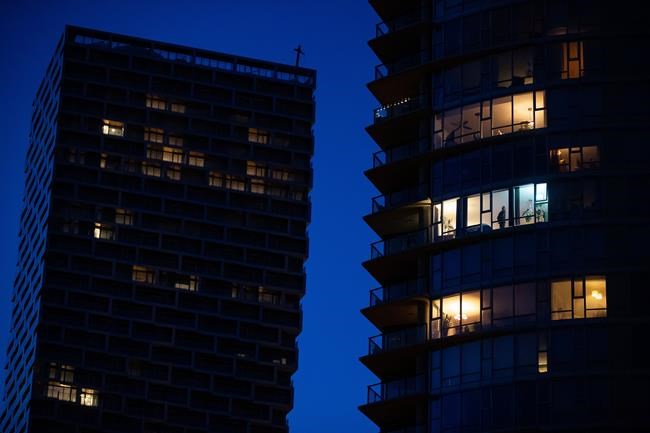
A man stands in the window of an upper floor condo as people have been urged to stay home to help prevent the spread of the coronavirus, in Vancouver, on Tuesday, March 24, 2020. THE CANADIAN PRESS/Darryl Dyck

“The risk is high in those spaces simply because of the population density,” said Kevin Coombs, an infectious disease researcher and professor of medical microbiology at the University of Manitoba. “At the same time though, it’s a bit of a double-edged sword — if you have a large cluster of people, and none of them are infected, well then there’s nothing to be transmitted.

“The danger of course, is that we don’t know who is and who isn’t infected because not everyone is getting tested. So it’s always best to be cautious.”

Many residential buildings across the country have been implementing more safety measures since the outbreak was classified a pandemic by the World Health Organization on March 11.

Chief among those steps has been the closure of shared amenity spaces such as gyms, libraries and party rooms. But some buildings have also put into effect a passenger limit in elevators — usually two to four people.

How do you enforce that, though?

“One of course runs into some of the practical applications of (limiting passengers),” Coombs said. “If you get into an elevator, what are you going to do if someone else wants to come in, say no? Nobody else can get into that elevator?

“I mean, it does raise some intriguing questions and I’m not sure I have the answer to that.”

Dr. Isaac Bogoch, an infectious disease expert based out of Toronto General Hospital, says people need to use common sense when navigating high-traffic areas like condo lobbies, elevators and shared laundry rooms.

And while guidelines and passenger limits are great to see, he agreed it’s difficult to make sure everyone abides.

“It’s impossible to micromanage every situation, right? But of course, we’re not aiming for perfection here,” Bogoch said. “We just have to be really, really good most of the time because there are going to be situations that we’re just not going to be able to avoid.

“And I wouldn’t start legislating numbers of people in elevators. I would just say: ‘let’s be smart about it.’ If the elevator door opens and it’s packed, maybe wait for the next one.”

Another solution could be to just take the stairs when possible.

“That’s a good way to avoid sharing elevators, and a good way to keep healthy too,” said Natasha Salt, the Director of Infection Prevention and Control at Sunnybrook Health Sciences Centre in Toronto.

With apartment buildings brimming with high-touch surfaces — think door knobs, elevator buttons, garbage chutes, the front desk and mail room areas — Bogoch and Salt both stressed maintaining good hand hygiene, especially for people living in close proximity with what could be hundreds of others.

“It’s just important that people are mindful,” Bogoch said. “Think about what you may be touching on your way in or out of the building.”

Salt said she has been generally pleased with the steps taken by building managers to help ensure safer spaces for residents.

Not only have they shut off access to shared amenities, but some have also installed hand sanitizer dispensers in lobbies and increased the cleaning of high-traffic areas.

Salt said tenants and residents shouldn’t be afraid to ask about the cleanliness of their buildings, though.

“Work with management to make sure that they’re amping up or increasing frequency of cleaning and disinfection and potentially looking at what kinds of products they’re using for cleaning and disinfection because not everything is created equal,” she said. “That’s another way of helping to prevent transmission, increasing the frequency of cleaning.

“But just like any shared space, maintain your separation, keep your hands clean, keep your hands away from your eyes, mouth and nose, those are all important.”

This report by The Canadian Press was first published March 27, 2020.

Report Error Submit a Tip

More Stories

Smith’s pretzel logic confuses

Editorial 4 minute read Preview

Smith’s pretzel logic confuses

Editorial 4 minute read Saturday, Sep. 5, 2026

Alberta Premier Danielle Smith had both sides of her mouth working overtime on Aug. 30, when she spoke at an event in Calgary to commemorate Alberta Day, the annual celebration of the province’s entry into Confederation in 1905 (officially Sept. 1, it was celebrated on the weekend).

Smith’s comments — and the things she did not say — revealed a lot about the political tightrope the premier is trying to walk over the challenges currently faced by her province. At the top of that list of challenges is a persistent campaign to separate Alberta from the aforementioned Confederation. A campaign that Smith appears to both support and oppose, depending on which day of the week it is.

Her Alberta Day remarks were an excellent case in point.

Smith has decided that on Oct. 19, Albertans will vote on a series of non-binding propositions in a province referendum. One of those questions will ask Albertans whether they want to hold a referendum on separation, thus making this fall’s vote a “referendum on whether to hold a referendum,” as some observers have dubbed it.

Read
Saturday, Sep. 5, 2026

‘Soapy disco’ for your ride

Aaron Epp 4 minute read Preview

‘Soapy disco’ for your ride

Aaron Epp 4 minute read Friday, Sep. 4, 2026

For Kyle Thompson, foam is where the heart is.

As a high school student at Winnipeg’s Transcona Collegiate, one of his classes required him to create a business plan. He was cleaning vehicles part-time at the Chamois Car Wash and Detail Centre, so he used the assignment to envision a car wash of his own — one with a Regent Avenue address.

Fast forward some 25 years later and that dream is a reality. Thompson is the co-owner and general manager at Flamingo Express Car Wash.

Located at 868 Regent Ave. West — east of the row of car dealerships that call the thoroughfare home and across the street from an Amazon distribution hub — Flamingo opened last month.

Read
Friday, Sep. 4, 2026

‘It’s childish’: Americans in Canada react to Trump’s renaming of Lake Ontario

Sharif Hassan, The Canadian Press 5 minute read Preview

‘It’s childish’: Americans in Canada react to Trump’s renaming of Lake Ontario

Sharif Hassan, The Canadian Press 5 minute read Updated: Yesterday at 10:39 AM CDT

If you’re angered by U.S. President Donald Trump's renaming of Lake Ontario to “Lake America,” chances are that an American living in your neighbourhood might be just as outraged — if not more.

Many Americans who've made Canada their home are calling it an embarrassing, even "childish," stunt.

Ben Davis, a retired law professor, said Trump’s executive order to change the lake’s name is "so beneath the office of the United States president."

"And obviously it's another one of his distractions of the day, but it's just pitiful,” Davis said.

Read
Updated: Yesterday at 10:39 AM CDT

What’s open, what’s closed, what’s up in Winnipeg on Labour Day

Free Press staff 4 minute read Preview

What’s open, what’s closed, what’s up in Winnipeg on Labour Day

Free Press staff 4 minute read Friday, Sep. 4, 2026

Here's a roundup of hours of business for services and things to do on September 7.

Read
Friday, Sep. 4, 2026

‘We belong… and we are giving back”: Sikh celebration enlivens downtown Winnipeg

Melissa Martin 3 minute read Preview

‘We belong… and we are giving back”: Sikh celebration enlivens downtown Winnipeg

Melissa Martin 3 minute read Updated: Yesterday at 5:59 PM CDT

Downtown Winnipeg came alive with vibrant sights, sounds, and scents on Sunday, as Manitoba’s Sikh community flocked to Memorial Park to celebrate its annual Nagar Kirtan procession and festival.

This year marked the 422nd anniversary of the completion of the Guru Granth Sahib, the holy scripture central to the Sikh faith. Shortly after 1 p.m., a palanquin bearing a copy of the scripture was led in parade through downtown Winnipeg, with musical accompaniment.

“This is a chance to tell the public and the whole community where we come from and who we are,” said volunteer Prabh Grewal shortly before the procession got underway. “In a community there are people from every race and every country, and our main objective is to have everybody live in peace and harmony together.”

Before, during, and after the procession, the park hummed with life. As many as 55,000 people converged on the site, with the majority dressed in festive traditional attire. Near the height of the day’s 30 C heat, families relaxed in patches of shade, enjoying plates of Punjabi cuisine dished out for free at dozens of tents sponsored by local businesses.

Read
Updated: Yesterday at 5:59 PM CDT

Manitoba doctor denies working to revive Carberry ER in response to recruitment lawsuit

Erik Pindera 4 minute read Preview

Manitoba doctor denies working to revive Carberry ER in response to recruitment lawsuit

Erik Pindera 4 minute read Yesterday at 9:40 AM CDT

A Manitoba doctor has denied he was working as a recruiter after an Ontario doctor accused him of misleading him about a position at the Carberry hospital.

Dr. Klevis Iliriani, who worked at the hospital in Carberry from May to August 2024, filed his statement of claim in Court of King’s Bench earlier this year.

Iliriani, who lives in an Ottawa suburb, has alleged recruiters negligently misrepresented the job at the Carberry hospital and breached the terms of his contract, which resulted in less pay than promised.

His court filing names defendants Dr. Dave Maharajh and Barry Banek as the recruiters.

Read
Yesterday at 9:40 AM CDT