

Red River flood levels ‘something we can handle’
Advertisement
Read this article for free:
or
Already have an account? Log in here »
To continue reading, please subscribe:
Monthly Digital Subscription
$1 per week for 24 weeks*
- Enjoy unlimited reading on winnipegfreepress.com
- Read the E-Edition, our digital replica newspaper
- Access News Break, our award-winning app
- Play interactive puzzles
*Billed as $4.00 plus GST every four weeks. After 24 weeks, price increases to the regular rate of $19.95 plus GST every four weeks. Offer available to new and qualified returning subscribers only. Cancel any time.
Monthly Digital Subscription
$4.99/week*
- Enjoy unlimited reading on winnipegfreepress.com
- Read the E-Edition, our digital replica newspaper
- Access News Break, our award-winning app
- Play interactive puzzles
*Billed as $19.95 plus GST every four weeks. Cancel any time.
To continue reading, please subscribe:
Add Free Press access to your Brandon Sun subscription for only an additional
$1 for the first 4 weeks*
*Your next subscription payment will increase by $1.00 and you will be charged $16.99 plus GST for four weeks. After four weeks, your payment will increase to $23.99 plus GST every four weeks.
Read unlimited articles for free today:
or
Already have an account? Log in here »
Hey there, time traveller!
This article was published 12/04/2020 (2206 days ago), so information in it may no longer be current.
Manitoba’s municipal leaders in the Red River basin share a cautious optimism that the flood risk remains low, but refuse to lower their guard.
And they watch with great interest at what’s happening south of the border.
High water is pushing its way from North Dakota, which has flood warnings in effect in several areas. Flooding has forced the closure of a 40-kilometre stretch of Interstate 29 in both directions from the Manvel to Grafton exits.
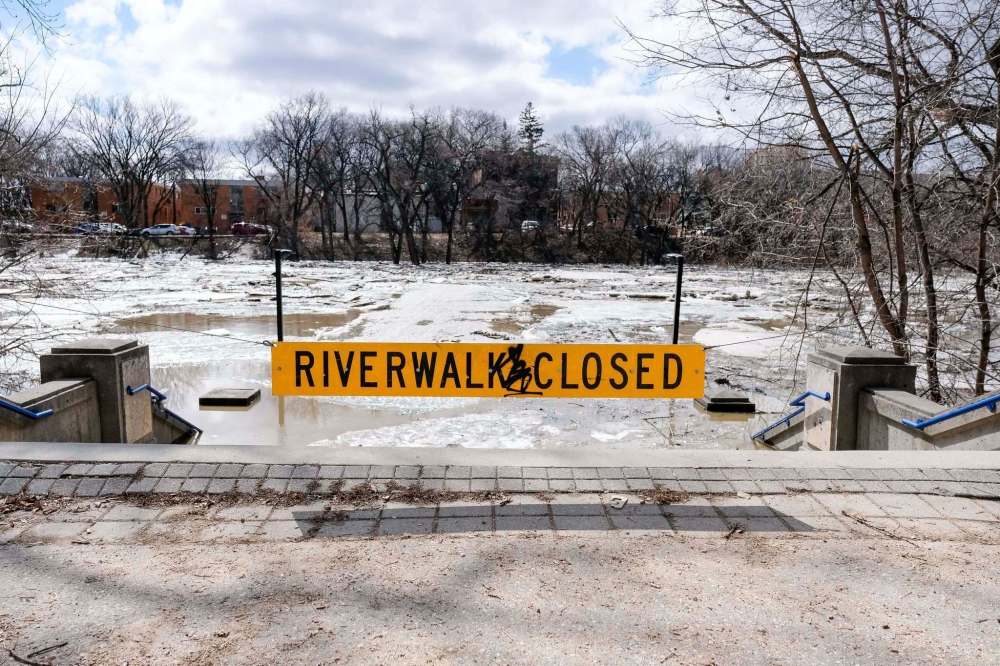
Several bridges around Grand Forks are inaccessible, and the water is high enough to cut off the Minnesota hamlet of Oslo, which is old news for the 300 residents protected annually by a ring dike.
Indeed, it’s a scene that’s played out many times before, and isn’t causing Emerson-Franklin Reeve David Carlson any sleepless nights quite yet.
“At this point it looks like it’s definitely something we can handle. We’ve done our preliminary dike closures in Emerson in a couple of spots, which is pretty standard,” Carlson said Saturday. “The big concern will be some road washouts, flooding into the farmland and debris that’s left behind, which really delays harvest. The debris is a real pain in the neck. Farmers have to clean out fields and we have to clear out ditches and it’s a real inconvenience.
“But if things stay as they are right now, we’re pretty confident things should be fine.”
In St. Norbert, nothing will be left to chance. Of the 57 properties identified as high-risk to flooding this spring, 31 are in that ward.
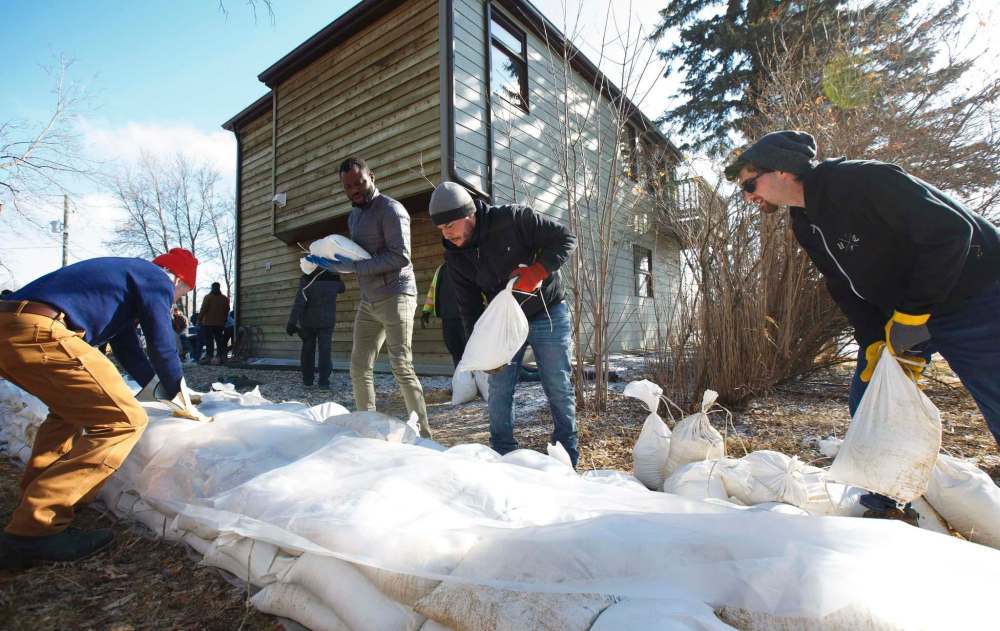
St. Norbert councillor and deputy mayor Markus Chambers, who joined a large, enthusiastic crew of volunteer sandbaggers Thursday at properties on St. Pierre Street, said the mood was entirely upbeat.
“People were so positive, really excited to help out. It’s the typical Winnipeg story, people wanting to offer support,” said Chambers. “I also think people are tired of being cooped up” during the COVID-19 pandemic.
Chambers said about 4,700 bags were placed in four hours to protect one home. Volunteers stood one to two metres apart, using a ‘zig-zag pattern’ on the assembly line. About half of participants wore masks.
Earlier this month, Manitoba’s Emergency Measures Office released a guide to sandbagging during the pandemic. Among other options, it suggested using two-person teams to build small dikes, with workers alternating trips to the sandbag stockpile. For large efforts, it proposed using a “carousel” of workers staggered 10 feet apart, to circle between the stockpile and the dike.
At a news briefing Saturday, the province’s chief public health officer, Dr. Brent Roussin, said hand sanitizer should be available on-site for sandbag workers. In areas which make physical distancing difficult, workers could also wear non-medical masks to reduce the risk they might unknowingly spread the virus to others, he added.
“Like other critical-type services, they have to go on,” he said. “I’ve reviewed some plans and they’re actually quite good and they do allow for physical distancing. Our messaging is, again, stay home if you’re ill, even mild symptoms. They’re going to have hand sanitizer around to ensure good hand hygiene.”
While the province is moving to enforce health orders relating to physical distancing with warnings and fines, Roussin noted that government operations are excluded from those orders. Sandbagging would fall into that category, he said.
The spring flood is turning out to be far less than the disaster some had feared by some in North Dakota. Below-freezing temperatures for the upcoming week will slow any remaining snowmelt into the river system, according to the U.S. National Weather Service.
Indeed, that weather forecast is a blessing for communities this side of the border, said Chambers.
Sandbagging efforts were primarily for precautionary reasons, however, the possibility of flooding downstream, as far south as St. Norbert, due to ice jams between Lockport and Selkirk remains a concern.

“It just backs everything up, and it’s my understanding that it does it quite quickly,” Chambers said. “One of our home owners on St. Pierre said if there’s an ice jam and it backs up, it could go up three feet in a couple of hours, and that’s where you’re, “OK, that could be some major flooding.’”
Provincial officials activated the floodway on Good Friday. With it operational, a channel just south of the city takes part of the Red River’s flow around Winnipeg, Manitoba and discharges it back into the Red River just below the dam at Lockport.
With the aid of the floodway, the Red River level at the James Avenue gauge is expected to crest at a manageable 19.5 feet, likely on April 17.
jason.bell@freepress.mb.ca
Twitter: @WFPJasonBell