Regional approach to COVID-19 beginning as feds roll out new measures

Advertisement

Advertise with us

Regional disparities in Canada's COVID-19 crisis emerged with growing clarity on Friday, as some provinces celebrated relative success while the federal government rolled out new measures to help others still grappling with the pandemic.

Read this article for free:


or

Already have an account? Log in here »

To continue reading, please subscribe:

Subscribe and receive a limited-edition Free Press branded hat or tote.

Digital Subscription

One year of digital access for only $205*

  • Enjoy unlimited reading on winnipegfreepress.com
  • Read the E-Edition, our digital replica newspaper
  • Access News Break, our award-winning app
  • Play interactive puzzles

*First annual payment billed as $205.00 + GST for one year. This annual subscription will automatically renew at $233.00 + GST every 52 weeks (10% off the regular annual price of $259.35). Offer available to new and qualified returning subscribers only. Cancel any time.

To continue reading, please subscribe:

Add Free Press access to your Brandon Sun subscription for only an additional

$1 for the first 4 weeks*

  • Enjoy unlimited reading on winnipegfreepress.com
  • Read the E-Edition, our digital replica newspaper
  • Access News Break, our award-winning app
  • Play interactive puzzles
Start now

*Your next Brandon Sun subscription payment will increase by $1.00 and you will be charged $17.95 plus GST for four weeks. After four weeks, your payment will increase to $24.95 plus GST every four weeks.

Hey there, time traveller!
This article was published 17/04/2020 (2312 days ago), so information in it may no longer be current.

Regional disparities in Canada’s COVID-19 crisis emerged with growing clarity on Friday, as some provinces celebrated relative success while the federal government rolled out new measures to help others still grappling with the pandemic.

Government and medical officials said different parts of the country are experiencing the outbreak to varying degrees, with central provinces accounting for the bulk of new cases and other jurisdictions reporting flattened curves and limited outbreaks.

Prime Minister Justin Trudeau acknowledged the disparate circumstances on Friday as he unveiled new stimulus measures targeted at specific provinces, rather than the country as a whole.
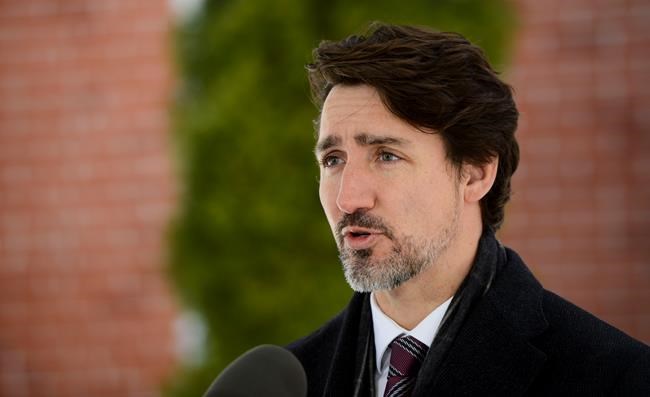
Prime Minister Justin Trudeau addresses Canadians on the COVID-19 pandemic from Rideau Cottage in Ottawa on Wednesday, April 15, 2020. THE CANADIAN PRESS/Sean Kilpatrick

“We will continue our co-ordination around principles and steps that need to be taken. But this is Canada, which means there are very different needs and very different approaches that will be in place across the country,” Trudeau said at his regular morning news conference.

The latest round of economic measures were specifically geared towards Newfoundland and Labrador and the country’s western provinces, including a $1.7 billion funding promise to clean up orphaned oil wells largely found in Alberta.

Despite the regional differences, the country’s top public health official cautioned against relaxing protective restrictions — even in regions where the pandemic seems to be under control.

Dr. Theresa Tam said the bulk of COVID-19 cases are concentrated in just two provinces, Ontario and Quebec, where new provincial numbers continue to show the most positive diagnoses. Comparatively, some provinces have reported no fresh cases for several days running and British Columbia has openly declared it has flattened its pandemic curve.

But Tam cautioned against letting the public guard down, saying physical distancing measures and economic shutdowns must stay in place to prevent the pandemic from flaring up in other areas.

“Some areas will experience the epidemic slowdown earlier than others. But no matter where we are in the country, we’ve got to remember that Canadians are highly susceptible to the virus. Unless we all remain diligent in maintaining our new habits of physical distancing and good hygiene, new outbreaks can be sparked anywhere at any time.”

The regional differences were also clear from the nature of government responses to the crisis.

Trudeau indicated members of the country’s Armed Forces would be on the ground in Quebec later Friday, particularly to help with an ongoing series of outbreaks at long-term care facilities.

Quebec reported 16,798 total COVID-19 cases in the province as of Friday, nearly 700 of which have been fatal.

In Ontario, meanwhile, the number of COVID-19 cases continued to climb, though at a consistently lower rate in recent days. The province reported its largest single-day increase on Friday, with 564 new cases and 55 new deaths.

Prince Edward Island, in contrast, reported no new cases, continuing a streak the province’s medical officer of health called encouraging. Manitoba and New Brunswick also said virus cases remained flat on Friday.

And in B.C., where provincial officials released fresh data on the impact of COVID-19, chief medical officer Dr. Bonnie Henry hailed the province’s success in coping with the outbreak relative to other jurisdictions.

“Our pandemic started earlier than other parts of Canada,” she said. “But … we have flattened that curve.”

Even in those provinces with more encouraging numbers, however, restrictions aimed at curbing the spread were expected to remain in place for some time.

And in harder-hit regions such as Ontario, a return to the pre-pandemic norm is still a distant prospect.

“The number 1 priority is health over everything,” said Premier Doug Ford. “I am zoned in on this economy … after we get through this and we get the green light.”

Regional variations are evident across Canada’s business community, Trudeau acknowledged as he announced yet another financial assistance effort initiatives.

The package targets the oil and gas sector, among others, with funding earmarked for cleaning up so-called orphaned oil wells.

The measures are unlikely to satisfy the country’s oil producers, who have been sounding alarms about the economic devastation in the sector in the lead-up to Friday’s announcement.

With western Canada’s heavy crude selling for under $5 a barrel this week — less than a tenth of the price it garnered a year ago — a letter to Canada’s natural resources minister from the Canadian Association of Petroleum Producers called for freezing the carbon tax and delaying new climate change regulations while the industry weathers the storm.

More than 31,000 Canadians have tested positive for COVID-19, which has killed more than 1,300 people across the country. About half of those killed have been residents of long-term care facilities.

This report by The Canadian Press was first published April 17, 2020.

Report Error Submit a Tip

More Stories

Feds begin regional measures to fight virus

Michelle McQuigge, The Canadian Press 4 minute read Preview

Feds begin regional measures to fight virus

Michelle McQuigge, The Canadian Press 4 minute read Friday, Apr. 17, 2020

Regional disparities in Canada's COVID-19 crisis emerged with growing clarity on Friday, as some provinces celebrated relative success while the federal government rolled out new measures to help others still grappling with the pandemic.

Government and medical officials said different parts of the country are experiencing the outbreak to varying degrees, with central provinces accounting for the bulk of new cases and other jurisdictions reporting flattened curves and limited outbreaks.

Prime Minister Justin Trudeau acknowledged the disparate circumstances on Friday as he unveiled new stimulus measures targeted at specific provinces, rather than the country as a whole.

"We will continue our co-ordination around principles and steps that need to be taken. But this is Canada, which means there are very different needs and very different approaches that will be in place across the country," Trudeau said at his regular morning news conference.

Read
Friday, Apr. 17, 2020

Trailblazing Western Scrap Metals heavy-equipment operator relishes role at massive crane’s control

David Sanderson 7 minute read Preview

Trailblazing Western Scrap Metals heavy-equipment operator relishes role at massive crane’s control

David Sanderson 7 minute read Friday, Aug. 14, 2026

Less than five per cent of heavy-equipment operators in the country are women but that number is trending upward, according to a study conducted by trade magazine Crane & Hoist Canada.

It was reported that in Ontario roughly eight per cent of jobs in the transport and heavy-equipment field are currently held by women. Furthermore, in 2024 almost 20 per cent of graduates at an Edmonton-based heavy-equipment operator training school were female, the article stated.

That brings us to Harmony Guspodarchuk, the first female crane operator in the 70-year history of Western Scrap Metals, a family-owned business at 18 Sutherland Ave.

Three years ago, Guspodarchuk literally stepped into the driver’s seat of a 27,500-kilogram, Liebherr C 924 Heavy Lift Litronic crane. The 29-year-old hasn’t looked back much since.

Read
Friday, Aug. 14, 2026

Could renewed interest in strategically critical rare earth elements finally make sub-sector profitable?

Joel Schlesinger 6 minute read Preview

Could renewed interest in strategically critical rare earth elements finally make sub-sector profitable?

Joel Schlesinger 6 minute read Yesterday at 3:00 AM CDT

Rare earth elements are among the most critical of mined resources for modern economies.

They’re essential in manufacturing specialized magnets used in a host of technologies from wind turbines and electric vehicles to hard drives, smartphones, television screens, and fibre optics. Most notably, however, rare earth minerals are increasingly vital to the defence industry.

These 17 elements — closely related chemically and usually found all together in mineral deposits — have indeed been growing in geopolitical importance as the United States, Canada and other Western nations recognize their dependence on production from China.

It is the world’s largest producer and processor of rare earths, including the most in-demand elements neodymium and praseodymium used to manufacture very light and powerful magnets for an array of technologies, including the most advanced weapons of modern warfare.

Read
Yesterday at 3:00 AM CDT

West Kildonan Industrial residents call for speed bumps after child hit by truck

Morgan Modjeski 3 minute read Preview

West Kildonan Industrial residents call for speed bumps after child hit by truck

Morgan Modjeski 3 minute read Updated: Yesterday at 3:09 PM CDT

Residents in the West Kildonan Industrial neighbourhood are calling on the city to install speed bumps in their area after a child was hit and dragged by a vehicle Thursday.

Katelyn Bemister lives near the area where the child — who was hospitalized as a result of the incident and has been upgraded to stable condition — was struck. She says people frequently speed in the area.

“They’re going really fast, and they’re not really paying attention at all to the pedestrians in the area,” says Bemister.

In video supplied to the Free Press by a resident, the child can be seen riding a bike down a sidewalk along the 500 block of North Point Boulevard.

Read
Updated: Yesterday at 3:09 PM CDT

Proposed Transcona development — which could add 20,000 people — gets thumbs down from residents

Joyanne Pursaga 5 minute read Preview

Proposed Transcona development — which could add 20,000 people — gets thumbs down from residents

Joyanne Pursaga 5 minute read Friday, Aug. 14, 2026

Dozens of Winnipeggers fear plans to make way for up to 20,000 more people to live in south Transcona would dramatically alter their neighbourhood and tie hefty fees for new services to their property titles.

If city council adopts the proposed South Transcona secondary plan, all future development applications would need to conform to its goals. The affected area is located south of Dugald Road, north of St. Boniface Road, east of Plessis Road and west of Murdock Road.

Homeowner Virginia Page Jähne fears the plan could add a massive tab to the title of her 4.3-acre property to cover services required for the development.

“My main concern is that they are wanting to put $1.4 million onto my title to pay for this. Now, they say that I will not have to pay it unless I subdivide. But if a person comes by and wants to buy from me … and they see that $1.4 million … what’s the first thing (they’re) going to do?” said Page Jähne, in an interview.

Read
Friday, Aug. 14, 2026

Poilievre’s lips moving, but Canadians aren’t interested in what he’s saying

Tom Brodbeck 5 minute read Preview

Poilievre’s lips moving, but Canadians aren’t interested in what he’s saying

Tom Brodbeck 5 minute read Thursday, Aug. 6, 2026

Pierre Poilievre’s biggest political challenge right now isn’t Prime Minister Mark Carney’s popularity.

It’s the fact that he still seems to be campaigning against a political landscape that no longer exists.

More than a year after the 2025 federal election, the Conservative leader is still relying on the same message, the same themes and the same attacks that defined his party’s campaign before voters went to the polls.

And Canadians appear to be tuning it out.

Read
Thursday, Aug. 6, 2026