

Climate change, flood risk have complicated relationship, experts say
Advertisement
Read this article for free:
or
Already have an account? Log in here »
To continue reading, please subscribe:
Digital Subscription
One year of digital access for only $1.44 a week*
- Enjoy unlimited reading on winnipegfreepress.com
- Read the E-Edition, our digital replica newspaper
- Access News Break, our award-winning app
- Play interactive puzzles
*Billed as $5.77 plus GST every four weeks. After 52 weeks, price increases to the regular rate of $19.95 plus GST every four weeks. Offer available to new and qualified returning subscribers only. Cancel any time.
To continue reading, please subscribe:
Add Free Press access to your Brandon Sun subscription for only an additional
$1 for the first 4 weeks*
- Enjoy unlimited reading on winnipegfreepress.com
- Read the E-Edition, our digital replica newspaper
- Access News Break, our award-winning app
- Play interactive puzzles
*Your next Brandon Sun subscription payment will increase by $1.00 and you will be charged $17.95 plus GST for four weeks. After four weeks, your payment will increase to $24.95 plus GST every four weeks.
Read unlimited articles for free today:
or
Already have an account? Log in here »
Hey there, time traveller!
This article was published 17/04/2020 (2238 days ago), so information in it may no longer be current.
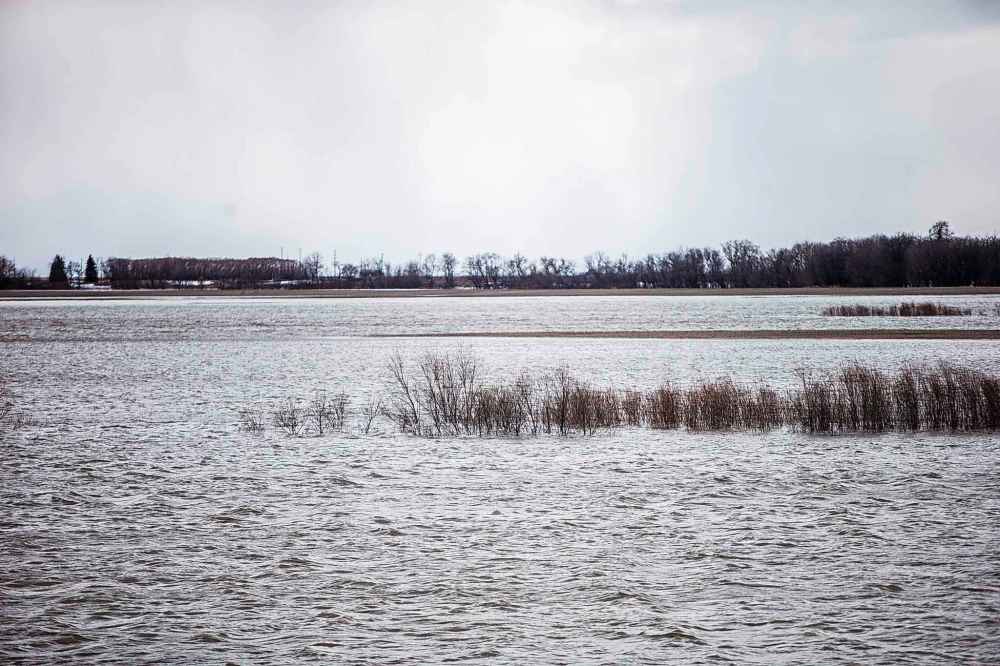
In Grand Forks, N.D., the water has slowly begun to recede, but 2020 is being called a top 10 flood year for the region.
This comes as little surprise to Corey Loveland, a service co-ordination hydrologist with the U.S. National Weather Service, who predicted as much in the weeks ahead of the spring melt. The high waters came after 2019 marked the wettest year on record for the state, along with Minnesota and Wisconsin.
While there have been several consecutive wet years, Loveland is hesitant to call it a trend.
“It’s too early really to tell,” he said.
This is a single piece of a complicated puzzle that hydrologists are looking at when it comes to analyzing and understanding how climate change will impact flood risk in Manitoba in the years to come, because more warming does not necessarily mean more flooding.
“The spring flood risk in Manitoba depends on three main things: how wet is the fall? How much snow do we get during the winter? And then, how does the snow melt?” said associate professor of hydrology Nora Casson, a co-director of the University of Winnipeg’s Prairie Climate Centre and a Canada research chair in environmental influences on water quality.
Climate change has differing impacts on each of these three factors. Projections shown in the Prairie Climate Centre’s atlas forecast predicts increasing autumn precipitation (increasing by roughly seven per cent by 2050 over levels seen between 1976 and 2005). Spring precipitation is also expected to increase between eight and 10 per cent.
This upward trend in precipitation will also be seen over the winter months. However, as temperatures warm, more of that snow is expected to melt during the winter, resulting in a thinner snowpack come spring, a big mitigating factor when it comes to potential flooding, Casson said.
“One of the challenges that we have is that the flooding we see here obviously doesn’t just depend on what happens in Winnipeg, it depends on what happens across the Red River basin. So that reaches down into North Dakota, and then also in the Assiniboine River basin, reaching across the Prairies,” she said.
Shorter winters might also help to alleviate flood risk, she suggests. “But because it also depends on how wet it is in the fall, and how fast (the snow) melts in the spring, we don’t necessarily think that just because the snow in the winter is going down that the risk of spring flood is going away.”
Don Burn was a member of the Manitoba Water Commission after the flood of 1997, before moving on to the faculty of engineering at the University of Waterloo. He’s studied hydrology across Canada and says these nuanced findings make it difficult for cities, towns and provinces to prepare for what’s coming.
“We can’t say that because of climate change, every year is going to be a larger flood than what we’ve ever seen before. Whether we are, overall, benefiting or not from climate change in the flooding perspective — we’ll see high years and we’ll see low years, there will be a mix of that,” he said.
“So, in terms of what governments can do — it’s a challenge right now. And I know a lot of governments in many different jurisdictions are struggling with how to change their expectations of what floods are going to be.”
Casson adds that extreme weather events — such as the snowstorm last October — are shown to be increasing in frequency, likely due to climate change. And those unpredictable, extreme events will push Manitoba’s flood risk upwards.

“What some jurisdictions are doing is simply preparing for things that are bigger than what they’ve seen before,” Burn said.
Manitoba might be one of the best-prepared jurisdictions in the country since the province has such a long history of flooding and already has a great deal of infrastructure in place to cope with high-water events, he said.
The provincial government entered into a new agreement with towns and cities recently allowing flood-repair funds to be earmarked for additional climate-adaptation projects.
sarah.lawrynuik@freepress.mb.ca
Twitter: @SarahLawrynuik