
More than 90% of Manitoba adults in poll expect long-term life changes from pandemic
Read this article for free:
or
Already have an account? Log in here »
To continue reading, please subscribe:

Digital Subscription
One year of digital access for only $205*
- Enjoy unlimited reading on winnipegfreepress.com
- Read the E-Edition, our digital replica newspaper
- Access News Break, our award-winning app
- Play interactive puzzles
*First annual payment billed as $205.00 + GST for one year. This annual subscription will automatically renew at $233.00 + GST every 52 weeks (10% off the regular annual price of $259.35). Offer available to new and qualified returning subscribers only. Cancel any time.
To continue reading, please subscribe:
Add Free Press access to your Brandon Sun subscription for only an additional
$1 for the first 4 weeks*
- Enjoy unlimited reading on winnipegfreepress.com
- Read the E-Edition, our digital replica newspaper
- Access News Break, our award-winning app
- Play interactive puzzles
*Your next Brandon Sun subscription payment will increase by $1.00 and you will be charged $17.95 plus GST for four weeks. After four weeks, your payment will increase to $24.95 plus GST every four weeks.
Read unlimited articles for free today:
or
Already have an account? Log in here »
Hey there, time traveller!
This article was published 05/05/2020 (2290 days ago), so information in it may no longer be current.
OTTAWA — A vast majority of Manitobans say they don’t expect life will return to normal any time soon, a new Probe Research poll reveals.
“The public is really expecting that there is no normal after this,” Probe founder Scott MacKay said Tuesday.
METHODOLOGY
Probe Research surveyed online 803 randomly selected Manitoba adults April 24-28. The sample was taken from both Probe’s online panel and a national surveyor, and slightly weighted for age, gender and region.
Technically, online samples do not have margins of errors like phone samples, but Probe says its results should be interpreted as having an MOE of 3.46 percentage points, 19 times out of 20.
The previous poll of 1,000 adults included some telephone polling.
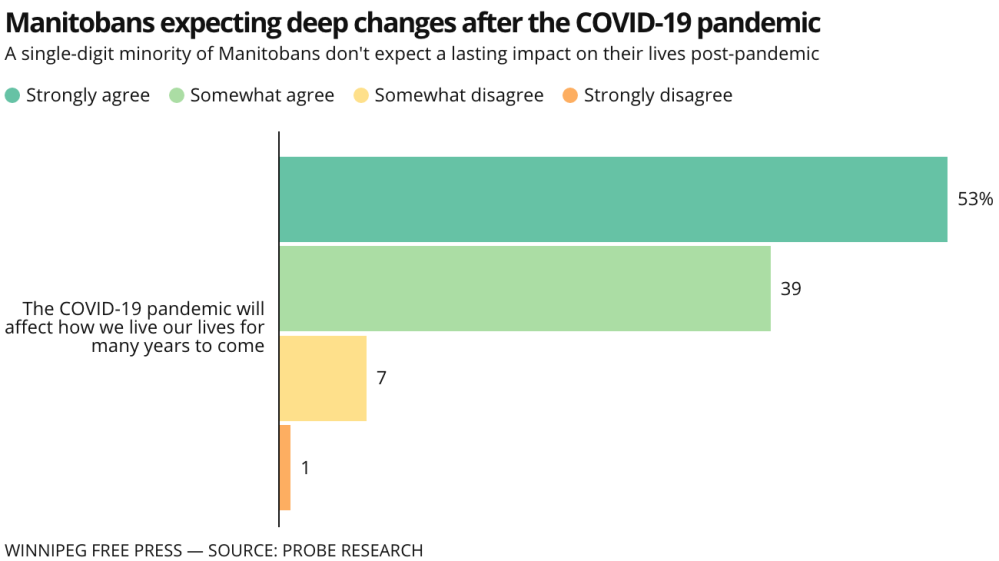
Of 803 Manitobans surveyed online a week ago, 92 per cent agreed with the statement: “the COVID-19 pandemic will affect how we live our lives for many years to come,” a result that surprised MacKay.
“Manitobans are very moved by this pandemic,” he said.
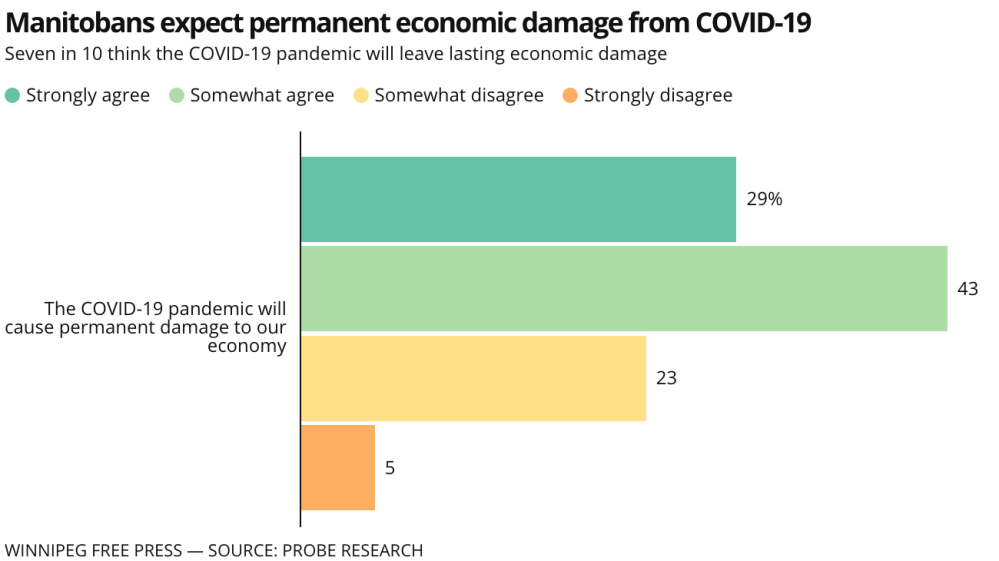
And 72 per cent anticipate “permanent damage to our economy” as a result of the coronavirus. The polling also suggests that young men are the most likely group to say the pandemic is overblown.
The polling, released Tuesday to the Free Press and CTV Winnipeg, showed 57 per cent of Manitobans expect life “will be very different than what it used to be” when the pandemic blows over, compared with 23 per cent who expect things to go back to normal.
MacKay said that’s probably due to so many sudden shifts, such as wearing masks, talking more often with neighbours, working at home and having time to reflect on life outside of a career.
“All these things cumulatively could add up to this idea that the world has really changed for a long time,” MacKay said.
He said he was stunned to see such widely held views, at numbers he’d normally attribute to a data error.
“It’s probably the most interesting thing we’ve ever done, because it’s just so deep and so unprecedented,” said MacKay, who founded Probe in 1994.
“They not only anticipate a drastic redesign of society in the future, but they think that anything that comes out of this new world… is going to be lasting.”
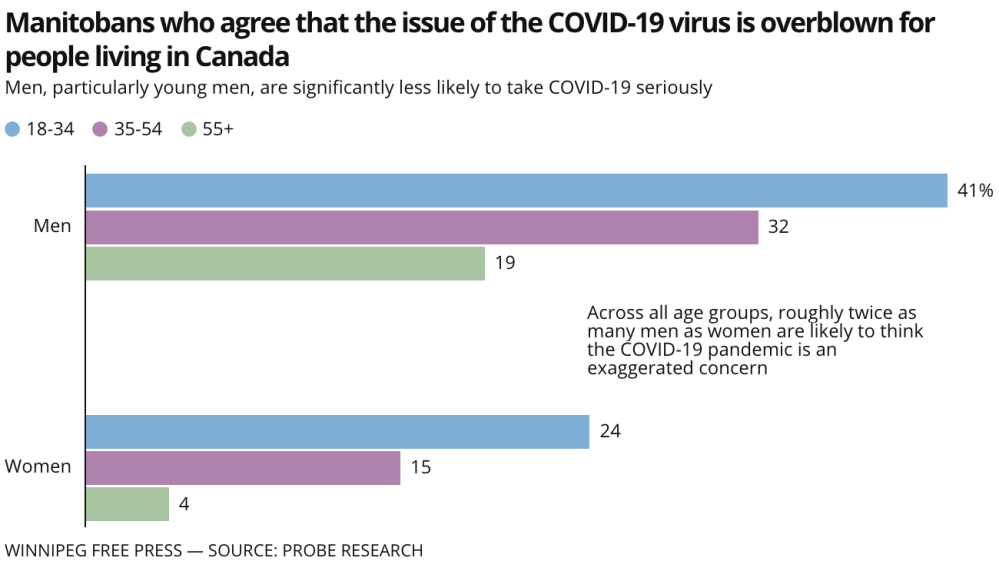
The poll also found 22 per cent of Manitobans feel the virus “is overblown for people living in this country,” down from 36 per cent of respondents a month prior.
Timothy Caulfield, a University of Alberta professor known for his research on medical myths and conspiracies, said he’s concerned by those figures, but not surprised given the scope of misinformation circling online.
“It speaks to the idea that there is some sort of nefarious agenda associated with the messaging around the coronavirus. It suggests there’s a sector of Canadians that don’t trust the leaders in this area,” said Caulfield.
Among Manitoba men age 18 to 34, 41 per cent feel the crisis is overblown, compared with 24 per cent of women in the same age group.
Caulfield said young men tend to be more likely to buy into conspiracy theories than the general population, though their views on COVID-19 could be driven by other factors.
Women reported far more job losses than men in the March labour-force survey as businesses closed. Younger people who contract the virus also tend to experience milder symptoms, even if they can easily spread it to others.
However, a poll of 600 Canadians a month ago by the Université de Sherbrooke found 38 per cent believe their government was hiding important information about the COVID-19, while 15 per cent felt the pharmaceutical industry is involved in spreading the coronavirus.
“One thing I’m worried about is that we are moving to a phase where there is more polarization,” Caulfield said, adding Canadians should better vet the information they spread on social media.
MacKay cautioned that only seven per cent of poll respondents feel strongly that the matter is overblown, a smaller percentage than last month.
He noted that young men are also believed to take more risks than the general population, resulting in higher vehicle-insurance premiums.
The polling also showed 76 per cent of Manitobans supported the provincial government’s handling of the issue, up from 62 per cent a month prior. However the results were collected just before Premier Brian Pallister unveiled his plan to gradually reopen the economy.
MacKay said his firm might separately ask Manitobans how they feel about the Pallister government’s response, and that of the province’s public-health officials.
dylan.robertson@freepress.mb.ca
Probe Research poll about COVID-19's impact on Manitoba
History
Updated on Tuesday, May 5, 2020 6:26 PM CDT: Updates header graphic
Updated on Wednesday, May 6, 2020 12:56 PM CDT: Updates header graphic


