

PCL builds Quaran-Tin Cans, for self-isolation in a hurry
Advertisement
Read this article for free:
or
Already have an account? Log in here »
To continue reading, please subscribe:
Monthly Digital Subscription
$1 per week for 24 weeks*
- Enjoy unlimited reading on winnipegfreepress.com
- Read the E-Edition, our digital replica newspaper
- Access News Break, our award-winning app
- Play interactive puzzles
*Billed as $4.00 plus GST every four weeks. After 24 weeks, price increases to the regular rate of $19.95 plus GST every four weeks. Offer available to new and qualified returning subscribers only. Cancel any time.
Monthly Digital Subscription
$4.99/week*
- Enjoy unlimited reading on winnipegfreepress.com
- Read the E-Edition, our digital replica newspaper
- Access News Break, our award-winning app
- Play interactive puzzles
*Billed as $19.95 plus GST every four weeks. Cancel any time.
To continue reading, please subscribe:
Add Free Press access to your Brandon Sun subscription for only an additional
$1 for the first 4 weeks*
*Your next subscription payment will increase by $1.00 and you will be charged $16.99 plus GST for four weeks. After four weeks, your payment will increase to $23.99 plus GST every four weeks.
Read unlimited articles for free today:
or
Already have an account? Log in here »
Hey there, time traveller!
This article was published 06/05/2020 (2144 days ago), so information in it may no longer be current.
PCL Construction has been responsible for some of the most challenging construction projects in the city, like the Canadian Museum for Human Rights and the Winnipeg Art Gallery’s Inuit Art Centre now under construction.
Its Winnipeg operating group put its collective mind to work creating something that might help the COVID-19 efforts and has come up with the Quaran-Tin Can, a modular isolation unit built from a shipping container.
Designed to be customizable, it’s a portable facility that can be deployed to temporarily — and quickly — augment hospital facilities in case COVID-19 cases overwhelm a community’s physical hospital resources.
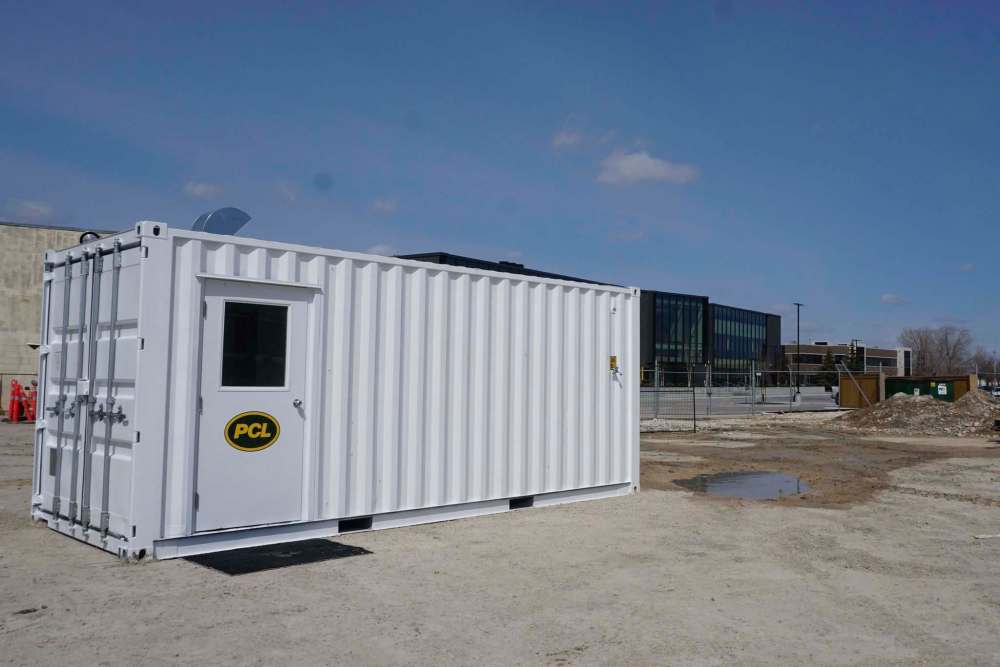
Monique Buckberger, PCL’s Manitoba district manager, said “It was something that germinated out of an idea in Winnipeg and I think it is great way to help solve potential issues that could arise in the COVID(-19) pandemic.”
With all sorts of ways to configure the setup, the design includes both 20-foot and 40-foot containers with room for between one and five beds.
PCL has access to a supply chain that could provide the containers and Buckberger said it would take about two weeks from the time they ordered the container until it left PCL’s Winnipeg yards completed. PCL could construct as many as 20 at a time.
The company is not disclosing costs or pricing, but it also seems that’s not the point.
“I think most of us contributed to this out of the goodness of our hearts,” said Justin Thorsteinson, vice-president of Thor Plumbing and Heating, who contributed some technical and inspirational design elements to the project.
PCL also partnered with f-BLOK Architecture, E.H. Price and P4 Electrical Contractors.
Metal shipping containers have proven to be durable, useful structures for every manner of deployment. There are plenty of examples of them being used for various styles of housing. Delta 9 Cannabis has built its entire cannabis production system using shipping containers.
“They are a great structure to work with,” Thorsteinson said. “They should be used more than they are in my opinion. Sometimes it’s tough to get permits to do stuff outside the box like that.”
It’s not clear if there are any destinations pending, but the units are designed to be easily transported by truck, rail or cargo plane.
Buckberger said there has been discussions with public health authorities in a few communities as well as some First Nation organizations and the Red Cross.
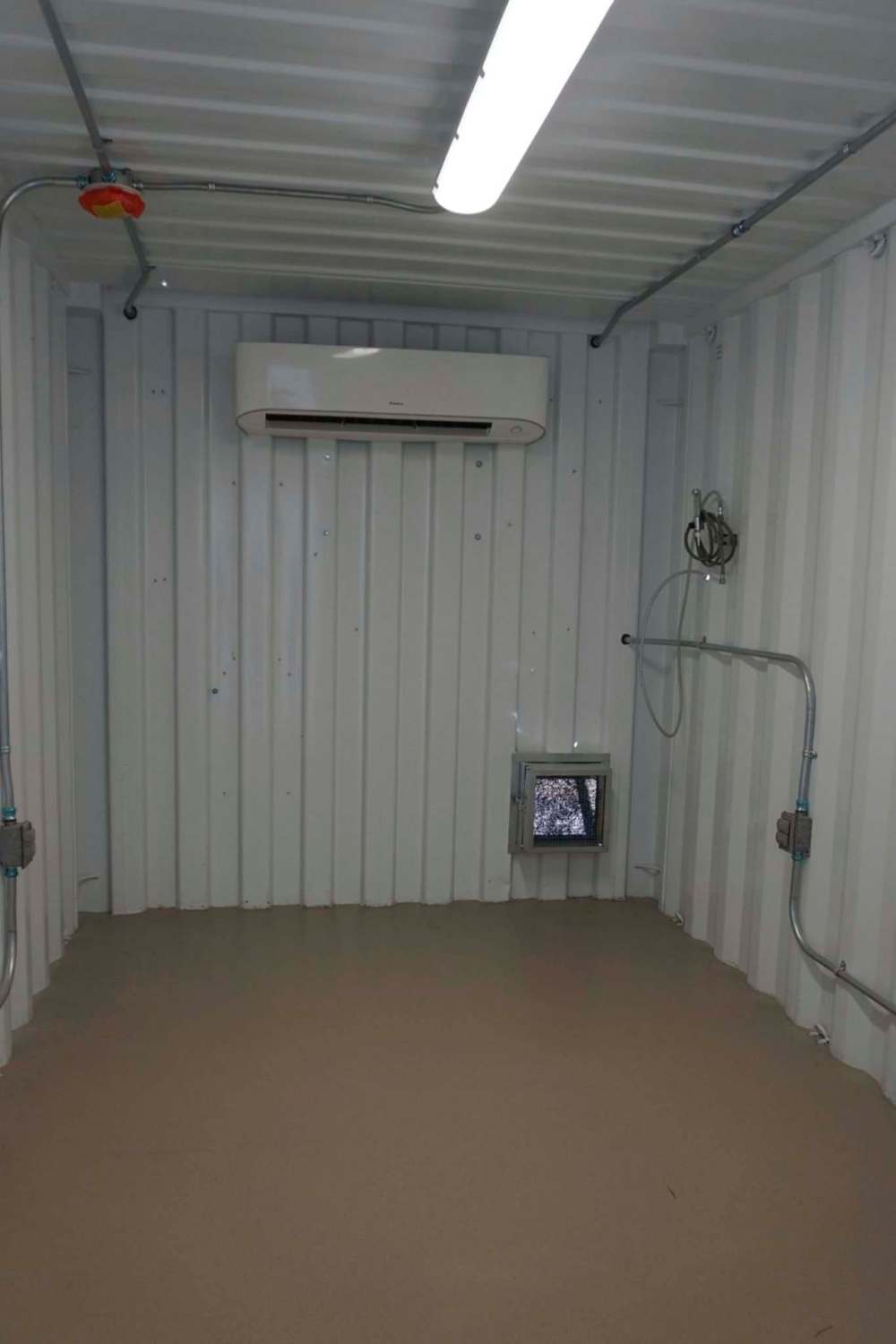
“From our view we’ve been very fortunate as to how well Manitoba has responded to the crisis,” she said. “But we thought it was a good fit and maybe it will be a helpful solution to a constantly changing scenario.”

The simplicity of the modular design and ease of transport means that once the units get to their destination, a forklift is all that would be required to get them in position. They can be operational in minutes.
Buckberger said, “These portable isolation units can be quickly and easily built and can be transportable across Manitoba and Northern Ontario and even further across the country if the need is there.”
They can be heated and air conditioned and the units allow for effective sterilization. Toilets and wash facilities can be installed and they can be connected together and easily located on an existing hospital site parking lot or green space.
Once installed on-site, the units only require a power connection for air conditioning and electric heating.
martin.cash@freepress.mb.ca
History
Updated on Thursday, May 7, 2020 12:08 AM CDT: Adds photo