

Meat-packing sector needs oversight
Advertisement
Read this article for free:
or
Already have an account? Log in here »
To continue reading, please subscribe:
Monthly Digital Subscription
$1 per week for 24 weeks*
- Enjoy unlimited reading on winnipegfreepress.com
- Read the E-Edition, our digital replica newspaper
- Access News Break, our award-winning app
- Play interactive puzzles
*Billed as $4.00 plus GST every four weeks. After 24 weeks, price increases to the regular rate of $19.95 plus GST every four weeks. Offer available to new and qualified returning subscribers only. Cancel any time.
Monthly Digital Subscription
$4.99/week*
- Enjoy unlimited reading on winnipegfreepress.com
- Read the E-Edition, our digital replica newspaper
- Access News Break, our award-winning app
- Play interactive puzzles
*Billed as $19.95 plus GST every four weeks. Cancel any time.
To continue reading, please subscribe:
Add Free Press access to your Brandon Sun subscription for only an additional
$1 for the first 4 weeks*
*Your next subscription payment will increase by $1.00 and you will be charged $16.99 plus GST for four weeks. After four weeks, your payment will increase to $23.99 plus GST every four weeks.
Read unlimited articles for free today:
or
Already have an account? Log in here »
Hey there, time traveller!
This article was published 11/05/2020 (2153 days ago), so information in it may no longer be current.
The first question that springs to mind is, “How could this happen?”
But after only a bit of reflection on the reality of the situation, it doesn’t take long for the feeling of surprise to be replaced by a resigned sense of chagrined inevitability.
As was the case when the first reports surfaced of deadly COVID-19 outbreaks in personal-care homes, one after another after another, the public has been outraged by news that a series of meat-packing plants has been forced to close by widespread coronavirus infection within their workforces.
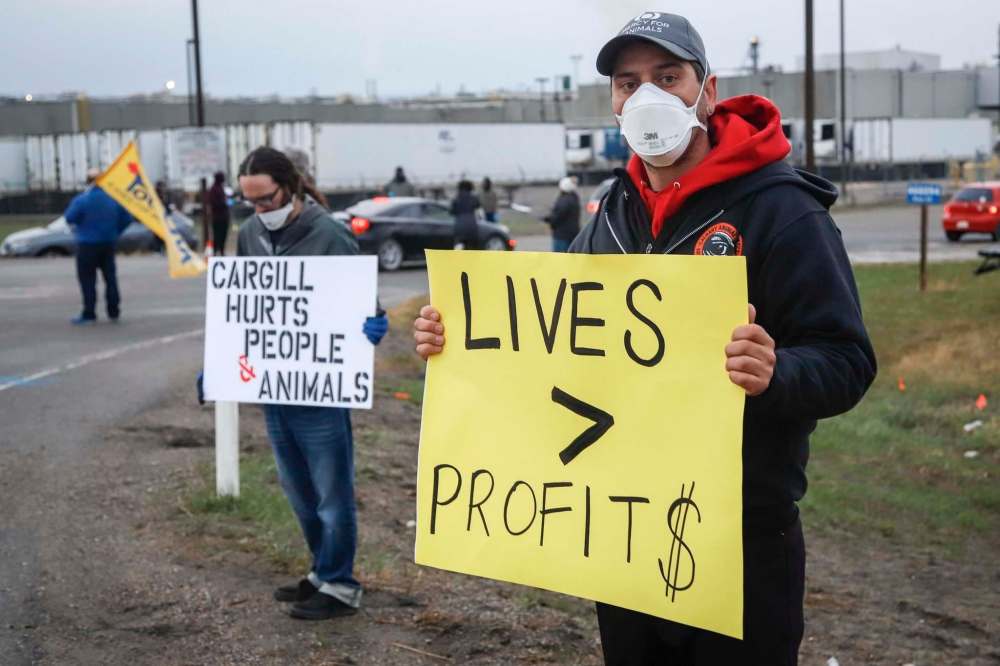
How could this happen? Given the circumstances, it might be more appropriate to ask how it hasn’t yet happened in all slaughterhouse facilities across North America. Simply put, meat-packing facilities are, by dint of their assembly-line operational model, marginalized workforces and intense focus on productivity and profitability, just about as perfect an environment as a spread-seeking virus could ever hope to encounter.
The Cargill packing house in High River, Alta., has become the focal point of discussions related to slaughterhouse safety during the pandemic, after half of its 2,000-strong workforce fell victim to COVID-19 infection and two COVID-19 deaths were linked to the plant. Contact tracing has found more than 1,500 cases connected to the plant and its workers.
The facility closed temporarily last month and reopened — despite strong objections from some employees and the union that represents them — on May 4.
Another Alberta plant — the JBS operation in Brooks — also closed temporarily after a COVID-19 outbreak involving nearly 500 cases and one death. Meat-packing plants in Ontario and Quebec have also closed their doors as a result of coronavirus-related illnesses among employees.
On Sunday, a Cargill plant in Chambly, Que., said it would temporarily close after at least 64 workers tested positive for COVID-19.
The industry in the U.S. has also been hit hard, with plants in several states reporting high numbers of COVID-19 cases. Clusters of coronavirus infection have also been reported in slaughterhouses in Australia, Brazil, Spain and Ireland.
A recent Globe and Mail investigation of operations at the High River facility laid bare the grim realities that make this sector an ideal environment for virus proliferation.

The slaughter and processing of livestock requires large groups to work in very close proximity, toiling shoulder to shoulder as conveyer belts move the variously butchered portions of the animals from the killing floor through to the packaging area.
The workers, whose pay ranges from about $25,000 to $50,000 a year, are mostly immigrants, often encumbered by language barriers and generally reluctant to dispute management orders for fear of losing their jobs. When COVID-19 arrives in such a facility, as it did in the Cargill plant and others, questionable management decisions and workers’ reluctance or inability to speak out can create a situation in which protective measures are slow to be enacted and a viral infection can quickly spread among close-quarters co-workers.
What emerges is a recipe for disaster when disease enters an equation that already includes the push for maximized profits, a frightened workforce and years of cuts to government inspection agencies.
COVID-19’s effect on North America’s food chain has yet to be determined, but what the pandemic has demonstrated is that the meat-packing industry is in need of rigorous oversight.
The bottom line, when food security is at stake, can’t just be the bottom line. And Canadians should be willing to accept slightly higher prices at the meat counter in exchange for a reliable food supply and safe working conditions for those who provide it.