Science summary: A look at novel coronavirus research around the globe

Advertisement

Advertise with us

Thousands of scientists around the world are working on problems raised by the COVID-19 pandemic. Here is a summary of some recent research from peer-reviewed academic journals and scientific agencies:

Read this article for free:


By clicking the button above, an account will be created and you will begin to receive some of our recommended newsletters. You may opt out of any newsletter by visiting your Email and Communication Preferences page or by clicking "unsubscribe" at the bottom of any email.

or

Already have an account? Log in here »

To continue reading, please subscribe:

Digital Subscription

One year of digital access for only $1.44 a week*

  • Enjoy unlimited reading on winnipegfreepress.com
  • Read the E-Edition, our digital replica newspaper
  • Access News Break, our award-winning app
  • Play interactive puzzles

*Billed as $5.77 plus GST every four weeks. After 52 weeks, price increases to the regular rate of $19.95 plus GST every four weeks. Offer available to new and qualified returning subscribers only. Cancel any time.

To continue reading, please subscribe:

Add Free Press access to your Brandon Sun subscription for only an additional

$1 for the first 4 weeks*

  • Enjoy unlimited reading on winnipegfreepress.com
  • Read the E-Edition, our digital replica newspaper
  • Access News Break, our award-winning app
  • Play interactive puzzles
Start now

*Your next Brandon Sun subscription payment will increase by $1.00 and you will be charged $17.95 plus GST for four weeks. After four weeks, your payment will increase to $24.95 plus GST every four weeks.

Hey there, time traveller!
This article was published 25/05/2020 (2336 days ago), so information in it may no longer be current.

Thousands of scientists around the world are working on problems raised by the COVID-19 pandemic. Here is a summary of some recent research from peer-reviewed academic journals and scientific agencies:

—

The International Journal of Infectious Disease has tracked the source of Canada’s first 118 cases of COVID-19. It found that despite nearly two-thirds of the world’s cases originating in China, and despite Canada’s large human and trade links with that country, only nine (7.6 per cent ) of Canada’s earliest cases originated there. Researchers say the most commonly reported travel among the 118 cases involved the Middle East, the United States and Europe. Nearly one-third — 30 cases — were from Iran. Researchers say the results suggest that future travel bans shouldn’t necessarily be restricted to only countries with high levels of infection.
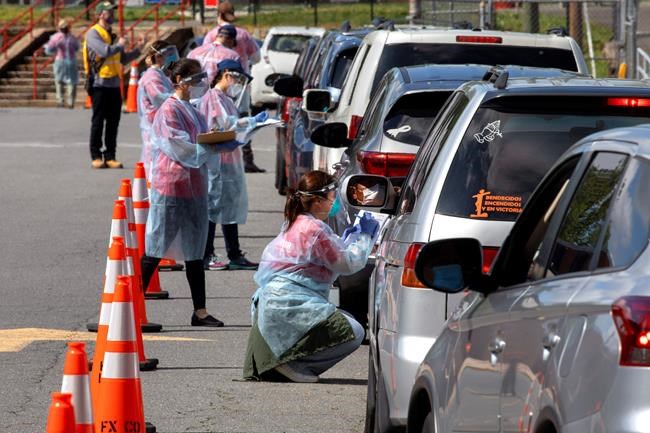
A man wearing a facemask waits inside his car to be tested for COVID-19 as volunteers take registration information in Annandale, Va., Saturday, May 23, 2020. COVID-19 testing was available from Fairfax County at no cost and without a doctor's order. Hundreds of people had lined up in cars and on foot by 10am. Officials planned on testing about 1000 people from 10 a.m. to 6 p.m. Testing will be available at Bailey's Elementary on Sunday. (AP Photo/Jacquelyn Martin)

—

The novel coronavirus has mutated thousands of times, but a large study from University College London suggests none of those mutations has made it more transmissible. The paper, which hasn’t been peer-reviewed, looked at more than 15,000 COVID-19 patients from 75 countries. It found 6,822 mutations. Of those, 31 mutations have occurred at least 10 times independently during the course of the pandemic. Researchers found no evidence those common mutations increased the virus’s transmissibility — including one mutation which has been widely credited with being more infectious. In fact, they found most mutations were mildly detrimental to the virus.

—

An unreviewed study from the Universite de Paris found cases of Kawasaki disease in children, which causes swelling blood vessels, seem to be associated with COVID-19. It found 17 children were admitted to the university hospital between late April and early May this year, when the average number of cases is one. Fourteen youngsters showed evidence of recent infection by the novel coronavirus. They also suffered gastrointestinal distress. All were treated and successfully recovered.

—

The journal The Lancet has published one of the largest studies yet on the value of hydroxycholoroquine as a COVID-19 treatment. The study looked at 96,032 patients from 671 hospitals on six continents. The paper reports no benefit from the antimalarial drug, either on its own or with anything else. It says hydroxychloroquine, which has known side effects on the heart, may cause more problems than its solves — although the paper cautions that conclusion isn’t definitive.

—

Studies in macaque monkeys suggest that developing immunity against COVID-19 is possible for humans, either through exposure to the virus causing it or through a vaccine, reports the journal Science. Researchers are still trying to determine if being infected with the virus creates immunity against future exposures. In this study, nine adult macaques who had recovered from an infection were exposed again 35 days later. All showed little to no symptoms and exhibited immune responses that protected against the second infection. The same researchers then inoculated 35 macaques with prototypes of six different COVID-19 vaccines and exposed the animals to the novel coronavirus. Antibodies showed up in all the monkeys’ bloodstreams.

—

A paper in the journal Science Immunology warns that testing for COVID-19 antibodies may be a good way to assess the immunity of large groups, but not of individuals. The authors suggest such tests could help with public-health questions such as when to relax stay-at-home orders or school closures. But they add such tests aren’t accurate or specific enough to determine if any one person is immune to infection, throwing into question the value of so-called immunity passports. Using currents tests for that purpose is insufficient and potentially harmful, they say.

—

This report by The Canadian Press was first published May 25, 2020

Report Error Submit a Tip

More Stories

A decision with potential for ‘distraction’ and ‘disrespect’ in Transcona

Malak Abas 6 minute read Preview

A decision with potential for ‘distraction’ and ‘disrespect’ in Transcona

Malak Abas 6 minute read Updated: Yesterday at 9:54 AM CDT

Transcona voters acknowledge they have a tough decision to make at the ballot box on election day.

The east Winnipeg working-class ward is replete with lawn signs and posters, but most of the people the Free Press spoke with said they were still undecided.

While Winnipeg is, historically, more likely to elect an incumbent, longtime councillor Russ Wyatt is seeking a sixth term while facing five criminal charges, including sexual assault and administering a noxious substance, after incidents alleged to have occurred in 2023 and 2025.

Residents are not without options. In addition to Wyatt, former councillor Shawn Nason — who occupied the city council seat from 2018-22 — is running for council (Wyatt chose not to run in the 2018 election after taking several months off to undergo addictions treatment), and there are three new faces on the ballot: Lora Meseman, Chris Giesbrecht and Nathine Dagdick.

Read
Updated: Yesterday at 9:54 AM CDT

Exiro Nickel takes ownership of Thompson Mine Complex

Gabrielle Piché 4 minute read 7:44 PM CDT

Exiro Nickel Company is officially the majority owner of nickel mining operations in Thompson.

The new firm announced its intent to buy Vale Base Metals’ mining complex in February. Ink dried on the deal Thursday evening, Exiro chief executive Shastri Ramnath said.

Leadership aims to double mining production — to two million tonnes from one million annually — over the next five years.

Such output used to be seen in Thompson, Ramnath said.

MPI still lacking brain injury expert

Nicole Buffie 5 minute read Preview

MPI still lacking brain injury expert

Nicole Buffie 5 minute read Yesterday at 2:00 AM CDT

Manitoba Public Insurance has failed to hire an independent brain injury expert to probe how personal injury claims are handled, nearly two years after it was recommended.

Read
Yesterday at 2:00 AM CDT

Disgraced ex-dean landed job at German university after fleeing Winnipeg

Maggie Macintosh 8 minute read Preview

Disgraced ex-dean landed job at German university after fleeing Winnipeg

Maggie Macintosh 8 minute read 3:07 PM CDT

Before he was arrested in a posh Paris suburb, the disgraced dean of Manitoba’s only law school — who fled the country following a 2020 expense scandal — kept a low profile at a German university.

Read
3:07 PM CDT

Klein promises new guidelines for infill builds, Gillingham gets union’s endorsement

Joyanne Pursaga 5 minute read Preview

Klein promises new guidelines for infill builds, Gillingham gets union’s endorsement

Joyanne Pursaga 5 minute read 5:57 PM CDT

Kevin Klein is promising to repeal “blanket” zoning rules and gather more public input to guide some housing projects, if he’s elected Winnipeg’s next mayor.

A “made-in-Winnipeg” strategy would invite more feedback from neighbours, he said, to help reduce unwanted side effects he linked to some infill builds.

“Residents in Glenwood watched lot splits turn two neighbours into eight and leave sidewalks and boulevards covered in mud,” said Klein Friday, in front of an infill home under construction on Clonard Avenue.

Last year, city council approved sweeping changes to Winnipeg zoning bylaws, which allowed the construction of up to four housing units on a single lot in most residential areas and fourplexes up to 12 metres tall within 800 metres of high-frequency transit stops. The changes aimed to speed up home building by removing the need to complete a city application process and public hearing to get those types of projects approved.

Read
5:57 PM CDT

Team president locked out, day after speaking out on arena’s closure

Morgan Modjeski 5 minute read Preview

Team president locked out, day after speaking out on arena’s closure

Morgan Modjeski 5 minute read Updated: 8:03 PM CDT

A longtime team official in Manitoba’s hockey community says he’s being punished by the City of Winnipeg for speaking out about the poor condition of one of its rinks.

Barry Bonni, president of the River East Royal Knights, has occupied an office at Terry Sawchuk Memorial Arena for more than four decades.

On Friday, he was locked out.

“They’re on the war path,” Bonni said.

Read
Updated: 8:03 PM CDT