New music
Reviews of this week's CD releases
Advertisement
Read this article for free:
or
Already have an account? Log in here »
To continue reading, please subscribe:

Digital Subscription
One year of digital access for only $205*
- Enjoy unlimited reading on winnipegfreepress.com
- Read the E-Edition, our digital replica newspaper
- Access News Break, our award-winning app
- Play interactive puzzles
*First annual payment billed as $205.00 + GST for one year. This annual subscription will automatically renew at $233.00 + GST every 52 weeks (10% off the regular annual price of $259.35). Offer available to new and qualified returning subscribers only. Cancel any time.
To continue reading, please subscribe:
Add Free Press access to your Brandon Sun subscription for only an additional
$1 for the first 4 weeks*
- Enjoy unlimited reading on winnipegfreepress.com
- Read the E-Edition, our digital replica newspaper
- Access News Break, our award-winning app
- Play interactive puzzles
*Your next Brandon Sun subscription payment will increase by $1.00 and you will be charged $17.95 plus GST for four weeks. After four weeks, your payment will increase to $24.95 plus GST every four weeks.
Read unlimited articles for free today:
or
Already have an account? Log in here »
Hey there, time traveller!
This article was published 23/07/2020 (2230 days ago), so information in it may no longer be current.
ROOTS/COUNTRY
Margo Price
That’s How Rumors Get Started (Loma Vista Recordings)

Before Margo Price broke through in 2016 with her debut solo album, Midwest Farmer’s Daughter, she and husband Jeremy Ivey, her bass-and-guitar-playing musical co-conspirator, paid their dues knocking around the East Nashville scene and formed their own rock band, Buffalo Clover. The group released three albums between 2010 and 2013 before the pair decided to focus on Margo as a solo act and reconstituted themselves as Margo Price and the Price Tags, a rockin’ little country combo with an old-school twang.
At least one Buffalo Clover album, Test Your Love, is available on streaming services and it’s well worth a listen, especially for fans of Price’s debut and its followup, All American Made, who may be a little confused by Price’s latest solo effort. Produced by Sturgill Simpson (a former member of the Price Tags), with Price and longtime collaborator David Ferguson credited as co-producers, the 10 songs on That’s How Rumors Get Started broaden Price’s sound and lift the curtain on her past as a roots rocker with a soul belter’s bent.
In fact, Rumors features nary a pedal steel guitar, eschewing the twang for fuzzed-out riffs (as on Twinkle Twinkle), synth-driven pseudo-new wave rockers (Heartless Mind), keyboard-based pop songs (Stone Me) and even gentle, torchy ballads, such as Hey Child or What Happened to Our Love?, both of which build to huge crescendos, all reverb and backing and Hammond organ with swirling Leslie amp. This material is less obviously autobiographical than Price has been in the past but it’s nevertheless focused on the personal struggles each of us must face, as heard in the breezy regret of Gone to Stay or the reproachful lament of the title track, on which Margo channels her best Stevie Nicks to a piano melody that Bruce Hornsby might have played. The best is saved for last, though, as I’d Die for You builds through a tense litany of struggle to become a soulful, lung-busting epic. HHHH out of five
STREAM THESE: That’s How Rumors Get Started; Twinkle Twinkle; I’d Die for You
— John Kendle
COUNTRY
The Chicks
Gaslighter (Columbia Records)
The Dixie Chicks have died, long live the Chicks. In a stunning act of double re-invention, the country-pop trio has changed its name and re-emerged from a 14-year hiatus and personal turmoil with its eighth album — one that feels so private it’s almost as if you are there, nose-pressed, steaming lead singer Natalie Maines’ windows. The artist — who worked through her feelings about her divorce from actor Adrian Pasdar creatively — commits an act of immolation of her marriage so radical, it bursts through every lyric on the record; Gaslighter is phoenix-like in more ways than one.
The Chicks’ two singles from the album, the title track and March March, envelop the listener in their up-tempo energy; the former with its boppy, almost playful drums, and the latter with its dramatic, synthy waterdrop effect that makes one forget its call-to-arms intent. They burst through with vigour and the promise of an energizing re-invention.
Instead, the 12 tracks are a deconstruction and reconstruction of emotions that sometimes drag on an album that tends toward a quiet, ballad-heavy vibe.
It will save many broken hearts along the way, taking this country theme to a new, almost quantum level. The Jack Antonoff-produced record’s low-key instrumentation — lots of strings in Tights on My Boat, Young Man and Set Me Free, banjos in Sleep at Night, the touch of the violin in Julianna Calm Down, a dash of church organ in My Best Friend’s Weddings — and stripped-down vocals make for a curious Schrödinger’s cat of a record. For the most part, the feelings of the lyrics are tampered down by the music: the anger is there but it’s not there, the sadness is there but it’s not there. The Chicks have worn their heart on their sleeve, but they’re afraid to move on and have fun.
After all, they’ve all been burned before. HHH out of five
STREAM THESE: March March, Gaslighter
— Kristin M. Hall, The Associated Press
JAZZ
Brad Mehldau
Suite April 2020 (Nonesuch)
Like many of us, pianist Brad Mehldau was isolating with his family during the pandemic. They were in the Netherlands, and Mehldau spent time composing a suite of 12 tunes that reflected the realities of the pandemic situation we are all in. From Waking Up through tracks like Keeping Distance, Remembering Before All This, Uncertainty, Yearning, and Family Harmony to the 12th tune, Lullaby, we are given a gift of recognition and beauty that is obviously completely current.
The always analytical Mehldau uses the cover of the album to give some brief and excellent comments on the background of the suite. The other three tracks are tunes that also have a topical reference and were chosen for that reason, including Neil Young’s Don’t Let It Bring You Down, and New York State Of Mind to recognize a city Mehldau loves and acknowledges is truly hurting.
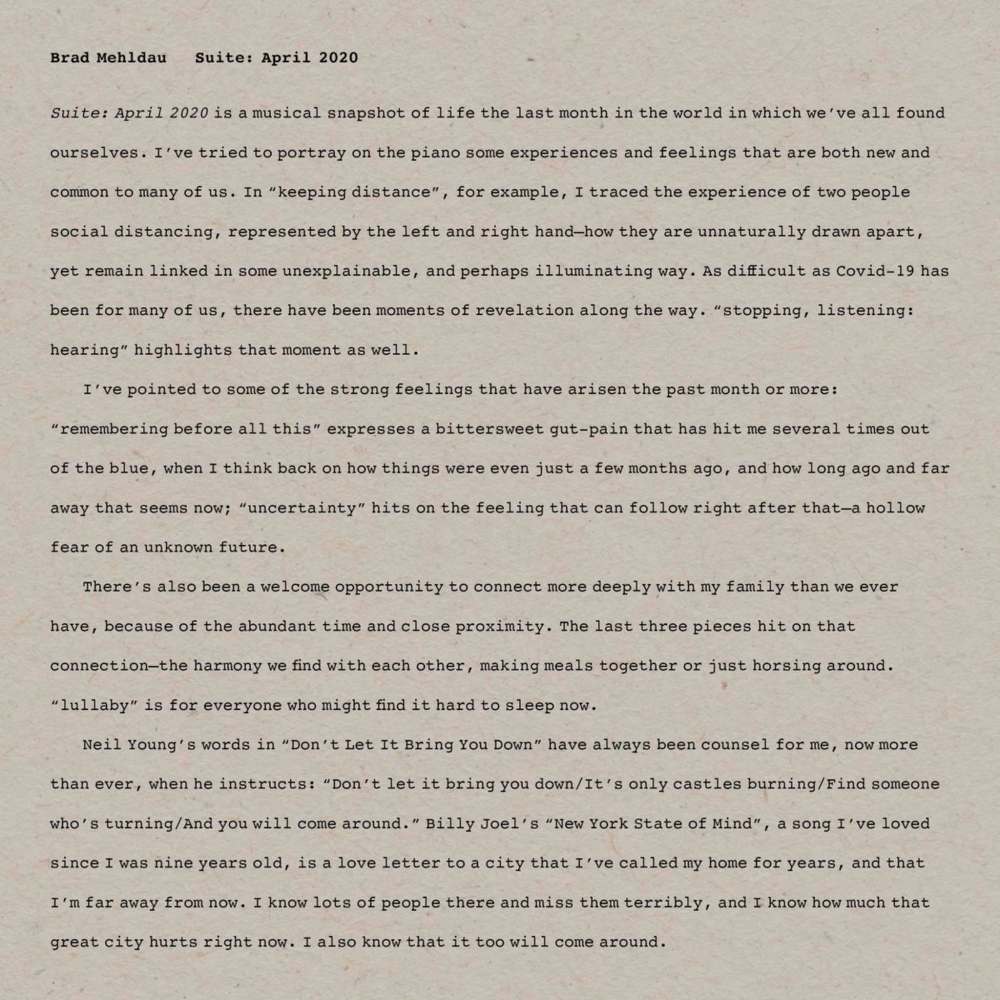
At 41 minutes, the album leaves one hoping for more — it’s good to know there is also a limited-edition vinyl release, numbered and signed, the full proceeds of which are for a fund assisting the many out-of-work jazz musicians in this current crisis.
The music here is simply beautiful from start to finish. There are gentle melodies, some stunning fugal moments, with repeated left hand riffs perhaps familiar to those who know Mehldau’s work. The pianist was able to safely use an Amsterdam studio to record the album, and the sound is absolutely luscious. Tracks like Yearning and Waiting offer a sense of peace that surely these times can use. In the Kitchen sounds like a family preparing a meal together. (On a personal note, when I first played the album, my wife, a professional pianist, wanted to know who was playing that gorgeous music.)
This is a gem for a troubled time — and the final track is a terrific version of Look for the Silver Lining. Say no more. Highly recommended. HHHHH
STREAM THESE: Remembering Before All This, Yearning
— Keith Black
CLASSICAL
Gustav Mahler: Das Lied von der Erde
Gerhild Romberger (contralto), Robert Dean Smith (tenor)
Budapest Festival Orchestra, Iván Fischer (Channel Classics)
“Symphony” and “song” come together in this upcoming fall release, featuring Mahler’s seminal song cycle, Das Lied von der Erde, (1908), composed in the wake of personal tragedy and once hailed by legendary American conductor Leonard Bernstein as “Mahler’s greatest symphony.”
German contralto Gerhild Romberger and American-Swiss tenor Robert Dean Smith breathe life into each of the work’s six movements conceived by the Austrian composer as his deeply felt ode to the Earth, with the Budapest Festival Orchestra skillfully led by Ivan Fischer.
Dean Smith immediately asserts his dramatic presence during the opening Das Trinklied vom Jammer der Erde, notorious for pushing the soloist into his uppermost range while underpinned by the lush sweeps of orchestral sound.
Romberger likewise imbues her following Der Einsame im Herbst with requisite melancholia, singing of “the dying of flowers and passing of beauty,” with her warm contralto matched equally by seamless phrasing. Her equally sensitive interpretation of Von der Schönheit features the singer spinning tales of pastoral beauty, while pacing her voice to rise in intensity by the end.
An album highlight quickly becomes Von der Jugend, with Dean Smith infusing its pentatonic sound world with the playfulness of youth, ostensibly serving as the symphonic work’s first scherzo. He also navigates multiple key changes during second scherzo, Der Trunkene im Frühling, including effective violin and flute solos evoking birdcalls.
Last but not least, Romberger’s Der Abschied, is rendered as a soulful farewell to the Earth, filled with evocative text painting and even a mandolin imitating the singer’s lute. As her voice fades into silence on final word, “ewig” (forever), one can’t help but reflect on our own fragile, yet dearly beloved, earthly home. HHHH1/2 out of five
— Holly Harris