WEATHER ALERT

Rounding the bases

Pioneering Japanese-American ballplayers struggled through American Midwest

Advertisement

Advertise with us

Before the likes of outfielder Ichiro Suzuki and pitcher/designated hitter Shohei Ohtani took Major League Baseball by storm, an earlier generation of Japanese players emigrated to the United States hoping to become professional baseball players.

Read this article for free:

or

Already have an account? Log in here »

To continue reading, please subscribe:

Subscribe and receive a limited-edition Free Press branded hat or tote.

Digital Subscription

One year of digital access for only $205*

  • Enjoy unlimited reading on winnipegfreepress.com
  • Read the E-Edition, our digital replica newspaper
  • Access News Break, our award-winning app
  • Play interactive puzzles

*First annual payment billed as $205.00 + GST for one year. This annual subscription will automatically renew at $233.00 + GST every 52 weeks (10% off the regular annual price of $259.35). Offer available to new and qualified returning subscribers only. Cancel any time.

To continue reading, please subscribe:

Add Free Press access to your Brandon Sun subscription for only an additional

$1 for the first 4 weeks*

  • Enjoy unlimited reading on winnipegfreepress.com
  • Read the E-Edition, our digital replica newspaper
  • Access News Break, our award-winning app
  • Play interactive puzzles
Start now

*Your next Brandon Sun subscription payment will increase by $1.00 and you will be charged $17.95 plus GST for four weeks. After four weeks, your payment will increase to $24.95 plus GST every four weeks.

Hey there, time traveller!
This article was published 08/08/2020 (2180 days ago), so information in it may no longer be current.

Before the likes of outfielder Ichiro Suzuki and pitcher/designated hitter Shohei Ohtani took Major League Baseball by storm, an earlier generation of Japanese players emigrated to the United States hoping to become professional baseball players.

Those wannabes lived a vastly different life, arriving in California as students or seeking employment, but always with the dream of making a living in baseball.

Instead they found themselves in a place that didn’t really want them, with the accompanying social and economic hardships.

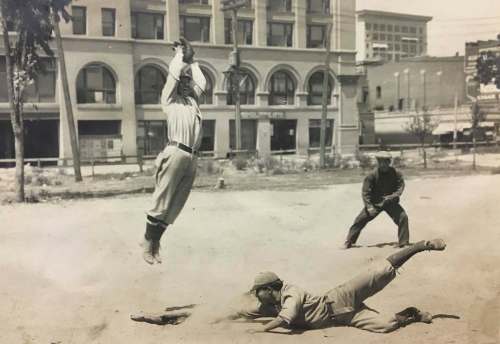
Courtesy of the author
In this undated photo, the Nanka Team practises in Los Angeles, Calif. Players saw the game as a chance for a better life and a means to bridge the gap between their home and adopted lands.
Courtesy of the author In this undated photo, the Nanka Team practises in Los Angeles, Calif. Players saw the game as a chance for a better life and a means to bridge the gap between their home and adopted lands.

Robert K. Fitts is a historian of Japanese-American baseball and the game’s link to Japan. Earlier books include Mashi: The Unfulfilled Baseball Dreams of Masanori Murakami and the award-winning Banzai Babe Ruth, about the Ruth-led major league baseball tour of Japan in 1934.

The key players in Issei Baseball, his fifth book, are five immigrants who shaped Japanese American baseball: Harry Saisho, Ken Kitsuse, Tom Uyeda, Tozan Masko and Kiichi Suzuki. It is a story of five passionate young men who were born in Japan and received a Western education as their fathers wanted them to be prepared for leadership roles in the new Japan, and who saw the game as a chance for a better, rewarding life, and as a means to bridge the cultural gap between their home and adopted lands.

They, and the many other Japanese immigrants on the U.S. West Coast in the early 1900s, were basically looking for the American dream. That quest was hampered by racism, some language difficulties and the complications of trying to put together a baseball team and barnstorm throughout the Midwest, chasing an income and baseball notoriety.

And their bats too often let them down on the field, even as their fielding and base running showed promise.

Rather than just playing Issei teams in California and Washington State, tours (mainly through the Midwest) were a key component in the development of Japanese-American baseball; they gave the newcomers competition outside their home communities.

Fitts also details tours made by Japanese university teams to the United States, American university tours to Japan as well as Japanese-American teams touring Japan — a period of activity taking place between 1905 and 1911.

Courtesy of the author
The 1905 Waseda University baseball team photograph.
Courtesy of the author The 1905 Waseda University baseball team photograph.

The major focus of Issei Baseball, however, is on the Issei tours of the American heartland, where the teams faced prejudice, racism, skepticism about their baseball skills as well as economic problems, because they lived on a share of the gate.

Some communities welcomed the teams as a novelty as they were billed being all-Japanese (although they did throw in ringers when facing a tough semi-pro opponent). In many other locales the players were referred to as “little brown boys,” and illustrations in newspapers depicted them with animalistic characteristics and big teeth.

The Issei teams were put in the same category as African-American and Native-American teams — all of them seen as outsiders with no hope of assimilation.

Fitts places the Issei in larger national and international context of the times, including the Russo-Japanese War of 1905, the move to segregate Japanese-American children by the San Francisco Board of Education in 1906 and the fears of the Yellow Peril in American mainstream culture.

After the Japanese attack on Pearl Harbor in 1941, Japanese Americans — Issei, the immigrants, and Nisei, their American-born offspring — were stripped of their possessions and placed in euphemistically named “relocation centres.” Fitts’ main protagonists spent the war incarcerated, having lost land, good jobs and any hope of being assimilated in their adopted home.

Issei Baseball is a detailed look at the Japanese immigrants’ attempts to realize their baseball dreams and start a new life in the U.S.

For some readers, there will be too much detail in game-by-game accounts (also appendices listing individual tour game scores and team lineups), but Fitts delivers an appealing account of a group of young men hoping to build a new western life for themselves with a bat, ball and glove.

Chris Smith is a Winnipeg writer.
Report Error Submit a Tip

More Stories

Man, 20, faces charges in street-racing incident

1 minute read Updated: Yesterday at 11:37 PM CDT

Speeding drivers were racing through Elmwood at up to 200 km/h overnight, Winnipeg police say.

Around 2 a.m. July 26, police got reports of a Corvette and other vehicles racing along Disraeli Freeway. Using the Winnipeg Police Service's helicopter, officers monitored the vehicles and recorded speeds, including vehicles crossing the Nairn overpass at up to 200 km/hr.

Officers with the central traffic unit tried to pull over a Jeep and a Corvette at Lagimodiere Boulevard and Regent Avenue. The driver of the Corvette didn't stop and sped past police, eventually stopping in the 100 block of Johnson Avenue where the driver and passenger got out and ran.

The K9 unit tracked the suspects to the 100 block of Poplar Avenue. One of them was taken down by a police dog and received medical attention. Both were taken into custody.

Qualico celebrating 75 years of growth, success since its first development of 13 bungalows in River Heights

Aaron Epp 6 minute read Preview

Qualico celebrating 75 years of growth, success since its first development of 13 bungalows in River Heights

Aaron Epp 6 minute read 6:00 AM CDT

The first things staff and visitors see after ascending to the third floor of Qualico’s head office in Winnipeg are two statues — one each for company founders David and Katherine Friesen.

Flanking the doors to the integrated real estate company’s C-suite offices, the bronze sculptures are monuments to the couple and the vision, strength and integrity (as the plaques attached to the wooden pedestals attest) it took to start Qualico in 1951.

But imagine for a moment what it would be like if the sculptures were less reverent and more whimsical. Picture them outfitted with the kind of pull-string voice boxes one finds in a child’s toy. What might they say?

It’s possible one of David Friesen’s phrases would be: “No margin, no mission.”

Read
6:00 AM CDT

Automation reaches new heights on farm

Laura Rance-Unger 4 minute read Preview

Automation reaches new heights on farm

Laura Rance-Unger 4 minute read Saturday, Jul. 25, 2026

LANGHAM, Sask. — The thousands of farmers from across the Prairies who flock to the annual Ag in Motion show every July seem oblivious to the possibility the technology on display could one day replace many of them.

Families with children in tow, Hutterite colony workers, grandparents and young couples just starting out roamed through the 600 or more exhibitor displays, amazed at how everything about farming just keeps getting bigger, more efficient and increasingly more automated.

It’s now possible to seed using a 100-foot-wide drill — a 12-foot jump over the widest available a few years ago — provided the farmer can afford a tractor with enough horsepower to pull it. Those sell for around $850,000 and up.

Granted, the number of farms with enough acres to justify that kind of width and drawing power is still relatively small, but farms continue to grow. And it’s no secret the number of people who have the interest, skills and financial wherewithal to run them continues to shrink.

Read
Saturday, Jul. 25, 2026

Cultural consultation gives Indigenous stories strength in Netflix’s new Little House on the Prairie

Jen Zoratti 13 minute read Preview

Cultural consultation gives Indigenous stories strength in Netflix’s new Little House on the Prairie

Jen Zoratti 13 minute read 5:49 PM CDT

Through her work as an Indigenous consultant for film and TV, Julie O’Keefe, a citizen of the Osage Nation, has brought accuracy and authenticity to works such as Martin Scorsese’s 2023 crime drama Killers of the Flower Moon, the 2025 western miniseries American Primeval and, most recently, Rebecca Sonnenshine’s new adaptation of Little House on the Prairie.

But she doesn’t work solo.

“One of the things that I always say is, in any of these jobs that I do — whether it’s Shoshone and Paiute and Ute or Osage — I never come alone to this,” says O’Keefe, who grew up in Pawhuska, Okla., the heart of the Osage Nation, and is now based in Santa Fe, N.M. “I engage because those stories are so much richer with our voices added to it, and we know that.

“I’m sitting down with brilliant directors, brilliant writers, and I’m handing over pieces of history that they’re like, ‘How come nobody knows this?’ And the great part is, this is the time in history … people are really starting to get on top of wanting this for their stories, because it really wasn’t of any importance before.”

Read
5:49 PM CDT

An eroding Winnipeg neighbourhood looks to new foundations

Ian Bickis, The Canadian Press 5 minute read Preview

An eroding Winnipeg neighbourhood looks to new foundations

Ian Bickis, The Canadian Press 5 minute read Updated: Yesterday at 1:34 PM CDT

WINNIPEG - The lot Jesse Bettcher lives on in Winnipeg's north end used to be a pile of burnt rubble. Same with the one next door. And the one across the street.

But he's now the proud owner of a two-storey house with blue-grey siding and white trim, so new the orange construction fencing is still out front.

It's a dream home for Bettcher, and the latest hope for a city seeking to knock down, clean up and revitalize neighbourhoods that have seen hundreds of homes left vacant, leading to safety hazards and worries about the future.

He bought the house as part of a pilot project aimed at creating affordable home ownership. It let him and his family move out of a rental that he said was falling apart.

Read
Updated: Yesterday at 1:34 PM CDT

Cash injection will help women’s centre grow

Malak Abas 5 minute read Preview

Cash injection will help women’s centre grow

Malak Abas 5 minute read 5:22 PM CDT

Janice Lavellee grew up in a large family rife with substance abuse and domestic violence. She ran away from home at age 14.

When she found the North End Women’s Centre, it was a godsend.

“I never knew the North End Women’s Centre was there, because I never knew where to get help,” she said.

After having a child at 16, Lavellee said the centre gave her a job on the weekends. It was a stepping stone to finishing high school, and she later returned to the centre to work as a receptionist for 27 years before recently retiring.

Read
5:22 PM CDT