

Former Bison making soccer inroads
Mavignier aiming at male-dominated coaching ranks
Advertisement
Read this article for free:
or
Already have an account? Log in here »
To continue reading, please subscribe:
Digital Subscription
One year of digital access for only $1.44 a week*
- Enjoy unlimited reading on winnipegfreepress.com
- Read the E-Edition, our digital replica newspaper
- Access News Break, our award-winning app
- Play interactive puzzles
*Billed as $5.77 plus GST every four weeks. After 52 weeks, price increases to the regular rate of $19.95 plus GST every four weeks. Offer available to new and qualified returning subscribers only. Cancel any time.
To continue reading, please subscribe:
Add Free Press access to your Brandon Sun subscription for only an additional
$1 for the first 4 weeks*
- Enjoy unlimited reading on winnipegfreepress.com
- Read the E-Edition, our digital replica newspaper
- Access News Break, our award-winning app
- Play interactive puzzles
*Your next Brandon Sun subscription payment will increase by $1.00 and you will be charged $17.95 plus GST for four weeks. After four weeks, your payment will increase to $24.95 plus GST every four weeks.
Read unlimited articles for free today:
or
Already have an account? Log in here »
Hey there, time traveller!
This article was published 21/08/2020 (2251 days ago), so information in it may no longer be current.
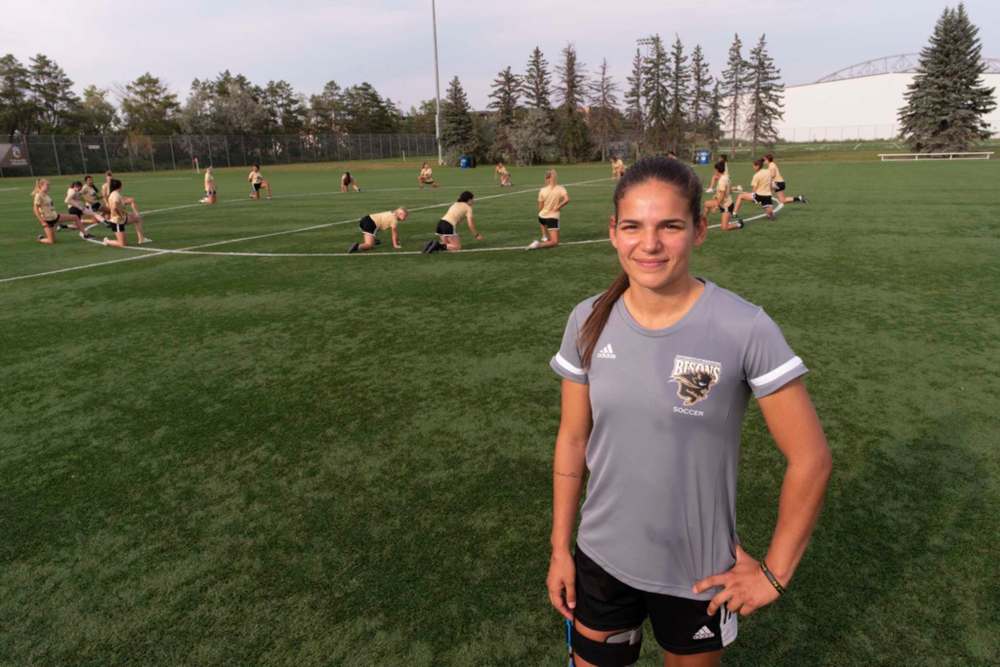
Bruna Mavignier has already figured out the world is not her oyster when it comes to coaching soccer at a top-flight level.
But the former University of Manitoba Bisons striker is prepared to tackle every obstacle in her way — including the significant gender imbalance that exists in coaching — to achieve her goals.
“I really want to work in professional women’s soccer and I’ll go wherever the opportunities are available. I would look more in Europe or the U.S., because I want to work at the highest level,” Mavignier said Friday. “Working with young women is very natural for me, because I’ve been through what they’re going through, I’ve been in their shoes, I’ve had those experiences.
“We always hear about that gap in coaching, and I want to be one of those women making a difference, showing we can be just as good as men as long as we are determined, have passion and have knowledge.”
U Sports, the national governing body of university sport in Canada, has devised a program aimed at helping driven individuals such as Mavignier follow their dreams. The 27-year-old Brazilian, who moved to Canada in 2013 and spent five seasons with the Bisons, is one of 18 former student-athletes across the country who will participate in the inaugural U SPORTS Female Apprenticeship Coach Program.
Funded through Sport Canada, the program aims to increase the number of females in coaching positions across Canadian universities by matching apprentice coaches who have recently graduated with a mentor coach in one of the 11 sanctioned sports. It’s a substantial move to bolster the number of female coaches in the nation’s university system.
In women’s soccer alone, just eight of 53 Canadian university squads have a female at the helm. The Bisons employ one of them, Vanessa Martinez Lagunas, a former member of Mexico’s national team and a former pro in Europe who is acutely aware of how difficult it is to break the gender barrier.
The National Women’s Soccer League has only one female head coach — Sky Blue FC’s Freya Coombe — and only nine women make up the league’s 36 total coaching jobs. Even in women’s soccer leagues in the United Kingdom, men still hold 90 per cent of all coaching jobs at all levels. And at the 2019 World Cup in Paris, just nine of 24 teams had female head coaches.
While more girls take up the sport, the questions remains: Where are all the female coaches?
“Men coaching women is the standard. So, I think there is a big gap in gender equity in coaching, and one of the biggest barriers women face is the financial barrier. It’s very hard to get a salary or honorarium or any money through coaching, and without that it’s hard for women to get into the profession, so they choose to go other avenues to earn a living,” said Lagunas.
“These apprentice programs help us be able to support our young female coaches with financial support throughout the year so they can get the experience and become great candidates for future positions.”
After her fifth and final season as a player (2018-19), Mavignier, stayed with the Bisons and volunteered as an assistant alongside Lagunas. This year, she’ll actually get paid — courtesy of the apprenticeship program — although the on-the-job experience she gains is more valuable to her than the extra bump to her bank account.
“It was totally volunteer last season, but the program gave me so much and I felt like I wanted to give back. I wanted to be involved still, I love the girls and I love the staff,” said Mavignier, who has a degree in kinesiology and recreation management, and is working on her masters. “As coach, when you see players dedicating themselves and wanting to get better, it just makes me want to help them so much.
Lagunas said Mavignier is an absolute natural and believes her coaching protege has all the traits to be successful leading on her own or focusing on the areas of strength and conditioning.
“I really think Bruna has great potential to become a great coach at a high level: university, professional or national team level. She reads the game very well, creates great rapport with players and has studied kinesiology and that’s a good field for coaching because you take many of the sports science courses,” said Lagunas, a former member of Mexico’s national team. “She has been great and the girls really relate to her because she has been in their shoes recently.
“She’s so friendly and she has that gift of integrating herself very well. She came from a new country but right away she won the love and trust of her teammates. She has a lot of charisma, a great competitive mentality that we’re trying to instil in the team as we try to improve every year. Definitely, we have made huge strides from where our team culture was to where we are now, and Bruna has been a really important part of that building process.”
The apprenticeship program kicked off Aug. 1 and ends April 30. However, the 2020-21 year is like no other for U of M student-athletes and coaches. U Sports cancelled all fall competition owing to the COVID-19 pandemic.
Instead, Lagunas entered the soccer team in the Winnipeg’s Women’s Soccer League (Premier Division). The Herd, as the team is aptly named, has a 4-1-1 record, losing Thursday night to the front-running WSA North Stars.
“It’s been very useful because it gives us an opportunity to focus on the players’ individual development and team development instead of results. I think for Bruna, it’s a great opportunity to help me work with individual players, smaller groups, more technical exercises and really working on skills that need more refining,” said Lagunas.
Mavignier was the epitome of a walk-on to the Bisons program in 2013. She had a scholarship, offered by a Brazilian program called Science Without Borders, which gave her a chance to study kinesiology abroad. She settled on the Manitoba capital, cold winters and all, and, after spending a year training as a non-roster player, she took the team and the Canada West conference by storm in 2014, scoring eight times in 12 games.

The diminutive speedster, listed at 5-4, immediately caught fire to begin the 2015 campaign, scoring six times in six matches but suffered a serious knee injury in practice that cost her the rest of the season. She rehabbed and returned to the pitch but struggled during the ’16 season and then tore the ACL in her other knee, sidelining her for all of 2017. Her final year of eligibility (2018) was far more positive, as she booted five goals in 15 starting assignments.
Mavignier said coping with the injuries definitely made her a stronger person — and should make her a better coach in the long run.
“Fighting through adversity is something I understand,” she said. “One of my main responsibilities is to work with the team to prevent injuries through strength and conditioning. Getting through my own injuries helped me understand better what players need so they don’t get hurt. And if they do get hurt, what they need to get them through that difficult experience.”
jason.bell@freepress.mb.ca
Twitter: @WFPJasonBell
Related Articles
CPL Roundup: Edmonton scores late for draw Fans clash with Paris riot police after PSG loses final






Advertisement Advertise With Us
Advertisement Advertise With Us