

Wearing orange to honour, remember the children
Advertisement
Read this article for free:
or
Already have an account? Log in here »
To continue reading, please subscribe:
Digital Subscription
One year of digital access for only $1.44 a week*
- Enjoy unlimited reading on winnipegfreepress.com
- Read the E-Edition, our digital replica newspaper
- Access News Break, our award-winning app
- Play interactive puzzles
*Billed as $5.77 plus GST every four weeks. After 52 weeks, price increases to the regular rate of $19.95 plus GST every four weeks. Offer available to new and qualified returning subscribers only. Cancel any time.
To continue reading, please subscribe:
Add Free Press access to your Brandon Sun subscription for only an additional
$1 for the first 4 weeks*
- Enjoy unlimited reading on winnipegfreepress.com
- Read the E-Edition, our digital replica newspaper
- Access News Break, our award-winning app
- Play interactive puzzles
*Your next Brandon Sun subscription payment will increase by $1.00 and you will be charged $17.95 plus GST for four weeks. After four weeks, your payment will increase to $24.95 plus GST every four weeks.
Read unlimited articles for free today:
or
Already have an account? Log in here »
Hey there, time traveller!
This article was published 21/09/2020 (2101 days ago), so information in it may no longer be current.
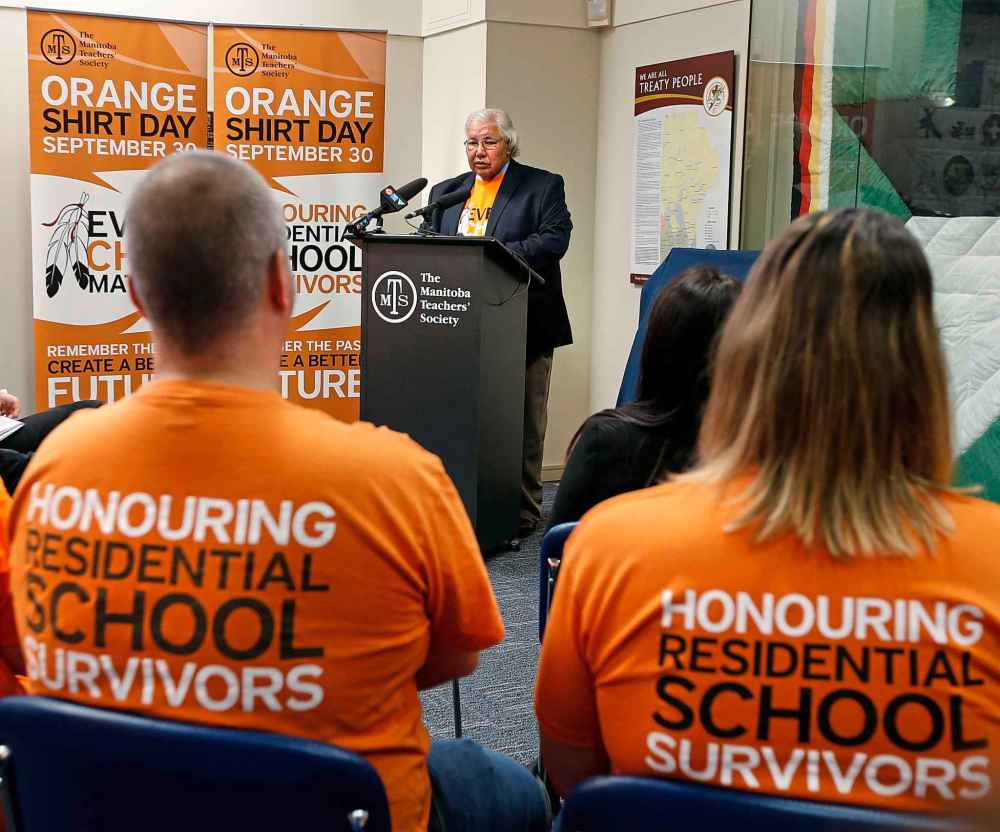
Orange shirt day is Sept. 30.
If you’re not familiar with this movement, the inspiration came in 2013 from a residential school survivor named Phyllis Jack Webstad, who shared the story of her first day of residential school at six years old in Williams Lake, B.C., in 1973, when her new orange shirt — bought by her grandmother — was taken away from her.
Now this is a day when we honour Indigenous children who were sent away to residential schools in Canada and learn more about the history of those schools. If you have children, you have probably received a note or bulletin from their school encouraging them to wear orange on this day.
Many residential school survivors, such as Webstad, have bravely shared their own stories and traumas so that we can learn from this stain on Canadian history. However, there are some stories that have never been shared. Many traumas were never acknowledged and many people died with this burden.
One of those people is Annie Cook, my grandmother. I want to tell you her story, but I don’t know a lot about her.
She was born in Manitoba (Petersfield, I think) on Sept. 6, 1913. She was one of 11 children born to Henry and Arabella Prince. I don’t know anything about her sisters and brothers, except for her younger brother, Tommy, who was born two years after her and who would grow up to become one of Canada’s most decorated war heroes.
She was a great-great-granddaughter of Chief Peguis, a Saulteaux chief who signed the first treaty with Lord Selkirk, granting land along the Red River to the Selkirk settlers.
While she had some huge family connections, her legacy is small — a couple of tattered photos, an uncanny likeness to my little sister, a collection of stories and memories that my dad shares every once in a while, and a headstone among many at St. Clements Cemetery in Selkirk.
Aside from those things, her story is mostly lost.
Like so many other Indigenous children, she was taken from her parents and put into a residential school. She was isolated from her family, her community and her culture in an effort to assimilate her into white Canadian culture. She suffered, though if she spoke about her abuse, the details of those stories died with her and her generation. There are only fragments left.
They pulled out her teeth in residential school because, she told my dad, they said she had gum disease. But, she never believed that was the real reason.
“Those damn schools…” my dad said, his voice fading away as he retold that story.
We owe it to our grandmothers and to our children to keep these stories alive as best we can.
My dad and I never venture into those dark places where the trauma festers. It’s this big, shameful secret that you know things happened to her at the schools, but you don’t dig deep enough to see if anyone knows more than that. Knowing that she suffered is enough.
Glimmers of her traumatic childhood were present in her own parenting, and I know that she sometimes inflicted her suffering onto her own family. She could be downright wicked if she felt like it. She never learned how to be a mother because she was stolen from hers.
But even in darkness there is sometimes light.
A while ago, my little sister met an elder on our reserve who knew my grandma. This person wasn’t a peer, as she was younger than my grandma, but she knew her.
“You’re Annie Cook’s granddaughter,” she exclaimed, noting the uncanny resemblance my sister and my nana share. “She was always laughing, that Annie Cook.”
It was such a small but grand detail. More than that, it was a connection to our lost grandmother from someone who knew her outside of our family. She was real. She mattered.
I cried when my sister told me that. Deep down in her troubled soul, she still found a way to always be laughing.
She died in a nursing home in 1980. She had suffered a major stroke four years earlier from which she never fully recovered.
I don’t know that Annie Cook gets a happy ending in her own story. We want to believe that there will be a happy ending for all of us, but I don’t think she has one.
On Sept. 30 my kids will wear their orange shirts to school in honour of her and in honour of the other lost and stolen Indigenous children. We owe it to our grandmothers and to our children to keep these stories alive as best we can.
shelka79@hotmail.com
@ShelleyACook
History
Updated on Monday, September 21, 2020 7:37 AM CDT: Adds missing text