

Clash of the titans: Chartrand vs. Pallister
Relationship between Métis leader, premier 'the worst it's ever been in Manitoba history'
Advertisement
Read this article for free:
or
Already have an account? Log in here »
To continue reading, please subscribe:
Monthly Digital Subscription
$1 per week for 24 weeks*
- Enjoy unlimited reading on winnipegfreepress.com
- Read the E-Edition, our digital replica newspaper
- Access News Break, our award-winning app
- Play interactive puzzles
*Billed as $4.00 plus GST every four weeks. After 24 weeks, price increases to the regular rate of $19.95 plus GST every four weeks. Offer available to new and qualified returning subscribers only. Cancel any time.
Monthly Digital Subscription
$4.99/week*
- Enjoy unlimited reading on winnipegfreepress.com
- Read the E-Edition, our digital replica newspaper
- Access News Break, our award-winning app
- Play interactive puzzles
*Billed as $19.95 plus GST every four weeks. Cancel any time.
To continue reading, please subscribe:
Add Free Press access to your Brandon Sun subscription for only an additional
$1 for the first 4 weeks*
*Your next subscription payment will increase by $1.00 and you will be charged $16.99 plus GST for four weeks. After four weeks, your payment will increase to $23.99 plus GST every four weeks.
Read unlimited articles for free today:
or
Already have an account? Log in here »
Hey there, time traveller!
This article was published 19/10/2020 (1978 days ago), so information in it may no longer be current.
To those who follow Manitoba politics, a photo on the Manitoba Metis Federation’s Twitter page might look like it’s from an alternate reality, or possibly a clever Photoshop job.
Posted days after the PCs won the 2016 election, Premier Brian Pallister’s hand rests on the shoulder of MMF president David Chartrand. The two men are beaming.
“A productive and exciting meeting with premier-designate Brian Pallister,” reads the tweet. “Métis ready to partner.”
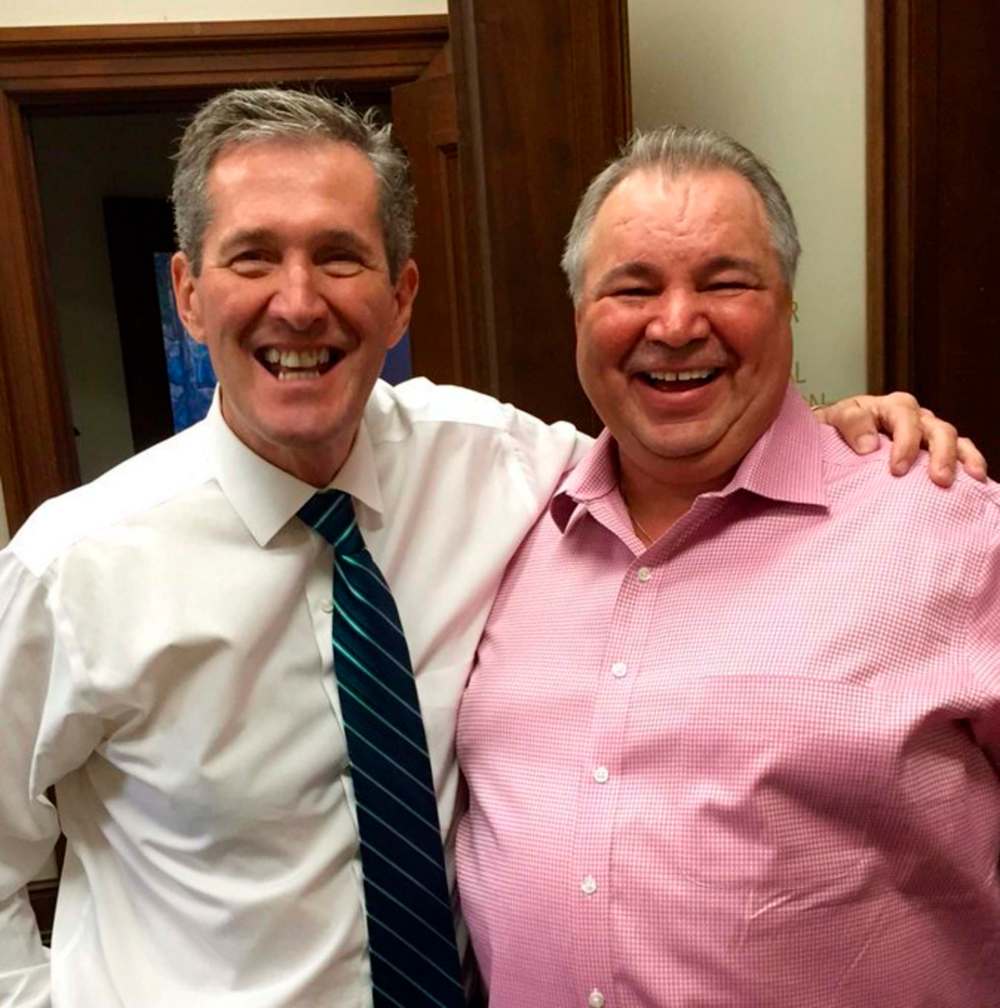
But within a year, the two men were at loggerheads, and political observers say the fractious relationship comes down to both personality and policy.
“There was always going to be conflict between these two,” said Royce Koop, head of the University of Manitoba political studies department.
“There’s a real kind of ‘when an unstoppable force hits an immovable object dynamic’ to their relationship.”
Brandon University political scientist Kelly Saunders recalls the PCs attending Metis federation events before the 2016 election as they courted Métis voters.
She said Métis people aren’t historically loyal to a specific party.
“The Métis are in many ways natural conservatives; they were the fur traders (…) the first entrepreneurs on the Prairies. Many Métis are small-business owners with a Catholic background,” said Saunders, who is married to an MMF minister and also worked for a PC minister during the Filmon government.
“It’s too bad the Pallister government has written them off as a voting constituency,” Saunders said.
“Shortly after the 2016 election, that’s where things started going south pretty fast.”
In early 2017, Pallister warned that tensions over night hunting risked “becoming a race war,” a comment for which he refused to apologize. Although Chartrand was miffed, the province’s work with the federation continued largely unchanged until a year later.
In March 2018, Pallister’s appointees to the Manitoba Hydro board resigned en masse over the premier’s rejection of a land-entitlement deal Hydro had inked with the federation.
The Métis would be paid $67.5 million in exchange for them not contesting a transmission line to Minnesota, and other projects, for 50 years. Pallister called the deal “persuasion money” and “hush money” for what he deemed “a special-interest group,” which incensed the Métis leader.
Chartrand accused Pallister of racial bias and being vindictive.
That fall, the premier scuppered a separate Hydro deal with the Métis. Ironically, Hydro had arranged both deals under a 2014 agreement meant to avoid adversarial spats.
The federation responded by launching multiple lawsuits against the province, and plans to appeal an initial loss.
In the spring of 2019, the province ended an annual payment for Métis self-government dating back to 1987, on the premise the federation has shown it can assert its own rights.
“This is a malicious attack against the Métis nation,” Chartrand said at the time. “There’s no relationship really left now.”
Behind the scenes, talks with the PCs about housing and health-care projects ground to a halt.
Over the years, the Métis have been in sync with First Nations leaders in believing the province hasn’t consulted them on child-welfare reforms and Interlake flood channels.
Indigenous groups felt ignored this May as Manitoba marked its 150th anniversary, when Pallister issued a statement that recognized immigrants, religious minorities and volunteers, but lacked any mention of Indigenous people.
But the feeling has cut particularly deep for the Métis because the premier has collaborated with some First Nations groups. In February, for example, the province inked an agreement to devolve control of some northern airports and ferries to First Nations.
Meanwhile, in the throne speech earlier this month, the PCs announced a statue of Chief Peguis would be erected on the legislature grounds, but they failed to mention Louis Riel, the Métis founder of the province. That irked Chartrand.
Koop said the Pallister government’s approach to Indigenous issues seems to follow the same guiding principle for most PC policies: cutting costs.
“Sometimes we look for a rationality, or a strategy where there just isn’t one,” Koop said. “When it comes to dealing with the Métis federation, (Pallister) sees any kind of concession as if it’s going to increase costs.”
Koop noted that a rural premier bent on small government was bound to clash with an imposing figure who has led Manitoba’s Métis since 1996. “You can see how they really would be on a collision course,” he said.
Saunders rejects that thinking, arguing the premier’s attitude echoes a historical trope that Métis people are only half-Indigenous by virtue of having a mixed bloodline.
“The premier seems to be very selective in whom he wishes to talk to,” she said.
“It appears to me the premier does not fully believe or accept that the Métis are unique Indigenous people with inherent rights.”
More recently, Chartrand has been at loggerheads with provincial health officials over sharing data about COVID-19. The province claims the federation hasn’t answered an invitation to share data, which could help Métis leaders respond early to outbreaks. The federation argued the province was wrong to ask people whether they self-identify as Indigenous, with Métis leaders particularly sensitive to people falsely claiming they have Métis roots.
Chartrand alleges the premier has sabotaged health officials’ efforts to help the Métis out of spite. When the MMF filed a human-rights complaint last month over the data issue, Pallister chalked it up to Chartrand “trying to weasel” public funds.
“I have tons of Métis friends whom I have way too much respect for to start throwing money at them,” the premier said. “It’s just David Chartrand looking to sue somebody, and there’s not many people in Manitoba he hasn’t chosen to sue.”
This month, the federation and the province sparred over moose hunting. The federation announced its own moose hunt as it claimed, along with First Nations, that the province’s ban on moose hunting in western Manitoba doesn’t fit with conservation plans.
The government insists it’s trying to protect the animals, but Saunders says that plays into stereotypes that Indigenous hunters don’t care about sustainability.
“There are a lot of white hunters that are Progressive Conservative voters,” she said. “Picking fights with the Métis plays to (Pallister’s) base; that’s the bottom line.”
When the NDP governed, the Métis launched a court battle over hunting rights and Chartrand spoke against cuts to provincial funding to the federation.
“They were still able to work on other files; the relationship had not completely and irrevocably broken down across all policy areas, the way that you see under this PC government,” said Saunders, who specializes in Métis governance in Manitoba.
“This relationship is the worst it’s ever been in Manitoba history.”
The two men clearly get under each other’s skin. In public, Chartrand has repeatedly compared Pallister with U.S. President Donald Trump. The premier often brings up Chartrand in interviews on unrelated topics.

Dan Vandal, Manitoba’s only federal cabinet minister, who is Métis, said he wishes the two could just get along.
“Obviously, there needs to be some education on the provincial side,” Vandal said, arguing Pallister’s comments show he has misconstrued the role of the Métis in Canadian history.
He worries the spat will mean average Métis people will be left behind.
“It’s unfortunate this is going on, and I’d like to see both parties come to the table.”
dylan.robertson@freepress.mb.ca