

Winnipeg’s homicide rate remains high

Advertisement
Read this article for free:
or
Already have an account? Log in here »
To continue reading, please subscribe:
Monthly Digital Subscription
$1 per week for 24 weeks*
- Enjoy unlimited reading on winnipegfreepress.com
- Read the E-Edition, our digital replica newspaper
- Access News Break, our award-winning app
- Play interactive puzzles
*Billed as $4.00 plus GST every four weeks. After 24 weeks, price increases to the regular rate of $19.95 plus GST every four weeks. Offer available to new and qualified returning subscribers only. Cancel any time.
Monthly Digital Subscription
$4.99/week*
- Enjoy unlimited reading on winnipegfreepress.com
- Read the E-Edition, our digital replica newspaper
- Access News Break, our award-winning app
- Play interactive puzzles
*Billed as $19.95 plus GST every four weeks. Cancel any time.
To continue reading, please subscribe:
Add Free Press access to your Brandon Sun subscription for only an additional
$1 for the first 4 weeks*
*Your next subscription payment will increase by $1.00 and you will be charged $16.99 plus GST for four weeks. After four weeks, your payment will increase to $23.99 plus GST every four weeks.
Read unlimited articles for free today:
or
Already have an account? Log in here »
Hey there, time traveller!
This article was published 28/10/2020 (2014 days ago), so information in it may no longer be current.
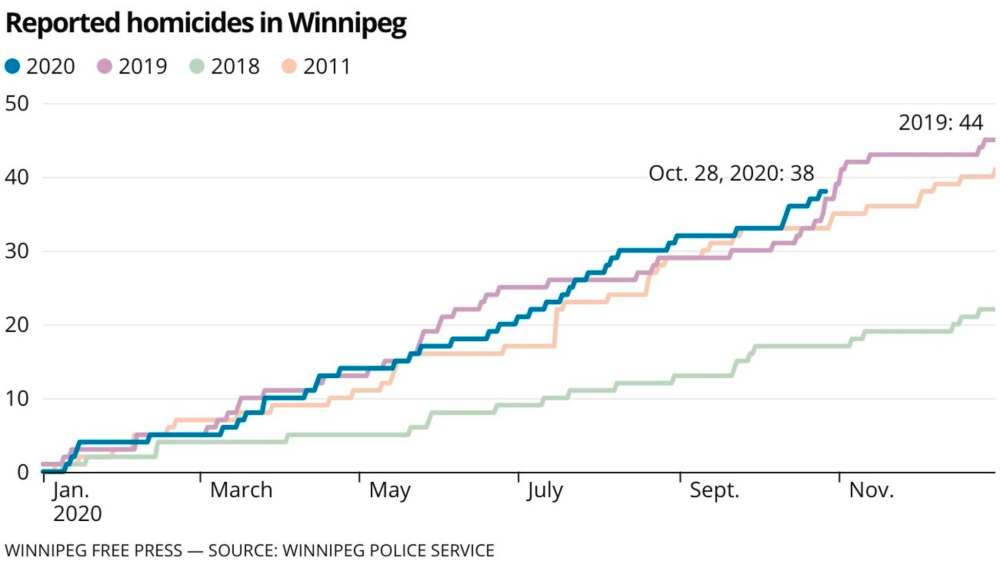
With two months left of an all-round grim year, Winnipeg is on pace to surpass last year’s record-breaking number of homicides.
As with so many aspects of life disrupted in 2020, is COVID-19 to blame? Maybe, says a University of Manitoba criminologist, but it will be years before anyone can offer a more definitive answer.
“It’s certainly possible that the pandemic is having some effects,” said Prof. Frank Cormier. “I think a lot of people are aware that everything is in a state of upheaval right now. People’s lives are chaotic and chaos or disruption in people’s lives is a very strong correlate of many kinds of crime, particularly violent crime, including homicides.”

Thirty-nine-year-old Adam Roy Solinger was found injured outside a Furby Street home last week and died, becoming the city’s 38th homicide victim of the year.
In 2019, the deadliest year on Winnipeg streets, the city recorded 44 homicides. At the time of Solinger’s death, the city had recorded five more homicides than the same time last year.
The breaking of normal patterns of behaviour can leave people feeling adrift and anxious, Cormier said, possibly contributing to a higher homicide rate.
“Maybe they have lost their jobs, or their family situation has become chaotic because they are all packed in the house together — those things can result in various coping behaviours which can mean people turning to alcohol or drugs to try to reduce their anxiety or normalize,” Cormier said. “And that’s a very, very strong correlate of violent behavior, particularly homicides.”
Cormier cautioned it could take up to 10 years before enough crime data can be analyzed to determine what is causing rising homicide numbers and whether they are a “trend” or a “blip.”
“Then we can start looking at controlling or eliminating certain variables and we can we try to narrow down what we believe was behind it,” he said.
Unlike other crimes, such as property offences that can more easily be tied to specific causes like a poorly performing economy, homicides are most often an “irrational event,” making them much harder to pin down statistically, Cormier said.
Homicides are “almost always committed under the influence of alcohol or drugs… virtually always in the heat of the moment, in extreme anger,” Cormier said.

Further complicating matters, many serious assaults could just as easily be homicides, but for bad aim, speedy medical intervention or other factors.
“The line between an aggravated assault and homicide can be a very, very fine one,” he said. “We can almost put the (most serious) assaults in with the homicides, put them all in the same bucket and maybe look at them that way, which might get us much better and more comprehensive information.”
Thirty-eight homicides is “a shocking and terrible number,” Cormier said, but still a small one, statistically speaking, making it difficult to draw conclusions from one year to the next.
“That makes it even more challenging to ferret out the variables that are contributing (to the homicide rate),” he said. “The larger the sample size, the more data we have, the more accurate we can be.”
dean.pritchard@freepress.mb.ca
Dean Pritchard is courts reporter for the Free Press. He has covered the justice system since 1999, working for the Brandon Sun and Winnipeg Sun before joining the Free Press in 2019. Read more about Dean.
Every piece of reporting Dean produces is reviewed by an editing team before it is posted online or published in print — part of the Free Press‘s tradition, since 1872, of producing reliable independent journalism. Read more about Free Press’s history and mandate, and learn how our newsroom operates.
Our newsroom depends on a growing audience of readers to power our journalism. If you are not a paid reader, please consider becoming a subscriber.
Our newsroom depends on its audience of readers to power our journalism. Thank you for your support.
Dean Pritchard is courts reporter for the Free Press. He has covered the justice system since 1999, working for the Brandon Sun and Winnipeg Sun before joining the Free Press in 2019. Read more about Dean.
Every piece of reporting Dean produces is reviewed by an editing team before it is posted online or published in print — part of the Free Press‘s tradition, since 1872, of producing reliable independent journalism. Read more about Free Press’s history and mandate, and learn how our newsroom operates.
Our newsroom depends on a growing audience of readers to power our journalism. If you are not a paid reader, please consider becoming a subscriber.
Our newsroom depends on its audience of readers to power our journalism. Thank you for your support.
Advertisement Advertise With Us
Advertisement Advertise With Us