Fleeting fame, back to obscurity
Mike Swistun, the Strongest Man in the World in Ringling Brothers Barnum & Bailey Circus, languished unhappily on family farm in Olha, a speck on Manitoba map
Advertisement
Read this article for free:
or
Already have an account? Log in here »
To continue reading, please subscribe:

Digital Subscription
One year of digital access for only $205*
- Enjoy unlimited reading on winnipegfreepress.com
- Read the E-Edition, our digital replica newspaper
- Access News Break, our award-winning app
- Play interactive puzzles
*First annual payment billed as $205.00 + GST for one year. This annual subscription will automatically renew at $233.00 + GST every 52 weeks (10% off the regular annual price of $259.35). Offer available to new and qualified returning subscribers only. Cancel any time.
To continue reading, please subscribe:
Add Free Press access to your Brandon Sun subscription for only an additional
$1 for the first 4 weeks*
- Enjoy unlimited reading on winnipegfreepress.com
- Read the E-Edition, our digital replica newspaper
- Access News Break, our award-winning app
- Play interactive puzzles
*Your next Brandon Sun subscription payment will increase by $1.00 and you will be charged $17.95 plus GST for four weeks. After four weeks, your payment will increase to $24.95 plus GST every four weeks.
Read unlimited articles for free today:
or
Already have an account? Log in here »
Hey there, time traveller!
This article was published 31/10/2020 (2112 days ago), so information in it may no longer be current.
This story was first published in Manitoba History by the Manitoba Historical Society in 1982.
The Strongest Man in the World carries a special significance for the Manitoba film scene, for not only was it shot in this province, but virtually the entire production crew was drawn from the ranks of The Winnipeg Film Group, the only independent film co-op in the province. It is also one of the few short films on a truly Canadian subject financed through private investments and the federal government’s tax incentive program for film.
When Halya Kuchmij came to Olha (population 100) in 1978, she was looking for what she termed “interesting old-timers with intriguing tales to tell” as part of a project for the National Film Board. She hardly expected to discover the perfect subject; but that was precisely what happened. Hidden away in this overlooked prairie outpost lived Mike Swistun, once “The Strongest Man in the World” as he was billed by Ringling Brothers Barnum & Bailey Circus when he toured with the world-famous troupe during the summer of 1923. In Kuchmij’s film about Mike Swistun, fittingly titled The Strongest Man in the World, we meet this remarkable man who once could bend iron bars in his teeth, support five men on his stomach, and hold two automobiles to a standstill with his massive arms.
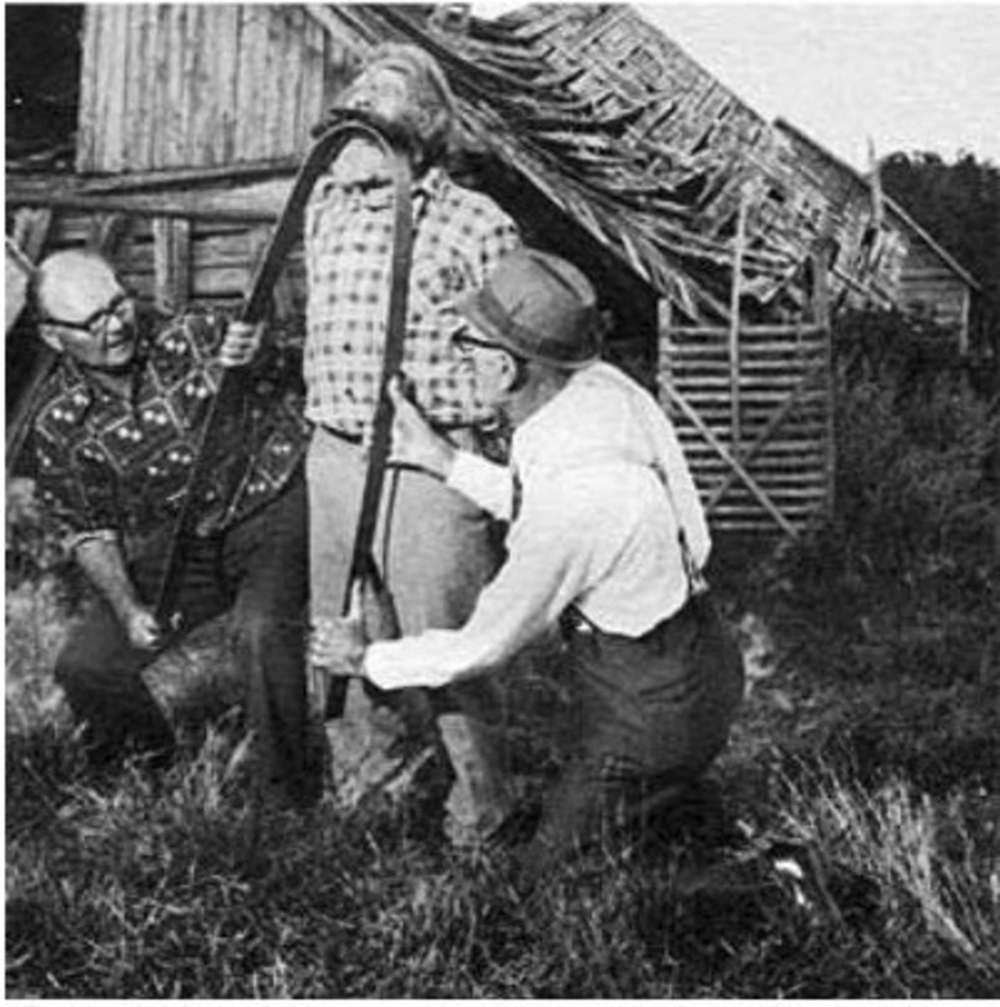
Despite these former feats, the film shows how Mike remained a controversial figure and often a virtual outcast in his own community. The townsfolk of Olha still carry many of the superstitions of their forefathers, and some feared Mike because of his hypnotic powers — a gift fuelled by his personal friendship with no less than Harry Houdini, possibly the greatest illusionist of all time. More likely, however, residents’ attitudes towards Mike derived from jealousy of someone who broke away from the rather mundane rural life, even if that break was all too brief. Many point with glee at Mike’s failure as a farmer, the only true measure of ability in their eyes.
But Mike’s ineffectiveness as a farmer was not totally of his own doing. He, like so many other young men of that early prairie era, became a victim of circumstance. His first love lay in entertaining, and the tour with the Barnum & Bailey circus seemed to answer this love; but when he received a telegram from his father telling him to return home for the harvest, Mike had no recourse but to comply, as any dutiful son must. The people of the circus could not believe that he would give up the chance of a world tour for a town “not even on the map.” When his father died, Mike, as the eldest son, had to swear an oath to stay with the land. There he remained until his death. He half-heartedly cared for the farm he never wanted, taking his greatest satisfaction in restoring the old Budas — shelters made of wood, mud, and straw where the original Ukrainian immigrants to the Olha area lived… and often died.
Death and decay provide the film’s major underlying theme. For although it celebrates the achievements of Mike Swistun and proclaims him a genuine Canadian folk hero, it also mourns the slow death of the rural prairie lifestyle. This connection becomes evident immediately as director Kuchmij utilizes shots of the Olha graveyard as a backdrop to the community. Still and in disarray, the graveyard mirrors the state of the town itself. Many of the buildings stand long deserted and neglected, while others appear well on their way to a similar fate. Mike’s own farmyard also exists as a graveyard to the past. Disused automobiles, machinery, and household articles crowd the yard in mute testimony to the past in which they saw active service.
In fact, death plays an important part in the area’s heritage. The images of death forge crucial links with history. Kuchmij followed Mike and his granddaughter as they searched for the graves of two small children who died in the Budas during one particularly harsh winter. The children lay buried in an area now overgrown with vegetation, but Mike found the graves and cleared the site to commemorate those who died in pursuit of “the promised land.”
In contrasted with his immediate physical surroundings, Mike Swistun, until his death two months after the premiere of the film, remained a vital human being. He still performed many of the illusions which astounded rural crowds across the West during the 1920s when he toured the small towns each winter. He even provided the music for the dances which followed his performances for, he alone, remained able to play the traditional instruments. At the climax of the film Mike undertook to bend a series of iron bars in his teeth. This marked the first time he had attempted the feat since 1930 when the trick backfired and almost cost Mike his life. Despite his age and the memory of that horrible accident, Mike bent the bars with apparent ease. The film ends with this accomplishment and catches Mike in a heroic moment. As Kuchmij would later say, “He’s no longer the clown of Olha, he’s the Strongest Man in the World again.”

On the one hand The Strongest Man in the World tells an almost fairy-tale story of how a farm boy from Olha became a star in the most famous circus in the world. On the other hand, it presents, through period photographs and vintage film clips, a few insights into the past of this region during the years of settlement. Kuchmij provides tangible proof that the past can be far from colourless and tedious because the past survives with those who lived it.
For more information or to become a member of the Manitoba Historical Society, call 204-947-0559 or email: info@mhs.mb.ca. The MHS is on Facebook, Twitter and Instagram as manitoba-history.