The battle to be ‘real Canadians’
Documentary tells story of Ukrainian immigrants who put lives on the line for adopted homeland

Advertisement
Read this article for free:
or
Already have an account? Log in here »
To continue reading, please subscribe:

Digital Subscription
One year of digital access for only $205*
- Enjoy unlimited reading on winnipegfreepress.com
- Read the E-Edition, our digital replica newspaper
- Access News Break, our award-winning app
- Play interactive puzzles
*First annual payment billed as $205.00 + GST for one year. This annual subscription will automatically renew at $233.00 + GST every 52 weeks (10% off the regular annual price of $259.35). Offer available to new and qualified returning subscribers only. Cancel any time.
To continue reading, please subscribe:
Add Free Press access to your Brandon Sun subscription for only an additional
$1 for the first 4 weeks*
- Enjoy unlimited reading on winnipegfreepress.com
- Read the E-Edition, our digital replica newspaper
- Access News Break, our award-winning app
- Play interactive puzzles
*Your next Brandon Sun subscription payment will increase by $1.00 and you will be charged $17.95 plus GST for four weeks. After four weeks, your payment will increase to $24.95 plus GST every four weeks.
Read unlimited articles for free today:
or
Already have an account? Log in here »
Hey there, time traveller!
This article was published 06/11/2020 (2131 days ago), so information in it may no longer be current.
A new war documentary follows a journey of acceptance for Ukrainian-Canadians that came at a heavy cost.
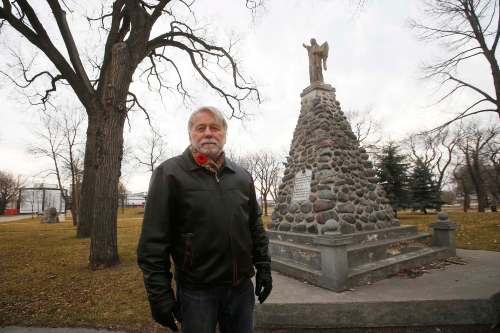
A Canadian War Story, directed by John Paskievich, a Winnipeg filmmaker and photographer, follows the plight of Ukrainian immigrants, who first came to Canada in the 1880s and for decades settled on homesteads across Western Canada, including Manitoba.
Those settlers, and their children, would join the Canadian effort during the Second World War, and the film offers their stories of sacrifice, tragedy and eventually victory.
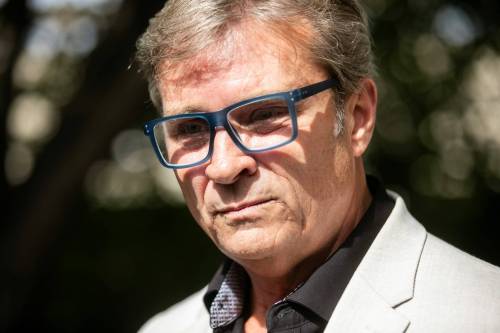
“The film isn’t just a series of veterans’ testimonials, like how it was to be in Hong Kong or D-Day. It was a coming-of-age story,” says Paskievich, who spent three years making the hour-long movie.
Like many immigrants past and present, Ukrainian settlers in Canada faced discrimination. Former prime minister Mackenzie Bowell, when describing those early migrants making their way west on the train, referred to them as “disgusting creatures.”
Many Ukrainian immigrants during the First World War were held in internment camps across Canada as the government feared they were sympathizers for the enemy, the Austro-Hungarian empire, which included Ukraine at the time. Others were unable to find jobs.
Michael Gowda was one of those early immigrants to Canada, and in a poem, To Canada, he wrote that Ukrainians would have to fight and die for the country in battle to become accepted.
“And are you not, O Canada, our own? / Nay, we are still but holders of thy soil, / We have not bought by sacrifice and groan / The right to boast the country where we toil,” Gowda wrote.

The Second World War gave them a chance to follow Gowda’s advice, Paskievich says.
“Before the Second World War, Ukrainians were considered second-class. Because of their sacrifice, they became, as (Royal Canadian Air Force airman) Joe Romanow says, ‘real Canadians,’ “ he says.
And while Gowda’s poem appears prophetic — Ukrainian-Canadians gained greater acceptance by Canada’s establishment after the Second World War and many have since held key roles in the nation’s power structure — other groups haven’t had the same experience. Canada’s Indigenous people, for instance, continue to face systemic racism despite many enlisting and fighting just as bravely for Canada in the war.
The film follows Ukrainians enlisting for the army, navy, air force and women’s military services, and offers their memories of serving the Canadian military in its battles and campaigns. Much to its credit, it goes beyond the famous successes and sacrifices of the D-Day invasion of 1944.
Its four-person research committee also uncovered harrowing stories of the Battle of the Atlantic and the lives of those who joined the Winnipeg Grenadiers, which fought in the Battle of Hong Kong in 1941 before many were captured and faced appalling conditions in prisoner-of-war camps or as slave labourers.

The committee scoured archives and libraries, old newspapers and Royal Canadian Legion newsletters, Paskievich says, to find and pass on the stories of those who served during the war. The use of archival photographs, some of which come from the Archives of Manitoba and the Manitoba Museum, voice actors to tell the stories, and old film footage help set the scenes of struggle, whether it was breaking a quarter-section of land on the Prairies, tragedy at Dieppe or the jubilation of V-E Day, which marked its 75th anniversary on May 8.
“It was like doing a picture puzzle but you have no idea what the final picture is,” Paskievich says.
“We didn’t find enough stories and testimonials that had to do with the Sicily and Italy,” Paskievich says. “There’s a gap there, but that was the luck of the draw. We looked and looked but we were unable to find anything.”
Several Manitobans’ recollections of the war are part of A Canadian War Story. Michael Sydorko of Lac du Bonnet describes a difficult journey across the Atlantic on an oceanliner jammed with thousands of Canadian troops. Murray Copot of Fraserwood, a navy coder, tells how he escaped the sinking of the corvette HMCS Alberni in 1944 after it was hit by a German U-boat torpedo. He was one of only 31 of the 90 crew members who survived the attack.
Ann Crapleve of Ladywood, a village north of Beausejour, signed up with the Canadian Women’s Army Corps in 1942 “to do my bit for the country.” After the war, she returned to Europe as part of the Ukrainian Canadian Relief Fund that helped displaced persons, many of whom were Ukrainians who fled westward as the Soviet army marched across Eastern Europe fighting the Nazis.

Amid all the battles and tragedies, A Canadian War Story also shows how Ukrainian-Canadians stuck together while serving in Europe. The Ukrainian Canadian Servicemen’s Association had rented a building in London that would serve as a hotel, a meeting place and a home away from home for Ukrainian-Canadian military personnel, where romances between soldiers and nurses would sometimes lead to wartime marriages.
The idea for creating a film to document Ukrainian-Canadians’ experiences during the Second World War began with Andre Sochaniwsky, a retired captain with the RCAF, Paskievich says. The money to finance the film took a journey as winding as that taken by those first Ukrainian settlers. Much of it comes from the sale of a Legion branch in downtown Toronto formed by Ukrainian-Canadian veterans, money that made it to the Ukrainian Canadian Research and Documentation Centre, which turned to Paskievich to direct the film.
“There was some worry that the Ukrainians before the Second World War would be presented in a bad light,” Paskievich says. “The question they asked me: ‘Was it necessary to have that historic preamble?’ I said, yes, absolutely.”
The most personal part of directing A Canadian War Story for Paskievich comes at the end, when Ukrainian-Canadian military personnel and non-governmental agencies found Ukrainians in displaced persons’ camps throughout Europe and helped them immigrate to Canada and avoid being repatriated to the Soviet Union.

“I was born in a DP camp and I was about four years old when I came over,” says Paskievich, 72, who was born in a camp in Linz, Austria, to Ukrainian parents in 1948. “Those first years growing up in a displaced persons community in Montreal first and then in Winnipeg, it actually formed a lot of my worldview.

“I certainly have sympathy for refugees and I also have a deep dislike of authoritarian regimes, whether they’re in Syria, Russia, Turkey or wherever.”
A Canadian War Story had a digital première Friday night across Canada, and DVD and Blu-Ray copies of the film can be purchased through the Ukrainian Canadian Research and Documentation Centre at office@usrdc.org or by calling 416-966-1819.
alan.small@freepress.mb.ca
Twitter:@AlanDSmall

Alan Small
Reporter
Alan Small was a journalist at the Free Press for more than 22 years in a variety of roles, the last being a reporter in the Arts and Life section.
Our newsroom depends on a growing audience of readers to power our journalism. If you are not a paid reader, please consider becoming a subscriber.
Our newsroom depends on its audience of readers to power our journalism. Thank you for your support.
Alan Small
Reporter
Alan Small was a journalist at the Free Press for more than 22 years in a variety of roles, the last being a reporter in the Arts and Life section.
Our newsroom depends on a growing audience of readers to power our journalism. If you are not a paid reader, please consider becoming a subscriber.
Our newsroom depends on its audience of readers to power our journalism. Thank you for your support.
Advertisement Advertise With Us
Advertisement Advertise With Us