WEATHER ALERT

Canada not on track to hit its first electric car target in 2025

Advertisement

Advertise with us

OTTAWA - National cash rebates convinced more Canadians to buy an electric car in the last 18 months, but Transport Canada says it won't be enough to hit the first zero-emission vehicle sales targets in 2025.

Read this article for free:

or

Already have an account? Log in here »

To continue reading, please subscribe:

Subscribe and receive a limited-edition Free Press branded hat or tote.

Digital Subscription

One year of digital access for only $205*

  • Enjoy unlimited reading on winnipegfreepress.com
  • Read the E-Edition, our digital replica newspaper
  • Access News Break, our award-winning app
  • Play interactive puzzles

*First annual payment billed as $205.00 + GST for one year. This annual subscription will automatically renew at $233.00 + GST every 52 weeks (10% off the regular annual price of $259.35). Offer available to new and qualified returning subscribers only. Cancel any time.

To continue reading, please subscribe:

Add Free Press access to your Brandon Sun subscription for only an additional

$1 for the first 4 weeks*

  • Enjoy unlimited reading on winnipegfreepress.com
  • Read the E-Edition, our digital replica newspaper
  • Access News Break, our award-winning app
  • Play interactive puzzles
Start now

*Your next Brandon Sun subscription payment will increase by $1.00 and you will be charged $17.95 plus GST for four weeks. After four weeks, your payment will increase to $24.95 plus GST every four weeks.

Hey there, time traveller!
This article was published 07/11/2020 (2073 days ago), so information in it may no longer be current.

OTTAWA – National cash rebates convinced more Canadians to buy an electric car in the last 18 months, but Transport Canada says it won’t be enough to hit the first zero-emission vehicle sales targets in 2025.

Transport Canada set targets to have 10 per cent of all light-duty cars be electric by 2025, 30 per cent by 2030 and 100 per cent by 2040. The most recent analysis suggests Canada will only reach between four and six per cent by 2025 and 10 per cent by 2030.

To get there, the federal government introduced the cash rebates for purchases, as well as millions of dollars to build more charging stations, tax credits for businesses that buy electric cars for their fleets and an effort to have automakers set voluntary sales quotas.
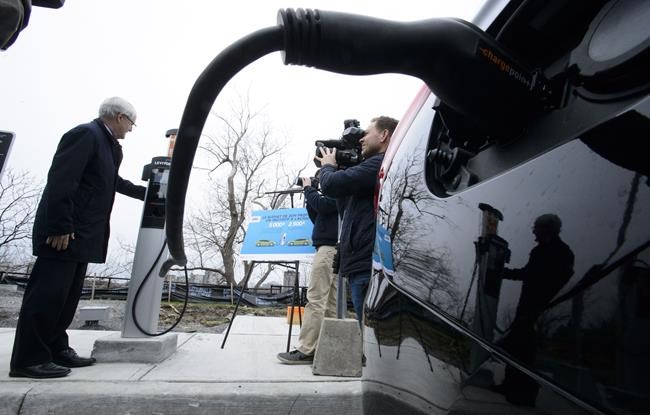
Marc Garneau, Minister of Transport, holds a photo opportunity at a new charge station for electric vehicles on Parliament Hill in Ottawa on Wednesday, May 1, 2019, to mark the coming into effect of the Incentive for Zero-Emission Vehicles Program. Garneau says he wants to extend the zero-emission vehicle rebate program, which is on track to run out of money more than a year ahead of schedule. THE CANADIAN PRESS/Sean Kilpatrick

Megan Nichols, the director general of environment policy at Transport Canada, told the House of Commons environment committee in late October that sales have been rising but there are efforts underway to see what else needs to be done.

“We know that additional measures are needed to achieve our sales targets,” said she said in her written brief to the committee Oct. 26.

Nichols and officials from multiple other departments told the committee an array of options are being studied, including sales quotas, offering money to scrap gas cars for electric ones, and making used electric vehicles eligible for federal rebates.

She also said it’s expected the cost of an electric car won’t be on par with a comparable gas model for another five years, noting that likely means purchase rebates will be needed at least until then.

The rebates currently offer up to $5,000 for buying a fully electric car and up to $2,500 for plug-in hybrid models. The maximum purchase price of the lowest-end model can’t be over $45,000.

The $300-million program started in May 2019 and was supposed to last until 2022. But more than $255 million had already been claimed by the end of September.

Transport Minister Marc Garneau has been looking at expanding the program for more than a year now and said this week it is still something he wants to do.

“It’s been an incredibly popular program,” he told The Canadian Press in an interview. “It’s something that I would hopefully like to see continued, but it is something that we’re looking at.”

Joanna Kyriazis, senior policy adviser at Clean Energy Canada, said it’s clear more needs to be done to hit the existing targets. She said on top of extending the existing rebate, used cars should also be eligible, and more should be done to target rebates to Canadians who wouldn’t be able to afford an electric car without them.

“We want to see a few tweaks to that program to make sure that the money is getting to Canadians who need it most done, not those who would have gone out and bought one anyway,” she said.

An electric car mandate that legislates the sales targets is also something that should be considered, she said. Quebec and British Columbia, the only two provinces with both provincial rebates and sales quotas, also accounted for almost eight in 10 electric car purchases.

According to Statistics Canada, electric and plug-in hybrid sales grew from less than one per cent of all light-duty sales in 2015 and 2016, to one per cent in 2017, two per cent in 2018, and 2.7 per cent in 2019.

Data from the lobby group Electric Mobility Canada further shows sales grew to 3.3 per cent in the first half of 2020, a period of time when all car sales were down because of the COVID-19 pandemic.

The group said there are 168,000 electric vehicles on Canadian roads now, less than one per cent of the 23 million light-duty vehicles registered in total.

Transport Canada’s sales targets aim to increase that to 825,000 electric cars registered in 2025, and 2.7 million in 2030.

Currently, light-duty vehicles produce more than one-tenth of Canada’s greenhouse gas emissions, and total emissions from them have grown 10 per cent in the last decade, despite tougher emissions standards for vehicles.

That’s mostly because more cars are on the road and SUVs and pickup trucks, which produce more emissions per kilometre, now account for almost eight in 10 passenger vehicles sold in Canada.

This report by The Canadian Press was first published Nov. 7, 2020.

— With files from Christopher Reynolds.

Report Error Submit a Tip

More Stories

Rainbow Stage cancels Sunday performance

1 minute read Yesterday at 9:38 PM CDT

Rainbow Stage’s closing performance of Jesus Christ Superstar on Sunday has been cancelled.

The outdoor musical theatre announced on social media Saturday night that it was forced to make the “difficult but necessary decision” to cancel the 2 p.m. show due to high humidex values forecast for Winnipeg.

“We do not believe it is safe or responsible to proceed with an outdoor performance,” the post said.

Rainbow Stage said those with tickets could transfer them to a performance of Legally Blond: The Musical, playing Aug. 13 to 30, donate the value of the tickets to the company and receive a tax credit, or receive a full refund.

Province has ‘serious concerns’ with Winnipeg personal care home

Tyler Searle 5 minute read Preview

Province has ‘serious concerns’ with Winnipeg personal care home

Tyler Searle 5 minute read Friday, Jul. 10, 2026

The Manitoba government has placed licensing conditions on a Winnipeg personal care home after an inspection uncovered “serious concerns” related to the safety of senior residents.

Health Minister Uzoma Asagwara confirmed the province issued the order against the Extendicare Heritage Lodge — an 86-bed nursing home at 3555 Portage Ave. — effective June 9.

“This is an important oversight tool, and it is not used lightly. Conditions are imposed when there are serious concerns that require enhanced oversight and clear, corrective action,” Asagwara said in a statement.

“Our expectation is simple: Extendicare must meet the standards Manitoba seniors and families deserve. We will continue working with the (Winnipeg Regional Health Authority) to monitor this facility closely and ensure the required improvements are made.”

Read
Friday, Jul. 10, 2026

Indigenous theatre founder gets nod for prestigious prize

Ben Waldman 3 minute read Preview

Indigenous theatre founder gets nod for prestigious prize

Ben Waldman 3 minute read Yesterday at 2:02 AM CDT

For her work as the founding artistic director of Oshkagoojin Indigenous Theatre for Youth, Winnipeg’s Nova Courchene has been named the recipient of one of Manitoba theatre’s highest honours for emerging arts leaders.

Since 2023, the Cherry Karpyshin Arts Management Prize has been given out by Prairie Theatre Exchange to early-career or aspiring arts managers. Named for PTE’s longtime general manager, for whom the company’s mainstage is also named, the Cherry Prize is accompanied by professional supports and a $2,500 cash award.

Meaning “new moon” in Anishinaabemowin, Oshkagoojin runs a variety of initiatives in Winnipeg, including the teen-focused Rising Voices, the middle years Growing Voices, and the early years Young Voices programs. Through storytelling, movement, narrative games and guided play, the Young Voices program introduces Indigenous children aged five through nine to the fundamentals of collaborative and co-operative theatre with a curriculum devised through a cultural lens.

“As I continue to grow Oshkagoojin Indigenous Theatre for Youth, I look forward to strengthening the organization’s capacity, sustainability, and national reach so that more Indigenous young people can access theatre, cultural learning, and artistic leadership opportunities in their own communities,” says Courchene in a release. “I believe that when Indigenous youth are empowered to tell their stories, entire communities benefit, and I am excited to continue building these pathways for future generations.

Read
Yesterday at 2:02 AM CDT

More aid needed to hit electric car targets

Mia Rabson, The Canadian Press 5 minute read Preview

More aid needed to hit electric car targets

Mia Rabson, The Canadian Press 5 minute read Saturday, Nov. 7, 2020

OTTAWA - National cash rebates convinced more Canadians to buy an electric car in the last 18 months, but Transport Canada says it won't be enough to hit the first zero-emission vehicle sales targets in 2025.

Transport Canada set targets to have 10 per cent of all light-duty cars be electric by 2025, 30 per cent by 2030 and 100 per cent by 2040. The most recent analysis suggests Canada will only reach between four and six per cent by 2025 and 10 per cent by 2030.

To get there, the federal government introduced the cash rebates for purchases, as well as millions of dollars to build more charging stations, tax credits for businesses that buy electric cars for their fleets and an effort to have automakers set voluntary sales quotas.

Megan Nichols, the director general of environment policy at Transport Canada, told the House of Commons environment committee in late October that sales have been rising but there are efforts underway to see what else needs to be done.

Read
Saturday, Nov. 7, 2020

Marla Somersall devoted her life to people in need

Zoe Pierce 6 minute read Preview

Marla Somersall devoted her life to people in need

Zoe Pierce 6 minute read Yesterday at 6:00 AM CDT

Whether it was helping women build businesses in rural Tunisia, leading homeless and addiction support organizations or delivering meals to vulnerable Manitobans, Marla Somersall spent her life dedicated to lessening other people’s suffering.

Over a career that took her from North Africa to Prince Edward Island and back to Manitoba, Somersall held leadership roles in a range of social service and non-profit organizations, always drawn to work that centred on supporting people in need.

Most recently, she served as executive director of Meals on Wheels Winnipeg — a non-profit organization that provides meals to people who are unable to prepare them for themselves.

Kelly Scrivener, client co-ordinator with Meals on Wheels, said Somersall was a very calm and respectful person who led with gentle direction and fostered a collaborative workplace.

Read
Yesterday at 6:00 AM CDT

Bombers go the distance, get under Argos’ skin to secure win

Taylor Allen 6 minute read Preview

Bombers go the distance, get under Argos’ skin to secure win

Taylor Allen 6 minute read Yesterday at 3:55 PM CDT

Now that looked like Winnipeg Blue Bombers football.

It wasn’t always pretty, but the Blue and Gold finally sent their droves of paying customers home happy with a 30-21 win over the visiting Toronto Argonauts on Friday.

“Osh was on it all week that we had to have a great three-phase game and tonight we did that,” said left tackle Stanley Bryant.

“If we can do that each and every week, we will be a great team.”

Read
Yesterday at 3:55 PM CDT