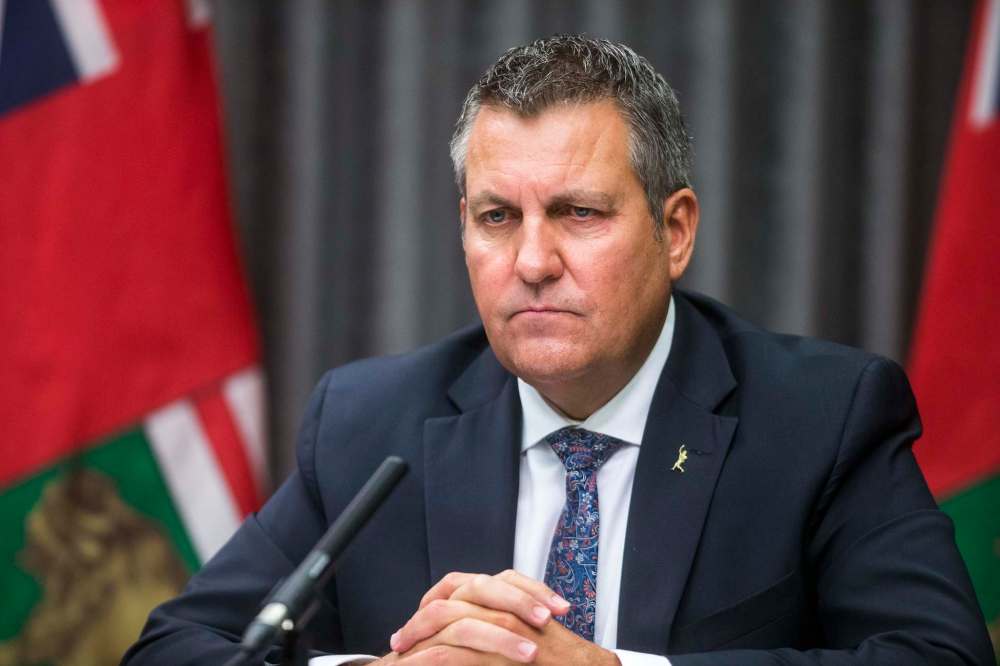
Manitoba urged to fix crime data
Lack of Indigenous statistics clouds picture of systemic racism, federal officials say
Advertisement
Read this article for free:
or
Already have an account? Log in here »
To continue reading, please subscribe:
Monthly Digital Subscription
$1 per week for 24 weeks*
- Enjoy unlimited reading on winnipegfreepress.com
- Read the E-Edition, our digital replica newspaper
- Access News Break, our award-winning app
- Play interactive puzzles
*Billed as $4.00 plus GST every four weeks. After 24 weeks, price increases to the regular rate of $19.95 plus GST every four weeks. Offer available to new and qualified returning subscribers only. Cancel any time.
Monthly Digital Subscription
$4.99/week*
- Enjoy unlimited reading on winnipegfreepress.com
- Read the E-Edition, our digital replica newspaper
- Access News Break, our award-winning app
- Play interactive puzzles
*Billed as $19.95 plus GST every four weeks. Cancel any time.
To continue reading, please subscribe:
Add Free Press access to your Brandon Sun subscription for only an additional
$1 for the first 4 weeks*
*Your next subscription payment will increase by $1.00 and you will be charged $16.99 plus GST for four weeks. After four weeks, your payment will increase to $23.99 plus GST every four weeks.
Read unlimited articles for free today:
or
Already have an account? Log in here »
Hey there, time traveller!
This article was published 07/12/2020 (1963 days ago), so information in it may no longer be current.
OTTAWA — Statistics Canada has been trying for five years to get Manitoba to properly report data on Indigenous people in provincial jails, the Free Press has learned, with Ottawa saying the gap prevents getting an accurate picture of systemic racism.
“There is an absence of data concerning the race or Indigeneity of victims and accused persons in official crime statistics,” reads an internal record bureaucrats prepared for federal Justice Minister David Lametti for a July 29 teleconference call with his provincial counterparts.
“The lack of data makes it difficult (and sometimes impossible) to track the representation of racialized groups and Indigenous peoples as they progress through the criminal-justice system. It also makes it difficult to measure the impact of programs, policies, and legislation on racialized and Indigenous peoples.”
The Pallister government says it intends to bridge this gap next year.
The meeting of justice ministers in late July occurred after a raft of protests, following the May 25 death of George Floyd at the hands of police officers in Minneapolis.
Canada’s Chief Statistician Anil Arora urged provincial ministers to beef up their data reporting, showing what Statistics Canada was able to do with data reported under a system launched in 2015.
A slideshow demonstrates projections made using Saskatchewan’s data, and measures the impact of gaps in education and of restorative-justice programming on the number of criminal cases. The agency is creating four scenarios, finding that reforms could mean as many as 7,785 fewer people involved in a criminal offence in that province by 2036.
“It also makes it difficult to measure the impact of programs, policies, and legislation on racialized and Indigenous peoples.” – Internal record prepared for federal Justice Minister David Lametti
Lametti’s notes point out that federal prisons collect racial data, but provinces often don’t. Arora’s slideshow notes a patchwork of “reporting of Indigenous and ethnographic-cultural identity,” identifying that at least four provinces are falling short.
Statistics Canada confirmed this includes Manitoba.
“Since 2015, Statistics Canada has been working with federal, provincial and territorial corrections to plan for the transition” to an upgraded data-reporting process, wrote agency spokeswoman Anna Maiorino.
“Manitoba has not yet transitioned to reporting their corrections data through this survey.”
The agency did not respond when asked to specify which other jurisdictions are lagging behind.
The gap surrounds the Canadian Correctional Services Survey, which in 2015 merged two existing programs, the Youth Custody and Community Services and Adult Correctional Services surveys.
Lametti’s internal notes say Ottawa cannot fully understand how Indigenous and racialized Canadians move through the justice system, because of such data gaps.
“We cannot identify whether there are certain points in the system that are especially problematic for particular groups of people. With that kind of information available to us, we would be better equipped to target interventions.”
Arora’s slideshow notes a 2015 snapshot where Manitoba led the provinces, by far, in having a high rate of Indigenous over-representation in court cases. Runner-up Saskatchewan’s disparity was less than two-thirds that of Manitoba.
It’s unclear whether provinces using the outdated correctional survey means StatsCan can’t create a more recent comparison. The two types of surveys involve data from jails and not courts, thought Lametti’s briefing notes multiple gaps in what provinces are reporting.
In an interview, Manitoba Justice Minister Cliff Cullen said he understands the issue to be a matter of how the data is sent to Ottawa, instead of a change in how thorough the information is.
“I haven’t heard the federal government express that there is a gap there; we are reporting the information that they are requesting,” Cullen said.
He described it as switching from a manual to automated process for sharing data, and he believes Statistics Canada has been receiving the datapoints it requests.
“We want to get [our] platform to communicate with the StatsCanada platform; we just don’t have the technical capability to do that just yet.”
Though older sets of studies involve a youth and adult portion, Cullen said he didn’t believe there would be an issue tracking laterally how many youth become adults while still moving through the justice system.
“In the New Year, we hope to have some test runs on this, and hopefully we can get the two platforms integrated,” he said.
Cullen said the change is happening alongside an upgrade to the province’s own case-management system, which he says will allow the province to better track its data.
He said this involves working hours from departmental staff, making it hard to quantify the actual cost of the change.
dylan.robertson@freepress.mb.ca
Internal records on race-data gap in criminal justice