

Mob mentality
Scorsese, Coppola take different paths in portraying mafioso in film

Advertisement
Read this article for free:
or
Already have an account? Log in here »
To continue reading, please subscribe:
Monthly Digital Subscription
$1 per week for 24 weeks*
- Enjoy unlimited reading on winnipegfreepress.com
- Read the E-Edition, our digital replica newspaper
- Access News Break, our award-winning app
- Play interactive puzzles
*Billed as $4.00 plus GST every four weeks. After 24 weeks, price increases to the regular rate of $19.95 plus GST every four weeks. Offer available to new and qualified returning subscribers only. Cancel any time.
Monthly Digital Subscription
$4.99/week*
- Enjoy unlimited reading on winnipegfreepress.com
- Read the E-Edition, our digital replica newspaper
- Access News Break, our award-winning app
- Play interactive puzzles
*Billed as $19.95 plus GST every four weeks. Cancel any time.
To continue reading, please subscribe:
Add Free Press access to your Brandon Sun subscription for only an additional
$1 for the first 4 weeks*
*Your next subscription payment will increase by $1.00 and you will be charged $16.99 plus GST for four weeks. After four weeks, your payment will increase to $23.99 plus GST every four weeks.
Read unlimited articles for free today:
or
Already have an account? Log in here »
Hey there, time traveller!
This article was published 11/12/2020 (1930 days ago), so information in it may no longer be current.
Here in the real world, New York mobster “Crazy Joe” Gallo was murdered in 1972, shot to death while dining with his family at Umberto’s Clam House in Little Italy.
That event was vividly and presumably accurately portrayed in Martin Scorsese’s 2019 film The Irishman. True to Scorsese form, the murder had a voiceover by Robert De Niro, who played the titular hitman Frank Sheeran, explaining the strategy of killing Gallo. (“For something like this, you’re gonna use two guns, the one you’re gonna use and a back-up.”) The hit itself is shot with fluid economy, just two shots, with a typically Scorsesean choice of music in the background (Santo and Johnny’s Sleep Walk), all artfully portraying the quotidian brutality of Mob life.
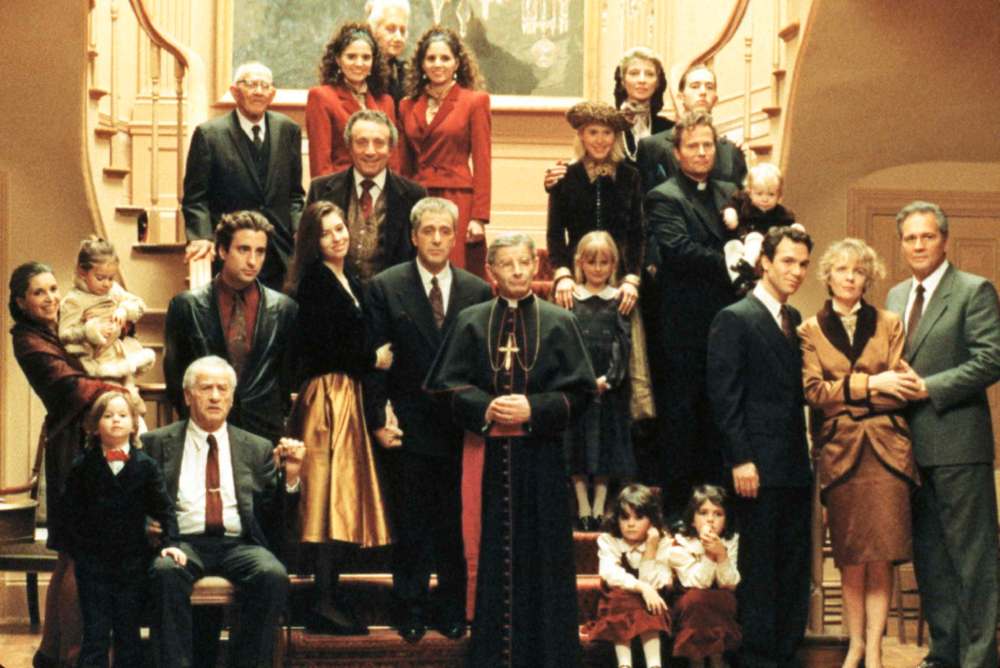
For contrast, look at The Godfather Part III. The Gallo figure, named Joey Zasa (Joe Mantegna) finds himself the target of an elaborate setup during an Italian pride/religious procession in Little Italy, wherein Joey’s bodyguards are shotgunned by hooded assassins disguised as penitents and Zasa himself is finished off by Michael Corleone’s nephew Vincent Mancini (Andy Garcia), masquerading as a mounted police officer. From the moment a gun is drawn, director Francis Ford Coppola uses roughly 30 cuts with probably an equal number of callouts to the past two Godfather movies: the disguised cop and the doorway hit from the first, and the Fanucci stalking/religious procession from the second.
The two scenes, viewed side by side, reflect the polar opposite approaches of Scorsese and Coppola. Coppola was in the business of creating dense mythologies of the Mafia to suggest the mobster as the ultimate metaphor for the capitalist. In films such as Goodfellas and Casino, Scorsese never really elevates the mobster to a tragic hero. His practitioners of violence and savagery are generally greedy for money, power and privilege, with results that almost always end either in prison or ignominious death.
Scorsese films may be truer to reality, but that is not to disparage Coppola, or novelist Mario Puzo, with whom Coppola collaborated on the Godfather screenplays. All three films are sumptuous exercises in classic Hollywood filmmaking, although the third instalment was, admittedly, the least satisfying. A couple of characters in the film refer to an irritating rival as “a pebble in my shoe.” There’s always been a bit of that pebble feeling in Godfather 3.
Evidently, Coppola felt the same way. Not entirely satisfied with the movie as it was released in 1990, Coppola has re-edited his 1990 work in a bid to come closer to what he and Puzo had envisioned, with a mouthful of a new title: Mario Puzo’s The Godfather Coda: The Death of Michael Corleone.
This restored re-edit is still sumptuous, but the sense of tragedy that ended The Godfather Part II permeates Part III. Remember, after ordering a hit on his brother Fredo (John Cazale) and being abandoned by his wife Kay (Diane Keaton), Michael is left to ponder the cruel irony that his efforts to protect his family have resulted in him destroying it.
This new iteration starts more succinctly, with Michael pressured to fund the bankrupt Vatican Bank in exchange for heading its real estate arm. Michael is finally moving to take his business into legitimacy, but at the same time he is being drawn into a mob power struggle involving the upstart Joey Zasa, as well as his own nephew Vincent (Andy Garcia), the illegitimate son of Sonny, who has clearly inherited his father’s hot-headed nature.
On top of that, Michael is riddled with guilt over the murder of Fredo, at one point suffering a breakdown. (One wonders if this didn’t inspire The Sopranos.)
The material suggesting corruption in the Vatican remains provocative stuff, spinning off from the theory that Pope John Paul I was murdered to cover up a scandal at the Vatican Bank.
Religion always plays a pivotal role in the films: the baptism (interlaced with bloody retributive violence) in the first movie and the First Communion that kicks off the second. Religion, in this third chapter, is another manifestation of the moral morass of Corleone life.
From a performance standpoint, the pebble in the shoe is Sofia Coppola’s performance as Michael’s daughter Mary. It’s not really a bad performance, but it’s wrong for this movie. (Sofia stepped in to replace Winona Ryder, who was ill.) Her more natural performance would fit better into a low-budget indie… of the type made by Sofia Coppola, in fact.
Still, the film feels subtly better for its trims and its final scene, which boldly contradicts the title The Death of Michael Corleone. Michael’s fate, in the wake of the murders at a Sicilian opera house at the movie’s climax, is worse than death.
randall.king@freepress.mb.ca
Twitter: @FreepKing
Our newsroom depends on a growing audience of readers to power our journalism. If you are not a paid reader, please consider becoming a subscriber.
Our newsroom depends on its audience of readers to power our journalism. Thank you for your support.
MOVIE REVIEW
Mario Puzo’s The Godfather Coda: The Death of Michael Corleone
Starring Al Pacino, Andy Garcia and Diane Keaton
● Now available on Blu-ray and digital
● 14A
● 158 minutes
★★★★ out of five
Our newsroom depends on a growing audience of readers to power our journalism. If you are not a paid reader, please consider becoming a subscriber.
Our newsroom depends on its audience of readers to power our journalism. Thank you for your support.
Advertisement Advertise With Us
Advertisement Advertise With Us